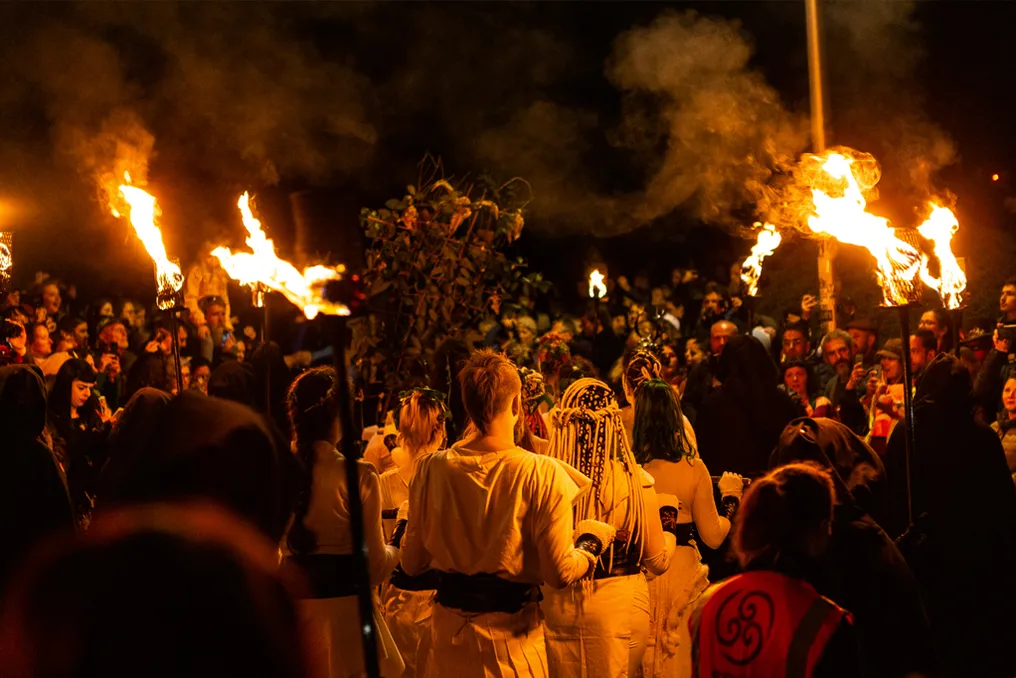
Although costumes, sweets, and carved pumpkins are part of the modern image of Halloween, the celebration popularized in the United States has much older and distinct origins. The best-known link points to Samhain, an ancient Celtic festival held at least 2,500 years ago in the regions that now correspond to Ireland, Scotland, and Wales.
For the Celtic peoples, Samhain was a crucial event on the calendar, occurring between late October and early November. This period symbolized the transition from the brightest phase of the year (spring and summer) to the arrival of winter, a season associated with darkness and death. According to tradition, on the night of October 31st, the boundary between the world of the living and the dead weakened, allowing spirits to circulate freely.
Ancient records suggest that the Celts believed that deceased individuals during the year migrated to another plane, while their spirits could return to visit the living. There was also the risk of someone accidentally entering this spiritual domain. Furthermore, the beliefs of the time mentioned the appearance of fairies emerging from mounds of earth, who enjoyed playing tricks on inhabitants.
To protect themselves from these supernatural entities, such as fairies, witches, and goblins, communities lit large bonfires. Some accounts indicate that they also used disguises to ward off these unwanted beings. It is possible that banquets, games, storytelling, and alcohol consumption were part of the Samhain festivities, serving to welcome back the deceased.
However, the veracity of this information remains uncertain, as the ancient Celts left few notes about Samhain. Much of the current knowledge comes from Christian writers from a period after the predominance of Christianity, or from observations of local customs made in more recent centuries.
It is observed that the Catholic Church may have influenced the celebration. Around the 8th century, Pope Gregory III changed the date of All Saints' Day, moving it from May 13th to November 1st, coinciding with Samhain. Some experts speculate that this change was deliberate, in an attempt to 'Christianize' Samhain, given that the Celts were a pagan people who worshipped various deities.
A historical milestone occurred between 1845 and 1852, when Europe faced a severe humanitarian crisis. In Ireland, a fungus called Phytophthora infestans devastated potato crops, which sustained a third of the population. With the loss of approximately one million lives and economic ruin, many Irish people were forced to emigrate to the United States.
In doing so, they brought their traditions with them, including Samhain. Consequently, the first mentions of Halloween emerged in North America shortly after this period. In 1870, for example, an American magazine published an article describing it as an 'English' holiday, as reported by the BBC.
The modern name, 'Halloween', is a combination of two terms: 'Hallow', an old word for 'holy', and 'eve', in English, meaning 'evening before'. Until the 16th century, this term referred to the night before All Saints' Day, celebrated on November 1st. Over time, people began to call the night of All Saints' Day (All Hallows’ Eve) 'Hallowe'en', which later simplified to 'Halloween.'
The celebration has undergone significant adaptations; many current Halloween practices originated in American culture. Examples include the tradition of 'trick-or-treating', pumpkin carving, the use of costumes, and the tradition of frightening. Currently, Halloween is the largest non-Christian holiday in the United States.
For adherents of pagan religions, the celebration of Samhain remains active. It has been incorporated and adapted into beliefs such as Wicca and Druidism, becoming a relevant festivity. Besides honoring ancestors, Samhain is seen as a moment of 'symbolic death', where people write down what they wish to leave behind on pieces of paper and burn them in bonfires to make way for a new cycle.