Autoclásica Expedition: From Fangio to Classic Argentine Cars
Read more
FlatOut
flatout.com.br

Autoclásica Expedition: From Fangio to Classic Argentine Cars

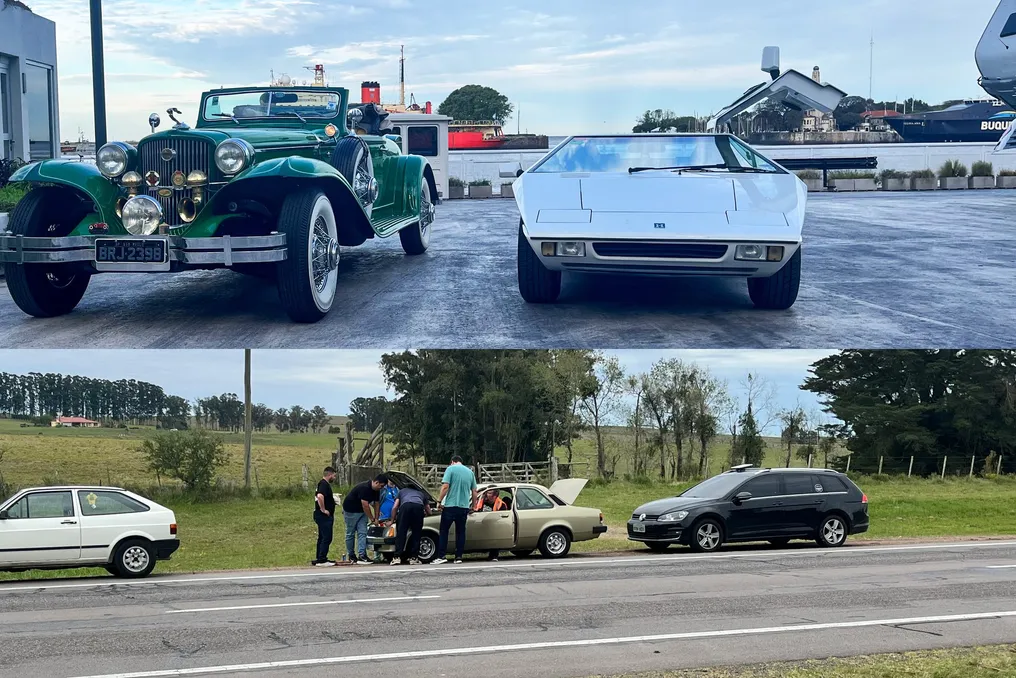
The first part of the Expedição Autoclásica 2026 adventure began in São Paulo with the participation of 1982 Chevette, 1992 Gol, 1972 Triumph GT6, and an auxiliary Golf Variant. The author joined the group in Santa Catarina, and then they traveled through Rio Grande do Sul and Uruguay into Argentina. During the trip, two Brazilian cars not part of the standard series, the Concorde and Hofstetter, were transported.

Four days on the road were marked by mechanical problems, border bureaucracy, a missed ferry, and other unforeseen circumstances, including the appearance of Lionel Messi. Participants managed to deliver two sports cars to San Isidro and arrived in Balcarce shortly before midnight. The group was fully assembled only at four in the morning when Marco and his father finally appeared with the Triumph after covering approximately 1100 kilometers in about 20 hours.

They were now in Balcarce, the city of Juan Manuel Fangio. In the following days, a visit to Crespi Competición, a local racetrack, and the Fangio Museum were planned before returning to Buenos Aires for the main event of the expedition—Autoclásica.

Balcarce, a City with Culture

The next morning, the group woke up later. After waiting for the Triumph until four in the morning, despite lack of sleep, they did not have to rush out early in the morning for the first time since the start of the expedition. Breakfast became an opportunity to meet Fernando and Leonardo, two participants who had arrived by plane and were in Balcarce from the previous day. After a brief chat, they went to visit Crespi Competición and then headed to the racetrack.

Balcarce is located just over 60 kilometers from Mar del Plata and more than 400 kilometers from Buenos Aires. The municipality has fewer than 50,000 inhabitants, distributed between the city and surrounding rural areas. It is a small settlement that nonetheless possesses a vast amount of automotive history: Juan Manuel Fangio was born here, there is a museum dedicated to him, a nearly 4.6-kilometer racetrack, and an operating race car manufacturer dating back to the 1960s.

Crespi Competición was founded by Tulio Crespi, who began building race cars in the 1960s and became one of the leading manufacturers of training monoports in Argentina. His cars participated in many national categories, and the company also produced street sports cars, such as the Tulia GT and Tulieta, presented at the Paris Exhibition in 1975.

Mazza met Tulio a year earlier during his trip through Argentina, and it was then that the opportunity arose to organize a trip to the racetrack. Unfortunately, they could not meet him in person: Tulio passed away on September 22 at the age of 88, just fifteen days before their visit. His sons, Luciano and Matias, hosted them, showing them the factory, projects, and cars being built or prepared on site.

Crespi designs and manufactures its own chassis, bodies, and components. This is not a workshop that takes a ready-made car and modifies it for racing; here, cars are literally born among tools, machinery, and components produced by the company itself.

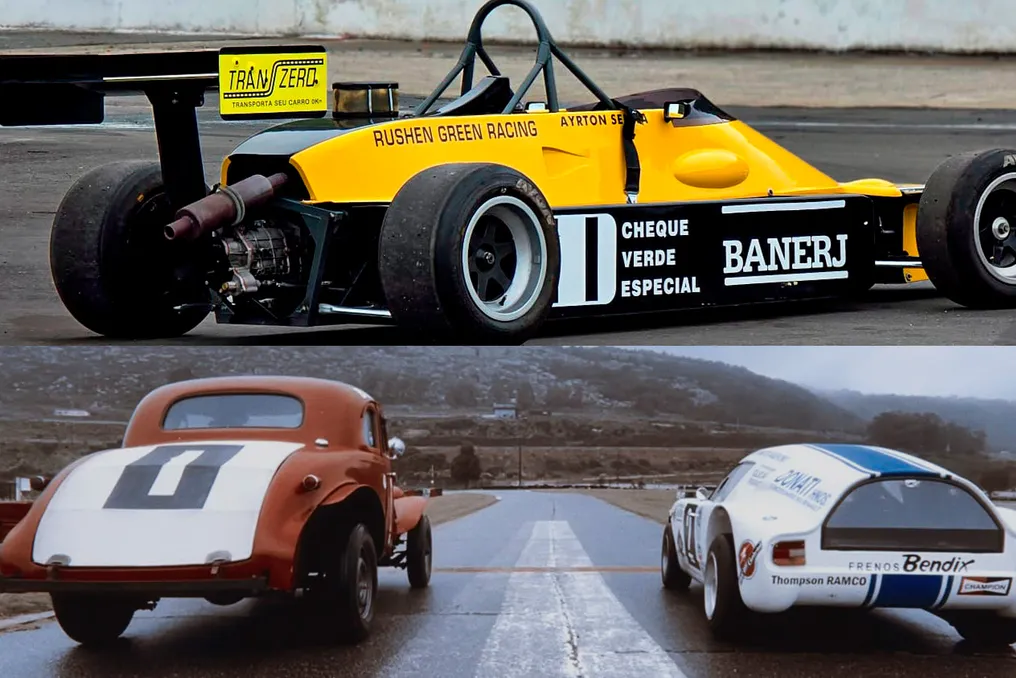
Among the cars at the factory were the Tulieta GT convertible and several monoports used in the filming of the Netflix mini-series Senna. The Crespi family built 22 functional replicas for production, reproducing various race cars from Ayrton Senna's trajectory. Luciano also drove these cars in the filming, while Matias played Alan Prost in the racing scenes. This is a story the author plans to tell in another report, as this piece contains much interesting engineering and manufacturing detail.

From the factory, they headed to the Juan Manuel Fangio Racetrack, one of the most beautiful tracks the author had ever seen. Balcarce is located near the Tandil mountain range, which interrupts the endless plains of the province of Buenos Aires. The racetrack was built on the slope of Serra La Barra, with mountains on one side and open fields on the other. The track follows the terrain, featuring turns of varying radii, changes in direction, and significant altitude changes over its 4592 meters.

The racetrack opened in January 1972 and reopened in September 2026 after about fifteen years without national competitions. Restoration work included safety and infrastructure interventions but did not change what most attracted the author. Juan Manuel Fangio is simple, but not primitive.

There are no large buildings or complex facilities for visitors. The workspace is mainly a hangar capable of holding several dozen cars, although fewer than ten can work comfortably there. There are toilets, a covered area, a viewing platform, and the necessary structure for managing races. The author recalled Willow Springs in the United States. These are completely different tracks, but both demonstrate that having a racetrack does not require building an entertainment complex. The track, hangar, and necessary event organization facilities can be sufficient—although this does not mean that building or maintaining a track is cheap, obviously.

This structure also helps explain the automotive tradition of Balcarce. The racetrack creates demand for mechanics, preparers, component manufacturers, workshops, and all types of services related to racing. Crespi is an example of this, although the city's history with motorsport predates the opening of the track.

The author is particularly interested in this connection because in Brazil, the cost of building racetracks and the viability of major competitions are often discussed, but what a track can represent for local motorsport is not always considered, regardless of whether it hosts national or international events.

However, on that day, they were truly interested in two monoports prepared by the Crespi brothers. The first was a recreation of the Van Diemen Formula Ford used in Senna's filming. The second was the Crespi FC-1, inspired by 1980s Formula 1 race cars. The FC-1 weighs about 600 kg and can use various engines. The available unit is equipped with a turbocharged 1.8 Volkswagen engine with 20 valves, tuned to about 300 hp, according to the Crespi brothers—a ratio of 2 kg/hp. The participants were supposed to drive the cars themselves, following a lead car that set the pace. That day, it was the Crespi brothers' own Mercedes-Benz C250.

The problem was the rain. From the morning, they faced cold, wind, and very fine precipitation that sometimes resembled hail. Even with slick tires, the monoports could move on the track, provided the pace matched the conditions. Participants got into the cars and completed laps while the author waited for his turn. He was curious to know if he could sit in the car. He is 1.85 m tall and weighs 120 kg, which does not make him an ideal candidate for a Formula Ford cockpit. He didn't manage to get into the seat, but he wanted to try at least.

Around 3:30 PM, the drizzle turned into heavy rain. The track became too wet, and Crespi decided to gather the cars. This was unsuccessful. The author did not find out if he would fit in the Formula Ford, and most importantly, did not get the chance to drive the car. It would have been interesting to drive a monoport on this track, but the rain prevented any discussion.

They still had a tour planned for that day. After visiting the Crespi family factory and the racetrack, they went to the center of Balcarce, where the Fangio Museum is located. They traveled from the racetrack to the Museo Fangio, in the center of Balcarce. This was one of the places the author had wanted to visit for years, long before the opportunity to drive the Crespi cars.

The building has a rather unique architecture. Its several levels are connected by a spiral ramp that allows one to go through the entire collection without interrupting the visit to change floors. Cars are displayed along this route, accompanied by photographs, documents, trophies, and items that help tell not only about Fangio's career but also about the history of Argentine motorsport. For those who grew up reading about the early years of Formula 1, seeing the original Maserati 250F and Alfa Romeo 308—of which only four examples were made—would already be a sufficient reason to visit Balcarce. There were also Talbot-Lago T26C and other race cars from different eras.

He knew these cars from books and photographs. Now he could examine their proportions, body construction, suspension, and details that are not always visible in pictures. The museum also houses authorized replicas of very rare cars, such as the Mercedes-Benz W196, Ferrari 166 Formula 2, Bugatti Type 32, and Lancia D50. Ferrari, incidentally, will appear again on his trip: next week he will find the original at the Automóvil Club Argentino museum in Buenos Aires.

After touring the galleries, they walked past the souvenir shop and returned to Casco de Fangio, where they were going to visit the main house of the estate used by the pentacampeon while in Balcarce. Unlike the guest quarters, the residence was preserved almost as it was in the final years of the driver's life. The furniture, decor, and even the placement of objects seem left in place. It looks like stepping into a 1991 home awaiting its owner's return.

There are photos and memories everywhere, many of which are reproductions of historical images. Among this material, he found a painting that made him stop for long minutes. It was a photograph signed by Rudolf Uhlenhaut, Piero Taruffi, Juan Manuel Fangio, Stirling Moss, Karl Kling, and Alfred Neubauer. The names need no introduction for those who know the history of Mercedes-Benz in 1950s racing. There were signatures of drivers, the engineer responsible for some of the brand's most important cars, and the man who led their teams on the track. And these were real autographs—traces of pen could be seen on the photo paper. He looked at it for a long time. The photograph, signed by these six legends of motorsport, hung unnoticed on the wall of the house in Balcarce. Who would have thought?

After the visit, they had another Argentine dinner with meat, potatoes, and wine. The rain still hadn't stopped, and he hoped for a break the next morning because they still had two historical Fangio Foundation cars to drive.

Another Side of the Museum

The next morning, the wind continued to howl in the trees surrounding Casco de Fangio. It was piercingly cold, and the fine precipitation did not cease. Sometimes it seemed like sleet burning upon contact with the face. Despite the weather, the Fangio Foundation decided to hold an event with historic cars. The activity was moved to the Balcarce karting track, where it was safer to drive on a wet surface. They were provided with two cars. The first was a Torino MK TC Liebre III, a late 1960s Turismo Carretera model designed by Peronillo, driven by Gastón Perkins, the 1969 Argentine champion. The second was a recreation of a 1939 Chevrolet Coupe that Fangio used in road races in the 1940s, including the 1948 South American Grand Prix, better known as Buenos Aires–Caracas. The author started with the Torino. This is a race car

} , {
Similar stories

Autoclásica Expedition: Journey with Classic Vehicles of Various Models to Argentina
Read more
flatout.com.br

Autoclásica Expedition: Journey with Classic Vehicles of Various Models to Argentina

The author recounts his long-held desire to participate in Autoclásica, an event held in San Isidro, Argentina, a wish he had been postponing for at least four years due to organizational difficulties and personal financial planning issues.

In addition to Autoclásica, there was another desired destination: the Fangio Museum, located in Balcarce. Both locations are considered must-see spots for automotive enthusiasts in Argentina, although they are not adjacent, requiring careful logistical planning.

In 2025, MAO managed to make the trip to Autoclásica. That year, Pedro from ACE organized an expedition sponsored by Ford, which transported five Brazilian Ford Model A cars to the Argentine exhibition, supported by a Bronco and an F-150.

This expedition led to something even more complex. In the same year, another Pedro, known as Mazza, undertook a motoring journey across Argentina, visiting workshops and racetracks. During a stop in Balcarce, at the headquarters of Crespi Competición, founded by Tulio Crespi in the 1960s, Mazza discovered the opportunity to drive some of the company's cars on the local racetrack.

Balcarce also offered the chance to visit the Juan Manuel Fangio Museum, administered by his foundation. The proposal went beyond just a visit, including the opportunity to drive historic cars maintained by the Foundation.

Organizing such an experience demanded more than just attending; it required building contacts, structuring logistics, and ensuring access. Thus, the two Pedros joined forces to put together the 2026 expedition, integrating ACE and Driven by Mazza. The package included the international travel, participation in Autoclásica, and exclusive experiences in Balcarce, with accommodation at the Casco de Fangio, a hotel belonging to the Fangio foundation.

FlatOut acted as a media partner, and the trip would serve as an opportunity for the format to be evaluated for members of the FlatOut Clubsport.

For the author, the main motivation was to realize the visit to Autoclásica and the Fangio Museum on the same trip, with the possibility of driving race cars in Balcarce being an unexpected bonus.

The expedition departed from São Paulo on October 3rd, traversing Southern Brazil, crossing Uruguay to Colonia del Sacramento, and subsequently crossing the Río de la Plata to Buenos Aires. From there, they headed to Balcarce, where Crespi, the racetrack, and the Fangio Foundation awaited them, before returning to the Argentine capital for the four days of Autoclásica.

The participants would use three different vehicles: a 1982 Chevrolet Chevette, a 1992 Volkswagen Gol CL with a 1.8 engine and GL characteristics, and a 1972 Triumph GT6. A Volkswagen Golf Variant would serve as support vehicle.

These cars belonged to the participants themselves, clients of the expedition, and FlatOut subscribers. Kiko, Fernando, and Marco decided to take the route by car. Fernando and Leonardo opted to fly to Buenos Aires, joining the group only for the activities in Balcarce.

Additionally, the organizers had the task of transporting two Brazilian sports cars from the Dream Car Museum collection in São Roque—a 1979 Concorde and an automatic Hofstetter Turbo—to Autoclásica, using their own platforms and logistics to cross borders.

The initial plan involved a second support vehicle, but the lack of sponsorship prevented this option, forcing the author to travel as a passenger. He also planned to extend his stay in Buenos Aires to meet his wife, returning later by car for a quieter trip, ideal for taking notes for a possible travel book.

The group met on Saturday evening in São José/SC, after the first phase started in São Paulo. On Sunday, they proceeded to Pelotas/RS, staying overnight before crossing the border into Uruguay on Monday.

A Long Sunday

On Sunday morning, while starting the trip from São José to Pelotas, the Triumph experienced ignition failures, a common electrical issue in old English cars. Although Marco, the owner, knew that exciting the alternator would be necessary, the procedure did not solve the problem that day. Suspicion fell on the battery, but since they were near Florianópolis, no one worried excessively.

After resolving the starting issue, the group continued, monitoring the battery charge. The pace was set by the slowest, especially the Chevette, maintaining an average speed between 80 and 100 km/h. During a stop between Santa Catarina and Rio Grande do Sul, it was noted that the battery was not charging, but the alternator prevented a drastic loss of charge. The cause of the Triumph's electrical problem was identified as a loose terminal on the alternator.

As they approached the Porto Alegre region, near Gravataí, Marco and his father noticed a noise coming from the rear axle. The suspicion was a wheel bearing defect, which required immediate attention. Finding a mechanic available in Porto Alegre on a Sunday afternoon was a challenge overcome thanks to the FlatOut network. Marcos de Sá indicated Jonatas, a mechanic who agreed to receive them at his residence.

While heading to the location, the Gol had another unforeseen event: its mechanical fuel pump failed, requiring towing to Jonatas's house. The expedition, which began with four vehicles, began facing problems with the Triumph (suspicion of bearings), the Gol (need for a tow truck), and the Chevette (unstable carburetor), all in the middle of the second day.

Despite the setbacks, the atmosphere remained friendly among the enthusiasts. After dismantling the Triumph's wheel hub assembly, it became clear that the bearing was damaged, possibly due to improper previous installation, where excessive tightening of the bolt damaged the component instead of just eliminating the play.

Without new bearings, continuing the trip would be risky. Marco chose to stay in Porto Alegre with his father, planning to source the bearings and finalize the repair to reach the group in Argentina on Monday. The rest of the group continued traveling that night, arriving late in Pelotas, thus ensuring compliance with the schedule to receive the platforms with the cars the next day.

The era of Brazilian sports cars: analysis of imported and national models between 2007 and 2017
Read more
flatout.com.br

The era of Brazilian sports cars: analysis of imported and national models between 2007 and 2017

Following the previous analysis, this chapter focuses on other sports vehicles, both manufactured and imported, that were introduced in Brazil during the period between 2007 and 2017, a decade marked by the diversity of automotive with sporty characteristics.

It is essential to contextualize this period due to the opening of imports, which generated a similar scenario. In 1990, the Collor government authorized the importation of cars (forbidden since 1976), applying a high tariff of 85% on the Import Tax. In June 1993, this rate was significantly reduced to 35%, facilitating the entry of more compact models, not only luxury or renowned sports ones, but also stimulating the arrival of generalist foreign brands focused on more accessible segments, including small Japanese and French sports cars. Later, in September 1994, the tax fell even further to 20%, coinciding with the currency conversion to the Real, which initially had parity with the dollar.

This tax reduction was extremely beneficial for importers, resulting in an avalanche of vehicles of various origins and types in the country. It was possible to acquire a brand new Alfa Romeo 164 for the same price as a new Chevrolet Omega CD, even though they were cars for distinct audiences. In 1990, the Italian Alfa Romeo was quoted at about US$ 130,000.00, and this discount margin benefited almost all vehicles in this early open market.

However, the fiscal benefit negatively impacted the trade balance, as the country began importing much more than it exported in the sector, harming the national industry already established for decades. For this reason, at the beginning of 1995, the tariff returned to rise to 35%, reaching 70% from March, with the objective of controlling the outflow of dollars.

This brief economic and political overview serves to explain the approach of this material: while imported options in the nineties were varied and attractive, they presented fiscal instability, causing prices to fluctuate greatly, and the availability of cars depended directly on governmental decisions. A little later, with the official imports sector more mature and new factories installed in Brazil, it becomes fairer to evaluate the true sports cars available to the consumer.

Peugeot 208 GT (2017-2019)

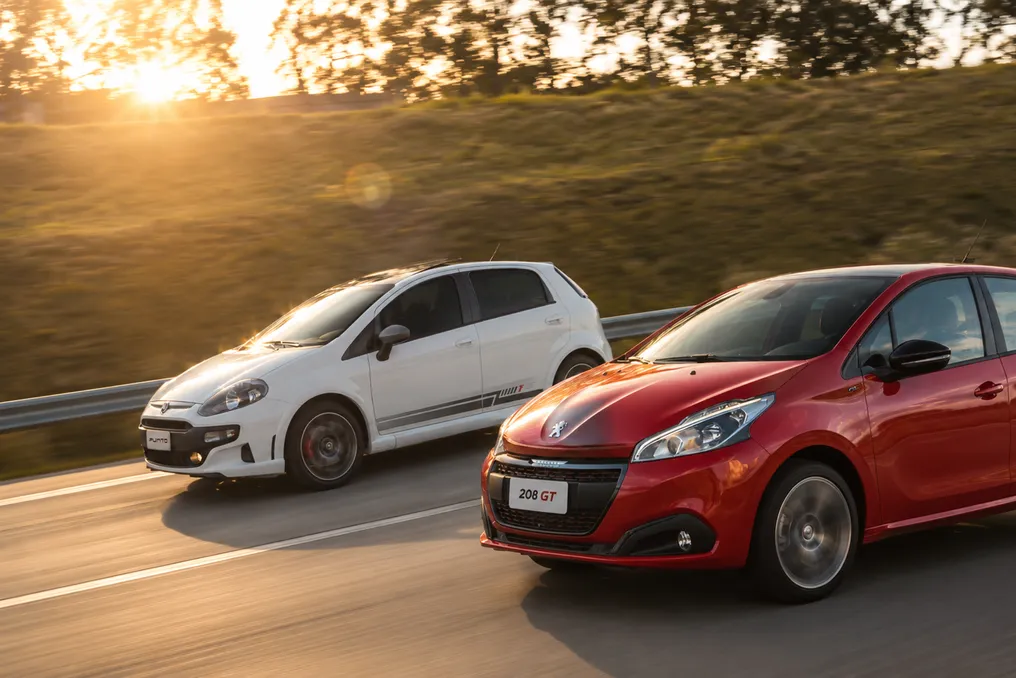
The Peugeot 208 GT is a highly sought-after model by readers, deserving special mention. There has always been an enthusiastic public for small Peugeots, and the GTI acronym was also relevant to the brand (as well as Volkswagen, which introduced it in the Golf in 1976). Even the most conventional models possessed dynamic and vibrant behavior. When the 206 arrived in Brazil, its cornering performance attracted as much attention as its modern and innovative design; it was agile and responsive on asphalt, and on dirt roads, its free rear axle provided fun and surprises to unsuspecting drivers. Regardless of the engine, the 1.0 16v worked with great vigor, the 1.6 8v was economical and smooth, and the 1.6 16v pleased the more hurried. In the WRC, the small 206 achieved two consecutive titles, elevating the vehicle's image.

After many years, this discreet sporting vein materialized in the 208 GT, launched in 2017. The significant advance occurred with the incorporation of the 1.6 THP FLEX engine (PSA/BMW), originating from the 2008 compact SUV/crossover. This powerful turbo engine, combined with a manual transmission, was unusual for the proposal and gained notoriety on the Acelerados channel when used by former Brazilian F1 pilots in speed tests. Although sharing the same platform, the 208 differed from the 2008, presenting visual improvements with an exclusive front bumper, 17-inch wheels, and a rear spoiler. The dual exhaust outlet signaled the more powerful engine (173 hp at 6,000 rpm with ethanol), and its performance figures were impressive: 0 to 100 km/h in 7.6 seconds and a top speed of 220 km/h, surpassing direct competitors such as the Sandero R.S. (more affordable) and the Suzuki Swift Sport (slightly more expensive).

It behaved similarly to the current Pulse Abarth, but offered the advantage of involving the driver in a more fun process due to the need for manual shifts. The set was completed by a small steering wheel, raised dashboard, powerful engine, and an elegant body, in addition to a suspension tuned for greater firmness and precision on an already solid base.

Although it was a car that would be desired by many, it had a short lifespan, lasting only two years. Currently, there is a 208 GT in 2026, but it follows the line with the 1.0 engine and automatic transmission from Fiat, without the special character of the first GT. If it had a manual transmission, it would at least better emulate the original, being more accessible and easier to maintain. However, the preference for three pedals has decreased currently.

Citroën DS3 2012-2017

The Citroën DS3 could be seen as an 'imperfect twin' of the Peugeot 208 GT, if both were simultaneously available on the market. When the DS3 stopped being imported, its successors had to settle for a car from the same group, with a similar engine and commitments. Due to the modest commercial success of the Peugeot, there was no total acceptance, as Peugeot and Citroën consumers, at least in past decades, had distinct perceptions.

The idea of a 'twin' is just a simplified marketing attempt, because, besides the engine, there was little similarity between the two sports cars. The DS3 maintained elements of the eccentricity characteristic of the original brand: floating roof over a two-door body, configurable pillars, and a vast range of interior and exterior finishes (including thematic stickers), making it bolder and more emotional than the more balanced 208. In a notable comparison on the Top Gear channel, the DS3 was pejoratively nicknamed 'sports shoe', and its extravagant colors and open personality likely fueled such a comment.

As the first model of the premium 'DS' line from Citroën in Brazil, this import had high aspirations, competing in the expensive and restricted niche of vehicles like the Mini Cooper and the Audi A1. The A1, in turn, had a limited presence in the country, selling little and still facing reservations due to its DSG automatic gearbox. The Mini Cooper was at a higher level in power, finish, and exclusivity, which made the French car even more attractive as a compact, beautiful, and powerful sports alternative.

The DS3 was a remarkable vehicle in itself, without needing external help due to the lack of similar alternatives at the same price. Its 1.6-liter THP engine had the capacity to generate torque at low RPMs and perform well at high RPMs, without depending on a small turbo that could restrict a similar-sized engine. With a six-speed gearbox—manual with satisfying and precise shifts, well-designed lever, and appropriately sized steering wheel—and front seats that functioned as true sports seats, wide and with excellent lateral support, the driving experience of a DS3 was pleasurable.

Its 165 hp were enough to challenge even the Fiat 500 Abarth, a smaller and lighter sports car. The thrust and liveliness of the engine brought smiles to the driver, and its grip on the asphalt was exemplary. It is regrettable the current absence of such cars at reasonable prices, around half the cost of a Type R or Yaris GR. The DS3 stopped being imported in 2017, and seeing it on the streets is a rare event; the remaining examples have often been modified, enhancing what was already excellent.

VW Fusca TSI (2013-2016)

During the retro wave of the early millennium, the New Beetle was one of the most popular models (in terms of price and impact) to arrive in Brazil, a country with a rich tradition of over 3 million Beetles. Like the original Beetle, most versions of the New Beetle did not have a sporty profile; it was a calm car, with a plant pot theme on the dashboard and a friendly appearance, as under its unusual body was a Golf IV. Therefore, there was no rear-wheel drive nor real risk in curves above the speed limit or common sense. The car behaved like a normal Golf within appropriate limits, and it is unlikely that anyone took it to extremes, given its gentle look.

Three years after the end of production in 2010, the New Beetle was renamed 'Fusca' in Brazil in its third generation, and the story changed drastically. Built on the PQ35 platform—the same used by the Golf and various VW and Audi compacts and mid-size cars—it incorporated an emblematic component of the Wolfsburg house: the two-liter TSI engine (direct injection turbo), responsible for the robust and constant performance of the Golf GTI and Jetta GLI. There was a departure from modest engine economy, as this version was created to accelerate the enthusiasm of Brazilian enthusiasts, configuring a 'Fuscão 1600S' of the new millennium, with 200 hp and performance capable of competing with the Audi A3 and Mini Cooper, surpassing most sports cars of the time.

The design also underwent changes, abandoning the traits of the original Beetle and seeking a resemblance to the Porsche 911. Rounded shapes gave way to more defined lines, the roof became lower, and the A-pillar straighter. Internally, it lost some of the air, lighting, and visibility of its predecessor, but this was compensated by a more compact, sporty, and luxurious cockpit. The windshield was not as far from the driver as in the original Beetle, and the ergonomics were improved with seats and controls more focused on function than aesthetics. The large accelerator pedal, the complete dashboard, and a good-grip steering wheel helped the driver get into the speed mood.

With the DSG transmission, the feeling was similar to that of the Golf GTI: fast and precise, facilitating difficult overtakes and accelerating well. The distinctive interior of the Golf conveyed the impression of driving something unique. The exhaust noises, the easily accessible power and torque, the precise steering, and an agile and stable platform on the roads, all wrapped up in an inspired look, appealed to those looking to escape the monotony of traditional sports cars. Perhaps the best feature was the possibility of combining the two-liter turbo engine with a six-speed manual gearbox, an exclusive privilege of VW, not offered in the Golf or Jetta. Although I never drove this specific configuration, one wonders about the enormous potential for fun of a manual Fusca TSI.

Popular