
Yusra Mardini claims that immigrants are used by European governments to divert attention from social problems
Read more
Noticias ao Minuto
noticiasaominuto.com

Yusra Mardini claims that immigrants are used by European governments to divert attention from social problems

Yusra Mardini, an Olympic athlete and Goodwill Ambassador for UNHCR, stated that European governments use refugees with the intention of diverting focus from other issues. She also advocated for greater freedom of movement for these people.

In statements made to Lusa, the ambassador, who is originally from Syria and has also experienced refugee status, criticized the tendency to blame refugees for the internal problems of host countries. She emphasized that refugees are not seeking to steal jobs or property, but rather a chance to lead a simple and peaceful life.

Mardini suggested that more responsibility must be demanded from governments, as refugees can serve as a means to divert attention from broader political decisions. During her participation in the 10th edition of the Estoril Conferences, held on the campus of Nova SBE (NOVA University of Lisbon), the activist and Olympic swimmer advised European leaders to concentrate efforts on integration and solving the real problems of societies.

The athlete recalled her remarkable journey, starting from Damascus, Syria, during the civil war (2011-2024), until reaching Germany, where she realized her dream of competing in the Olympics. Yusra Mardini gained notoriety for helping save 18 refugees who were trying to cross the Mediterranean in a precarious boat, along with her sister, Sarah Mardini, also an activist.

While crossing the Aegean Sea, from Turkey to Greece, the speedboat's engine failed. Yusra, Sara, and two other swimmers jumped into the water and managed to propel and pull the boat for over three hours until they reached the Greek island of Lesbos, ensuring the survival of everyone aboard. The journey of Sarah and Yusra mirrors that of millions of Syrians fleeing the conflict, and their story was adapted into the film 'The Swimmers' in 2022.

According to the UN, after the end of the war in 2024, about 1.7 million refugees and 1.9 million internally displaced persons returned to their communities in Syria. However, 5.5 million people remain internally displaced in the country, and more than six million Syrian refugees reside abroad.

After participating in two Olympic Games, in Rio de Janeiro (2016) and Tokyo (2020), Yusra is now dedicated to promoting the integration of people like her through the foundation she established and other humanitarian actions. The activist emphasizes that her current work consists of proving that refugees are human beings and informing about the reasons for their departure from their countries.

Arguing during the event, Yusra mentioned the diversity present in schools, saying that they are examples of how people from all over the world coexist. She reinforced that refugees deserve more freedom of movement. Questioning the audience, she asked why this freedom should not be granted to refugees, who need to move due to war, just as she has with her German passport.

The Olympic athlete reiterated that the essential factor is human integration and argued that European states must create more mechanisms so that refugees feel part of society. For her, sports was her path because it 'promotes unity,' facilitating practical integration, which her foundation in Germany successfully achieves.

Germany was the country that received the most Syrian refugees during the government of Chancellor Angela Merkel, who resigned in 2021. Currently, Chancellor Friedrich Merz has adopted a stricter stance regarding German immigration, under strong influence from the AfD, an extreme-right party competing with the CDU (center-right) for national political power.
Similar stories

Activists in Newark Protest Immigration Detention Conditions
Read more
noticiasaominuto.com

Activists in Newark Protest Immigration Detention Conditions

Activists in Newark held a protest on Sunday concerning the rights of immigrants in the United States. The demonstration took place near one of the country's largest Portuguese-speaking communities and resulted in the detention of several dozen activists in the area.

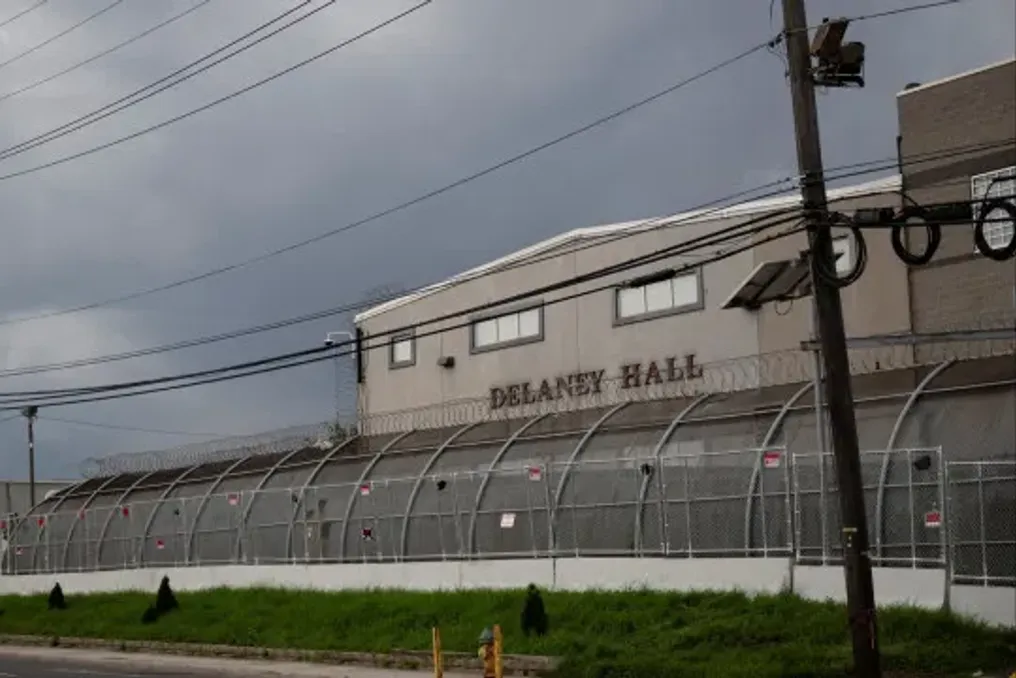
The protest was held on Doramus Avenue, a long industrial street where Delany Hall is located—a local jail managed by U.S. Border Patrol and immigration police. Distant sounds of freight trains and crows filling the electric poles could be heard.

Around sixty participants, representing local unions and left-wing organizations, sharply criticized both the institutions themselves and the staff working there. After months of demonstrations in front of Delany Hall, the complex's walls were covered in graffiti, including the message: 'From Dachau to Delany, a Nazi is a Nazi.'

Geoff Johnson, a union worker at the University of New York, categorically stated that calling it a concentration camp is no exaggeration, labeling it an 'abomination.' He demanded the release of all detainees and the complete demolition of the facility, arguing that it should not exist.

The exact number of detainees remains unknown, but it is estimated that about a thousand people are held in the monolithic building, surrounded by barbed wire and fences, who are transported from areas in New Jersey and New York. Johnson noted that the number varies, but hundreds of people are always present, who may stay for a short time or months, forced to work for meager pay, which he termed slavery.

Geoff Johnson emphasized that most of these individuals are either awaiting asylum decisions or are in the process of legalization. He condemned the current system, asserting that everyone there could be free, and that instead of functioning as before, the immigration system has turned into a network of 'Gulags' across the country.

He also mentioned that the location is neglected, and no local residents know about its existence, despite Newark housing one of the largest Portuguese-speaking communities. In Newark, families have encountered Delany Hall for negative reasons—either relatives were arrested, or they witnessed ICE raids.

Carl, a member of the Newark librarians' union, reported that many people are afraid to go outside and have stopped participating in community life. He recounted seeing ICE agents suddenly arresting people on the street, appearing unnoticed.

Union figures present at the monthly protest stated that they work alongside immigrants and can fight, for example, through strikes. They noted that they are organized, possess resources, and have influence in the electoral system, which they use to express dissatisfaction with this situation.

Geoff Johnson recalled the case in Minneapolis, Minnesota, where citizen mobilization led to the withdrawal of ICE agents from the city. Activists and their representative organizations aim to create a 'rapid response network' to counter ICE raids that attempt to abduct people. They coordinate their actions via the Signal messenger to respond quickly to detentions, as everything happens within minutes.

The protests, dubbed 'Labour eyes on ICE,' have been taking place in front of Delany Hall since May 2025. Johnson noted that the atmosphere is usually peaceful. Today, one activist approached agents at the post but received little response. Johnson considers ICE agents 'mercenaries' and 'bounty hunters,' claiming their actions are illegal because they do not pursue criminals but only people with immigration status issues or debts.

He added that these people are not criminals but working family members who have lived here for decades, and their deportation or confinement in places like Delany Hall, managed by the private group GEO, is absurd and a form of torture because they lack access to medical care. Johnson stated that three people have already died at this location, calling it 'fascism.'

Protest signs mentioned the name of Emiliano Andrade Covarrubias, a 56-year-old Mexican man who passed away last week in a center like Delany Hall in Laredo, Texas. Mary, whose family was affected by this incident, brought Covarrubias's name to Newark. She expressed doubt about the ability of the November 3 midterm elections to change the situation, especially given Trump's influence, who has repeatedly spoken about wanting to become a dictator.

Carl hopes that Trump will lose the midterm elections, fearing that Trump's victory could lead to manipulation of the electoral system. At the end of the day, activists began moving in circles, chanting slogans such as 'Free them all' and in Spanish 'Papeles para todos,' knowing that the detainees hear them, especially after instances of hunger strikes and internal labor.

Racism and resettlement theories cause concern among migrants in Tripoli, Libya
Read more
www.middleeasteye.net

Racism and resettlement theories cause concern among migrants in Tripoli, Libya

October 1 was scheduled as a 'deadline' for foreign migrants in Tripoli. Ahead of this date, dozens of groups and pages on social media called on Libyans to take to the streets with openly xenophobic protests.

These widely circulated posts on Facebook contained racist insults and images of migrants from sub-Saharan Africa, Arabs, and Asians, creating an atmosphere of intimidation. The group Refugees in Libya reported receiving a handwritten threat directed at 'black people,' which was delivered with a bullet just days before the planned protest.

Ultimately, the demonstrations barely took place, overshadowed by a major teachers' strike over unpaid salaries, aimed at Abdul Hamid Dbeib, head of the Government of National Unity (GNU), which governs the western part of the divided country.

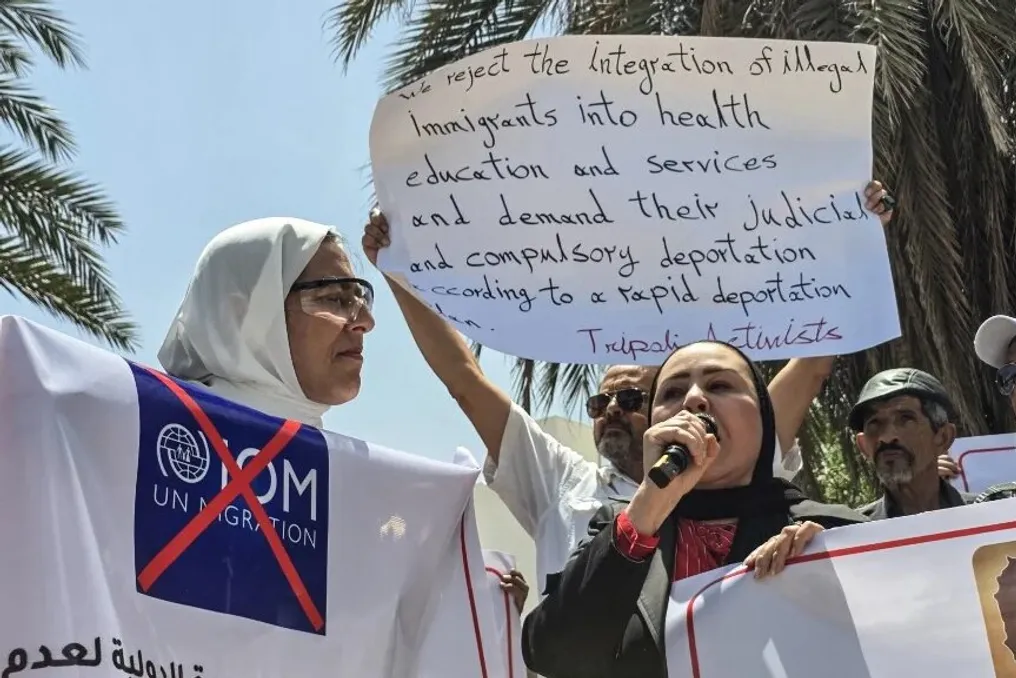
Nevertheless, on October 2 and 9, dozens of protesters took to the streets of Tripoli, gathering at Martyrs' Square and chanting slogans such as 'Libya for Libyans' and 'No Resettlement.' Similar actions have been held several times a month in central Tripoli since April, constantly increasing hostility towards migrants.

Nearly 700,000 sub-Saharan Africans reside in the Tripoli area, including about 335,000 Sudanese refugees fleeing war. The Libyan capital has become a major hub for migrants seeking entry into Europe. From January to August, Libya served as a departure point for approximately 80 percent of the 19,000 migrants who reached Italy via the Mediterranean Sea. Over 90 percent of departures originated from western Libya, particularly from the coast between Tripoli and Zuwara, long known as a major boat departure point.

Attacks on migrant aid agencies

Migrants, who already face smuggling networks, arbitrary detention, kidnapping, torture, and slavery—what the UN calls 'systematic human rights violations and abuses'—as well as violent interception at sea, are now facing growing threats in their homes and workplaces.

Albert G, a 37-year-old resident of eastern Tripoli of Yerreon origin, told Middle East Eye: 'I feel that Libyans are increasingly allowing themselves to do whatever they want to us without being obliged to obey the law.'

He added: 'Not only will torture and imprisonment continue to be a reality for migrants, which is already a known problem, but it also creates additional difficulties when we have no opportunity to visit public places or look for work to survive.'

Albert noted that hostility began to rise with the first protests in the spring and became truly frightening in early summer. In June, large groups of Libyans protested against the so-called 'resettlement plan,' which was claimed to be organized by the United Nations to prevent migrants from leaving the country.

Despite firm denials from the International Organization for Migration (IOM) and the UN High Commissioner for Refugees (UNHCR), hundreds of protesters blocked the UNHCR headquarters in Tripoli on June 4, accusing international agencies of trying to change the demographics of Libya.

These protests were accompanied by anti-migrant violence and waves of arrests of sub-Saharan Africans by police and armed factions linked to the Ministry of Interior in several western Libyan cities, forcing many sub-Saharan Africans to stay home for several days.

Although the unrest subsided in the summer, small gatherings and sporadic incidents continued. On September 7, tensions escalated when a group of Libyans stormed the IOM Migrant Response Centre in western Tripoli. Although no casualties were reported, the attack deeply alarmed the sub-Saharan African community.

Albert stated: 'If the authorities can allow an attack on the IOM camp, many lives will be affected because there will be no safe place for migrants.'

Authorities accused of 'inaction'

Following this incident, the GNU stated that 'the right to peaceful protest can never justify attacks, vandalism, or threats to life,' warning that those responsible could face legal liability.

When MEE asked about measures taken after the attack, the Ministry of Interior did not respond. Meanwhile, popular Facebook and X pages created in the spring remain active, spreading hate speech and calling for mobilization. Groups such as 'Libyan News – No to the Resettlement In Libya' (76,000 members) and 'The Tripoli Activists Movement' (39,000 members) daily share hateful content targeting migrants.

The degree of coordination of the movement and its origins remain unclear. A BBC investigation in August showed that the June protests were fueled by online rumors.

Locally, public figures such as lawyer Touria Al-Tuwaibi and journalist Salma Al-Shaab have repeatedly led the protests—which they call 'peaceful'—reinforcing their momentum.

Ahmed Hamza, a Libyan human rights defender, told MEE: 'These campaigns are still ongoing, even though they are based on false and misleading information.'

He added: 'The actions of those who support or coordinate this criminal movement constitute criminal offenses punishable under the Libyan Penal Code.'

Hamza pointed to a 'state of complacency, complicity, and suspicious silence on the part of the Ministry of Interior and other authorities.'

Migrants share this view, stating that while the GNU allows them to live and work in Libya—and sometimes even hires them—it has never guaranteed their safety in Tripoli.

Kingsley (pseudonym), a Cameroonian refugee who has lived in Tripoli for four years, told MEE that he 'never felt safe in Libya.'

This young man, arrested twice by security forces in 2024 and 2025, said he was only released after paying money to those he described as his 'kidnappers.' In addition to criminal gangs, armed groups affiliated with state institutions have been repeatedly accused of ransoming civilians.

Kingsley added: 'Now I consider the vast majority of Libyans a threat.'

While sub-Saharan Africans remain the primary targets of online hate campaigns, some posts are also directed against Palestinian, Syrian, and Bangladeshi communities—who are particularly numerous in eastern Libya but are becoming increasingly visible in Tripoli.

Migrants also report more frequent violations of their rights and disrespect from local residents amid the hostile environment, even when incidents are not directly related to the anti-resettlement movement.

Albert reported: 'Last week I worked on a construction site for two days and did not receive payment. I had to go home with an empty stomach.'

New protest dates have not been announced, but tension surrounding the anti-resettlement movement continues to build, raising fears that the situation could worsen.

Hamza warned: 'The authorities must fulfill their duties. The situation could escalate and get out of control.'

Currently, the hostile environment has not prompted a large number of migrants to leave Tripoli, but some are considering this option. IOM conducts voluntary return programs that have helped about 16,000 migrants in 2025, while Libyan authorities deported over 37,000 last year.

Albert said: 'Even if the situation there is terrible, I would prefer to be in Tunisia or Algeria. I don't know what awaits us here in the coming months.'

Popular