The challenge of restoring a forest affected by the collapse of an iron ore dam falls on Samarco, the mining company responsible for operating the Fundão dam in Mariana (MG), along with its shareholders Vale and BHP Brazil, since November 2015.
After the breach released about 43.7 million cubic meters of tailings and water, depositing approximately 25 million cubic meters along the Gualaxo do Norte, Carmo, and Doce rivers, the companies have implemented various repair measures as stipulated in the Conduct Adjustment Transaction Term (TTAC), covering the period from 2016 to 2024.
With the progress of these corrective actions, the focus has shifted to the sustainable and lasting development of the area, following the guidelines of the New Doce River Agreement, which was formalized on October 25, 2024. In total, more than 82.6 billion reais have been allocated to compensate people and repair damages in the Doce River Basin between November 2015 and September 2026.
The repair work includes soil protection, recovery of springs and preservation areas, creating ideal conditions for the establishment of native flora, and improving the quality, volume, and permanence of water. Furthermore, there is a significant benefit for rural properties, as the preservation and recovery of Permanent Preservation Areas (APPs) aid in the environmental compliance of these lands.
Thaís Silva, an environmental analyst at Samarco, explains that this is an extensive process that combines territorial conservation, water resources, and environmental recovery. She emphasizes that the main obstacle in the forest recovery of the Doce River Basin is the large size and diversity of the territory, stating that there is no universal solution, requiring the work to be adapted to the specific conditions of each property, the stage of vegetation regeneration, and local particularities. For this reason, different methodologies are employed, including passive, assisted, or active restoration.
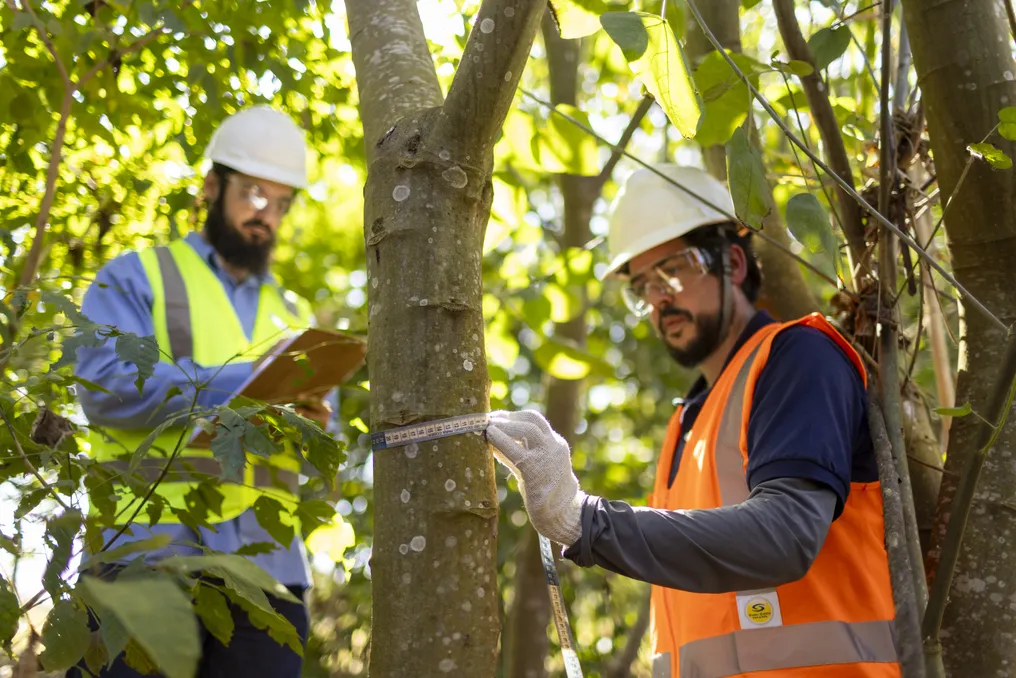
Among the central activities, Thaís details fencing and protection of the areas, direct planting, enrichment with native species, seedling production, seed collection, and restoration monitoring. Fencing, according to her, serves to prevent animal access to protected areas, which allows vegetation recovery and contributes to the safeguarding of soil, water, and springs.
The recovery effort follows two main paths. One focuses on reforestation and bioengineering on the riverbanks in the most impacted section of the basin. These techniques aim to stabilize and recover the banks of the APPs that were directly hit by the tailings. Another relevant project was that of renaturalization, which consisted of implementing structures for habitat recovery.
The second axis of actions comprises compensatory reforestation areas, which cover areas outside the impact zone of the breach but are part of the Doce River Basin ecosystem. Such initiatives include environmental assessments and mapping of erosion points, protection of soils and banks against animals and external interference, promoting natural regeneration and the emergence of vegetation, in addition to planting native Atlantic Forest species, soil green management, and fertilization.
Bioengineering techniques applied to banks and slopes involve the use of hydroseeding and focused planting of containment species, such as Vetiver grass, as well as the installation of biomats (both synthetic and two-dimensional coconut fiber) and geotextiles to prevent sheet erosion. Additionally, to treat eroded surfaces, coverings with hand stones and gabion walls are used. Teams also build drainage channels, water chutes, wet crossings, and concrete cellular manholes, in addition to mechanically removing accumulated sediments in dikes or water mirrors.
In the directly affected regions, the primary objective is to reestablish vegetation and ecological functions. Between the Gualaxo do Norte River and the Risoleta Neves Hydroelectric Plant, in Candonga, more than 357 hectares are undergoing forest recovery, involving 219 rural properties in five municipalities. In these areas, more than 1 million seedlings from over 300 native species of the Doce River Basin have been planted, and some vegetation already shows consolidated coverage and characteristics of a forest in an advanced stage of restoration.
Compensatory restoration expands the scope to other parts of the Doce River Basin. Until September 2026, 47,900 hectares were fenced for reforestation, and about 4,600 springs were protected, covering more than 3,000 rural properties. The New Agreement provides for the continuation of forest restoration of 50,000 hectares and the recovery of 5,000 springs.
The restoration cycle begins before planting. By September of this year, the Seed and Seedling Network had collected 204 tons of seeds from 354 native species, which supported the production of 14.4 million seedlings. In terms of personnel, forest restoration mobilizes approximately 3,000 professionals throughout the chain, from seed collection and seedling production to planting, maintenance, and monitoring. Only in seed collection are there more than 1,000 collectors distributed throughout the Doce River Basin.
This set of actions generates perceptible transformations in the environment. There is an increase in the density and diversity of species in the vegetation and soil, the complete development of seedlings, combined with the application of green fertilization. Soil stabilization also occurs in floodplains and banks, which helps contain the extra input of tailings and promotes the reduction of turbidity in water bodies.
In the naturalized channels and sections, there has been an increase in hydraulic retention capacity, resulting in sediment accumulation and multidirectional deposition, an effect of installing bioengineering structures. Such interventions have favored nutrient enrichment and facilitated the settling of fine particles.
As a result, the region presents a greater balance between the different types of substrate, which drives the development of habitats, increases the variety of biological communities, and raises the number of representative taxa, with greater variation in community composition.