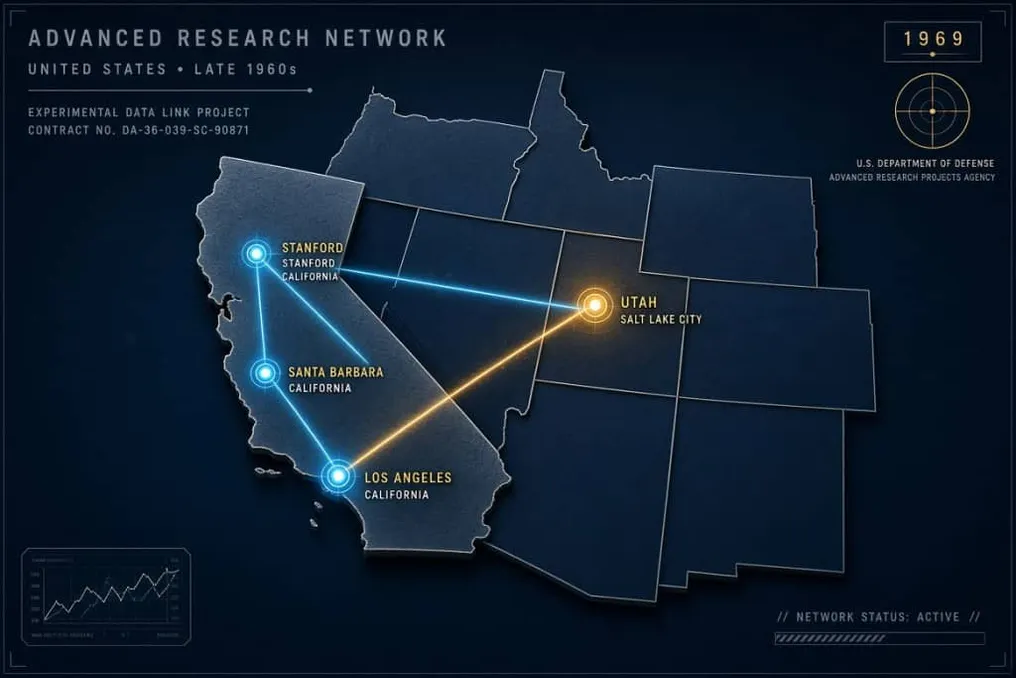
On October 29, 1969, researchers made the first connection between two computers on ARPANET, the experimental network that served as a precursor to the internet. The intended initial message was 'LOGIN,' but the system stopped functioning after transmitting the first two letters, 'LO.'
This event represented a significant milestone in machine communication. However, the modern internet evolved through a complex process that included protocol standardization and the development of new technologies to facilitate network access.
In the late 1960s, the U.S. government implemented ARPANET (Advanced Research Projects Agency Network), an experimental network designed to link computers at research centers. The purpose was to allow scientists to remotely access equipment and share computational resources.
At that time, computers were expensive and bulky equipment. The ability to use these systems remotely allowed researchers from various institutions to share their processing power.
The first transmission occurred between the University of California, Los Angeles (UCLA) and the Stanford Research Institute, which later became known as SRI International. Other connected universities included the University of California, Santa Barbara, and the University of Utah.
Leonard Kleinrock, a researcher at UCLA, was part of the team responsible for this first link. Despite the attempt to send 'LOGIN' being interrupted after the first two letters, ARPANET proved that computers from different institutions could communicate over a common network.
The 1969 connection was just one step in this evolutionary trajectory. A crucial advancement occurred on January 1, 1983, when TCP (Transmission Control Protocol) and IP (Internet Protocol) protocols were adopted as the standard for ARPANET and other computer networks. These protocols defined universal rules for machine communication, and some consider them the true starting point of the internet because TCP/IP helped integrate various networks, whereas ARPANET only enabled the connection.
In 2009, Marc Weber, founding curator of the Computer History Museum's Internet History Program, noted that ARPANET helped dissolve the isolation of groups that used large computers independently, paving the way for a connected environment.
Another important milestone happened in the 1990s when British scientist Tim Berners-Lee developed the World Wide Web (WWW). This system simplified access to online content and boosted its popularity. It is important to note that the Web did not create the connection between computers, but rather made navigating the network more accessible.
The expansion of the network was accompanied by the emergence of various browsers and the proliferation of websites and services, including Internet Explorer, Netscape, Mozilla Firefox, Google Chrome, Opera, and Lynx. Furthermore, communication and social networking services, such as Orkut, Facebook, MSN, and Twitter, increased opportunities for user interaction.
The arrival of the internet in Brazil began in academic contexts. In the late 1980s, Brazilian universities started exchanging information with institutions in the United States, establishing links that aided in introducing the technology to the country. In 1989, the National Network for Education and Research (RNP) was established, an initiative focused on connecting educational and research institutions, being part of the first efforts to structure communication between these centers and expand technological use in academia.
An additional step was taken in 1997, when local connection networks contributed to extending access to other regions of the national territory. These events demonstrate a gradual progression: the internet, initially restricted to communication between research centers, came to possess a broader connection infrastructure, serving as a basis for its dissemination in Brazil.