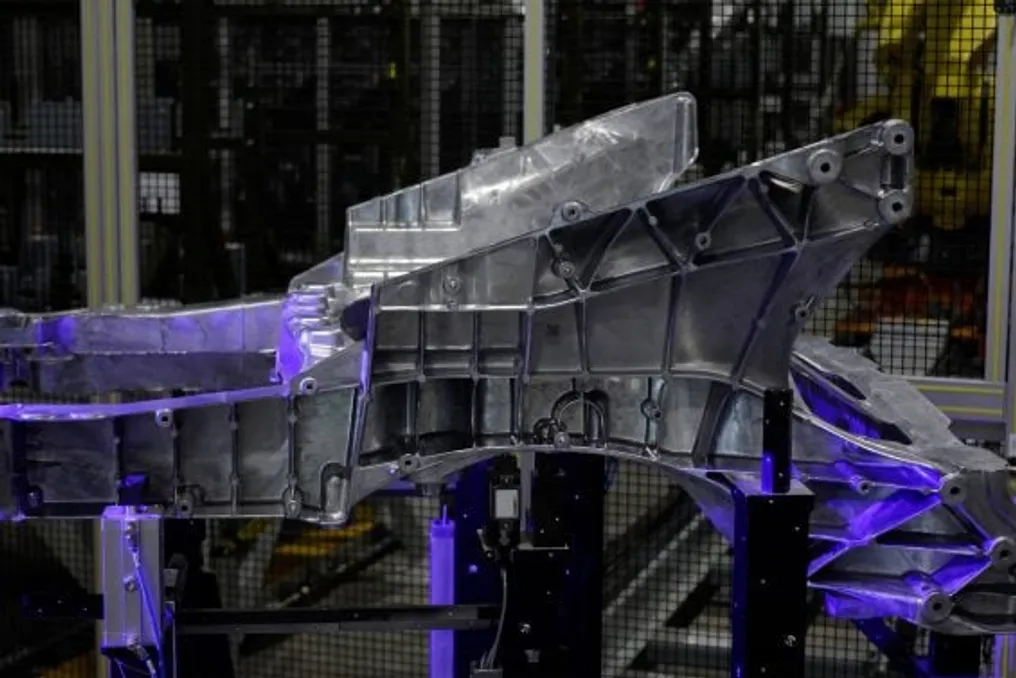
Ford looked to Tesla for inspiration to develop an electric pickup truck with reduced costs. Instead of building the body using dozens of welded sheet panels, the automaker plans to fuse the front and rear parts into two large aluminum components.
This process, called unicasting by Ford, will be applied to the Fathom, a mid-sized electric pickup expected to enter the American market next year at a price of US$ 28,350 (approximately R$ 151 thousand). According to the manufacturer, these two parts will replace 146 structural elements present in the Maverick, a model also sold in Brazil.
The methodology used is identical to the gigacasting utilized by Tesla on the Model Y since 2020.
In a conventional body, each section of the structure is molded from metal sheets and subsequently welded to the others by robots. In the casting method, liquid metal is poured into a mold and emerges as a single piece, resembling the principle of an ice mold, but on an industrial scale.
Ford has already manufactured over 5,000 of these parts, enough to produce 2,500 pickups, at the Shelbyville Technical Center, located in the state of Kentucky. Currently, these parts are only being used in prototypes.
The procedure begins with aluminum ingots heated to about 700°C. After being injected into the mold, the part is removed by a robot, cooled in a tank, trimmed, and subjected to machining processes.
Next, the parts undergo a rigorous battery of tests. In a climate-controlled area, equipment checks dimensions and hole locations. An industrial X-ray is used to detect any internal voids or bubbles in the aluminum, while an optical scanner maps the surface.
Samples from each batch are also evaluated for their chemical composition and strength. Only after approval is the batch sent to the Louisville factory, also located in Kentucky.
The giant components also allow Ford to incorporate an original invention of its founder. In 1913, Henry Ford introduced the moving assembly line for the production of the Model T, known as the Ford Moustache, where the vehicle followed a single conveyor belt receiving components along the way.
In the Fathom, this conveyor belt is replaced by what the company calls the 'assembly tree'. Three lines work simultaneously on assembling the front, the rear, and the battery, which serves as the floor and already receives seats, console, and carpet. These three sets are only joined at the final stage.
According to Ford, this new method has the potential to accelerate assembly by up to 40%. A portion of the saved time will be redirected to automation investments, projecting a final gain of 15%.
Production, confirmed only for the United States, is scheduled to begin in the first quarter of next year.