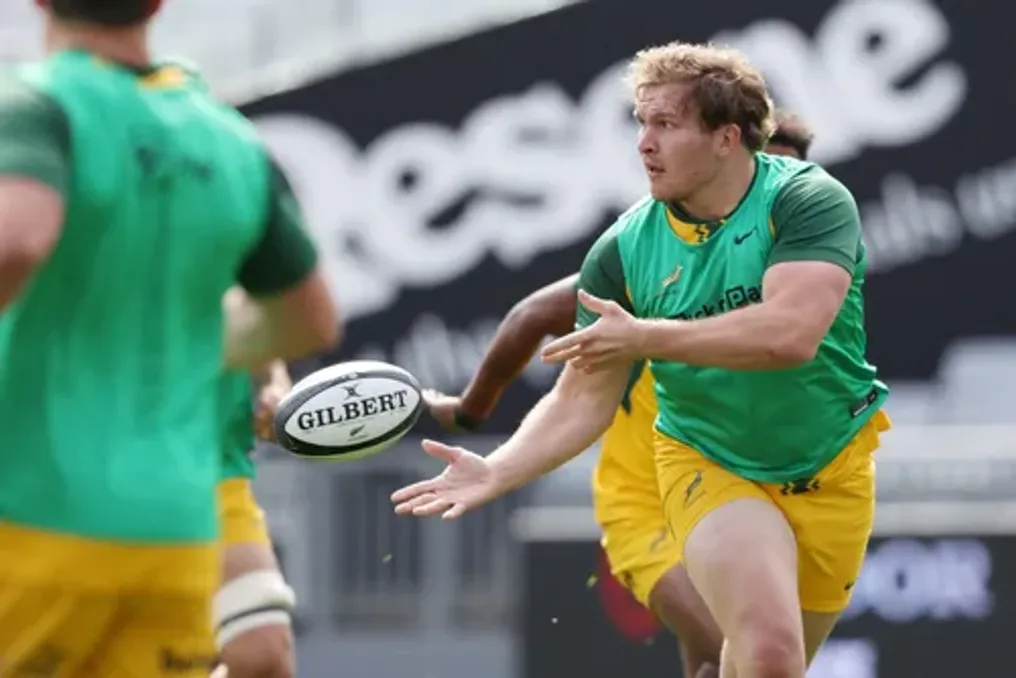
Jan-Hendrik Vessels prepares for a crucial test in the Springboks squad during the Nations Cup
Read more
IOL
iol.co.za

Jan-Hendrik Vessels prepares for a crucial test in the Springboks squad during the Nations Cup

Although the depth of the Springboks' prop positions is considered one of the best in world rugby, the situation with players at the hooker position looks different. After a long break, Bongani Mbonambi only recently returned to play for the Stormers, Deon Fury is nearing the end of his career, and Johan Grobbelaar failed to replicate the high results from last November.

Under these circumstances, 32-year-old Malcolm Marx continues to carry a huge load in the Bok squad. His recent outstanding performances, including over 200 minutes in four intense matches against the All Blacks, highlight how difficult it is to replace a player who is both a master of team play and an immovable tackling machine.

Enter 25-year-old Jan-Hendrik Vessels. He was selected alongside Marx as the sole specialist hooker in the Boks' 37-man squad for the Nations Cup in November. This tour marks a turning point for the dynamic Bulls forward.

Role Distribution in the Squad

With Marco van Staden available as a reserve hybrid third choice, the responsibility for providing a quality and complete replacement for Marx falls entirely on Vessels' shoulders. Erasmus has never been unfamiliar with glowing assessments of Vessels' potential; previously, he compared the mobility of the former Grey College prodigy in close combat to Springboks legends Ossu Randt and Ollie le Roux.

Since his debut against Portugal in 2024, Vessels has predominantly played low-shed prop for the Springboks, occasionally featuring at hooker in the second half. Having gone through the SA Rugby early development system and trained under Jake White at the Bulls, Vessels possesses a rare combination of athleticism and powerful physical strength.

Being a 'tougher' option with excellent ball-carrying abilities, Vessels provides the Springboks with a significant tactical advantage. When he is on the bench, South Africa effectively has a hooker and an extra prop, without disrupting the team's balance.

Challenges of Transitioning to Hooker

Nevertheless, the transition from low-shed prop to international hooker is a major achievement. While scrummaging and carrying the ball come naturally to the young athlete, finding the jump in the attacking line under strong pressure remains his main area for growth. Erasmus called for patience regarding Vessels' development as a hooker, but next month in the Northern Hemisphere will not allow him to hide.

As matches against Italy, France, and Ireland are scheduled before the Final Weekend in London, the Nations Cup becomes the ideal high-pressure environment for Vessels to establish himself as Marx's successor. Daily training against seasoned props such as Wilko Lou, Thomas du Toit, and Ox Nche has accelerated his learning of team play. However, more time on the field under high pressure in the role of hooker will significantly aid his development.

If Vessels can improve his execution in the attacking line, reliably secure the scrum, and replicate his explosive abilities in open play during the tour, he will resolve one of the biggest tactical questions facing the Springboks ahead of the 2027 Rugby World Cup. For Vessels, the November Nations Cup is an opportunity to master the profession of a true front-row forward and stop being a versatile tool for the Boks that only temporarily replaces a prop in a crisis. It is a chance to prove that he belongs on the biggest stage as Marx's heir in the Springboks.

Similar stories

Rassi analyzes the composition of the South African squad ahead of defending the World Cup title
Read more
iol.co.za

Rassi analyzes the composition of the South African squad ahead of defending the World Cup title

Rassi Erasmus faces the challenge of deciding which players from the Springboks and young forwards of the South African national team should be retired, and whom to support to form a team capable of winning a third consecutive World Cup.

World Cups are often remembered by teams that crossed the line when their emotional coaches could not let go of aging stars. However, Erasmus will not allow such a scenario, as the 'Boks' are preparing to defend their title in Australia next year.

His November squad demonstrates an understanding of this task. The inclusion of several promising young players is aimed not at a complete overhaul of the South African national team, but at ensuring the readiness of the next generation for when the current elite leaves the field.

Young talents such as Yakin Ahmed, Luan Gillime, Marcus Müller, and Riley Norton were included, while Sebastian de Clercq and Emmanuel Tsituka took their places due to good form in the United Rugby Championship.

As the South African national team's opening match against Italy in Adelaide on October 3, 2027, approaches, Erasmus has little time to determine which young players can transition from promising candidates to genuine contenders for the Tests.

The November tour is seen as the ideal opportunity for this determination. At the beginning of the year, Erasmus set two key goals for 2026: achieving victory in the 'Great Rugby Rivalry' and building squad depth during international matches in July and November.

He followed this plan in July, making significant changes to the lineup for matches against Scotland and Wales after fielding his strongest team against England. Now, ahead of another intense series of games, the focus is on finding players who can withstand the pressure of international rugby without lowering the standard of the South African team's victories.

Erasmus acknowledges the value of investing in youth. The South African junior team won the U-20 Rugby World Cup in both 2025 and 2026, providing a promising stream of talent for the senior team.

Fourteen players from these recent junior successes have already gained experience in the United Rugby Championship, and three—Wusi Moyo, Jaco Williams, and Norton—have advanced to play for the senior South African team.

This is an encouraging result, but the real test is how many of them can establish themselves as permanent international players and, ultimately, World Cup contenders.

Rugby in South Africa has previously shown similar progress. The 2002 Junior World Cup champions under Jake White included John Smith, Shalk Burger, Jean de Villiers, Frikkie du Preez, and Ricky Januarie. They became central figures in the triumph of the South African team at the 2007 World Cup, where Smith led the team to glory.

The takeaway is not that every junior champion will become a star in the senior squad, but that a strong development system can lay the foundation for future international success.

School rugby is also becoming increasingly professional, helping young athletes arrive in senior squads better prepared for the demands of elite competition. Erasmus has an additional advantage in close cooperation with South Africa's U-20 coach, Kevin Fourie, which gives him insight into the progress and potential of young players long before they reach the senior squad.

His current task is to turn this potential into reliable squad depth for the Tests. This does not mean throwing a handful of young players into deep water and hoping they learn to swim. Erasmus usually prefers to introduce newcomers gradually, surrounding them with experienced veterans who can help them settle in.

The November opponents must provide a tough test. Italy is capable of causing problems for the South African team, regardless of its world ranking. Old rivals France and Ireland will be very difficult opponents.

Erasmus acknowledged that the National Championship format adds extra motivation, as every earned point could be decisive in the race for the top of the table.

South Africa is currently leading the Southern Hemisphere rankings in points difference, with 15 points, the same as New Zealand. The South African team will play Italy on November 7, France on November 13, and Ireland on November 21, before the Final weekend in London from November 27 to 29.

The immediate goal is to win, but the long-term mission is no less important. Erasmus must determine which veterans are still playing a vital role, which young players are ready right now, and where succession planning remains incomplete.

Popular