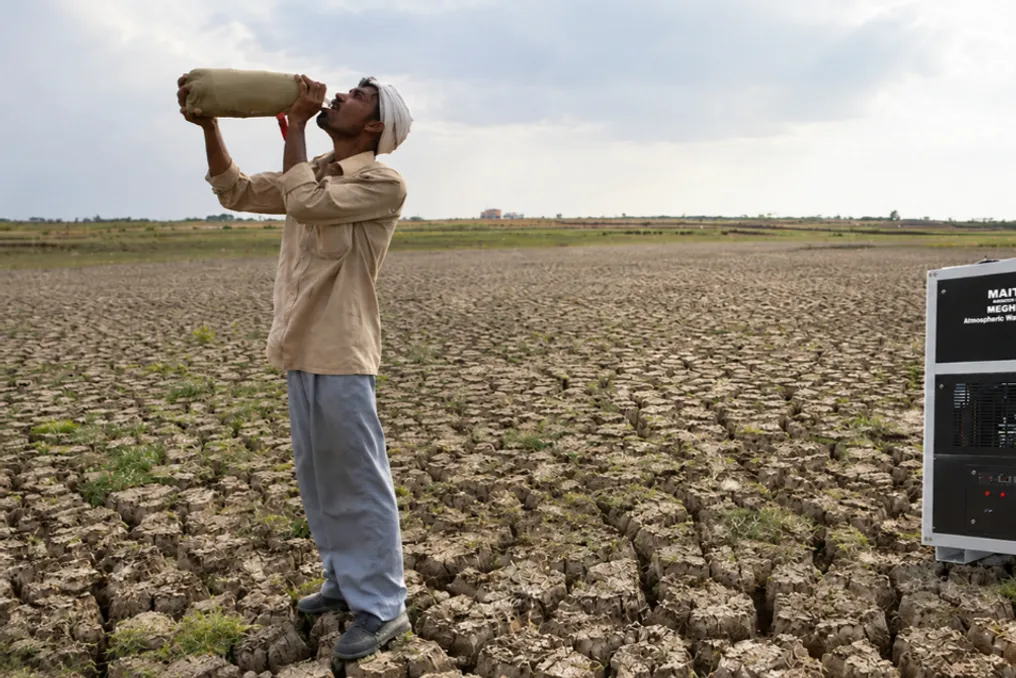
In the village of Vadji, located in the Washim district of Maharashtra state, residents have long faced the problem of water scarcity. They had to travel up to one and a half kilometers to bring water home, which became especially exhausting during hot summer months when water sources dried up.
The solution to this problem was found in the air itself. A machine called Meghdoot was introduced in the village, capable of extracting moisture from the atmosphere and converting it into drinking water. This unit can produce up to 500 liters of purified water per day, providing the village with a new water source that does not depend solely on wells or groundwater.
Even a single jug of water required a long walk
Vadji, home to about 2000 people, is part of the communities in the Vidarbha region suffering from water shortages. The problem extends beyond the village itself: according to reports from the Central Ground Water Board, nearly 40 villages in the Risod taluka are classified as having semi-critical groundwater levels.
For local residents, difficulties intensify in the summer due to rising temperatures and increased difficulty accessing reliable drinking water. To address this issue, the Gram Panchayat of Vadji adopted a technology that utilizes a resource that people rarely consider a source of drinking water—moisture contained in the air. This village is the first and only one in Maharashtra to implement this technology.
How does the technology turn air into water?
The Meghdoot system uses atmospheric water generation technology to extract moisture from the air and convert it into a liquid state. The process begins with fans drawing moist air into the machine. Filters then remove suspended particles, such as dust and pollen, before a cooling-based mechanism lowers the air temperature to the dew point.
As the air cools, water vapor condenses into droplets, similar to condensation on a cold glass surface. The collected water undergoes further purification: activated carbon, ultraviolet (UV) disinfection, and other treatment methods make it potable. The purified water is stored until it is dispensed for consumption.
The installed unit has a stated capacity of about 500 liters per day. However, the actual volume obtained by the atmospheric water generators depends on factors such as temperature and humidity, as well as the operating mode of the machine. Unlike traditional sources that draw water directly from groundwater or surface water, this method collects moisture from the atmosphere, allowing for an additional source of drinking water where existing supplies are under pressure.
The water supply innovation in Vadji was developed by scientists from the Council of Scientific and Industrial Research—Indian Institute of Chemical Technology (CSIR-IICT) in Hyderabad in collaboration with the company Maithri Aquatech. Key participants in the project include Dr. Sridhar, Dr. Nivedita Sahu, and their team. The system was acquired with support from CSIR-IICT under the leadership of the then Director, Dr. Chandrashekhar.
At the village level, the initiative was taken up by the Gram Panchayat of Vadji. The unit was placed in the Zilla Parishad primary school and in the Anganwadi, ensuring access to drinking water in places frequented by children and local residents. This placement allows students and Anganwadi visitors to utilize a source of clean water near their location.
Despite the advantages, it should be noted that atmospheric water generation does not replace the need for groundwater conservation, rainwater harvesting, or the presence of reliable public water infrastructure. The technology also requires electricity, and its efficiency depends on local atmospheric conditions. Long-term viability will be determined by operational costs, maintenance, and operational stability.
For Vadji, the promise of Meghdoot lies in a simple principle: bringing drinking water closer to those in need. What once required a journey of a kilometer or more can now be partially provided by a machine extracting moisture from the air. Although this technology cannot replace long-term solutions such as groundwater conservation and rainwater harvesting, it offers an alternative way to combat water scarcity. With proper maintenance and adaptation to local conditions, such innovations can help more communities find alternative sources of drinking water.