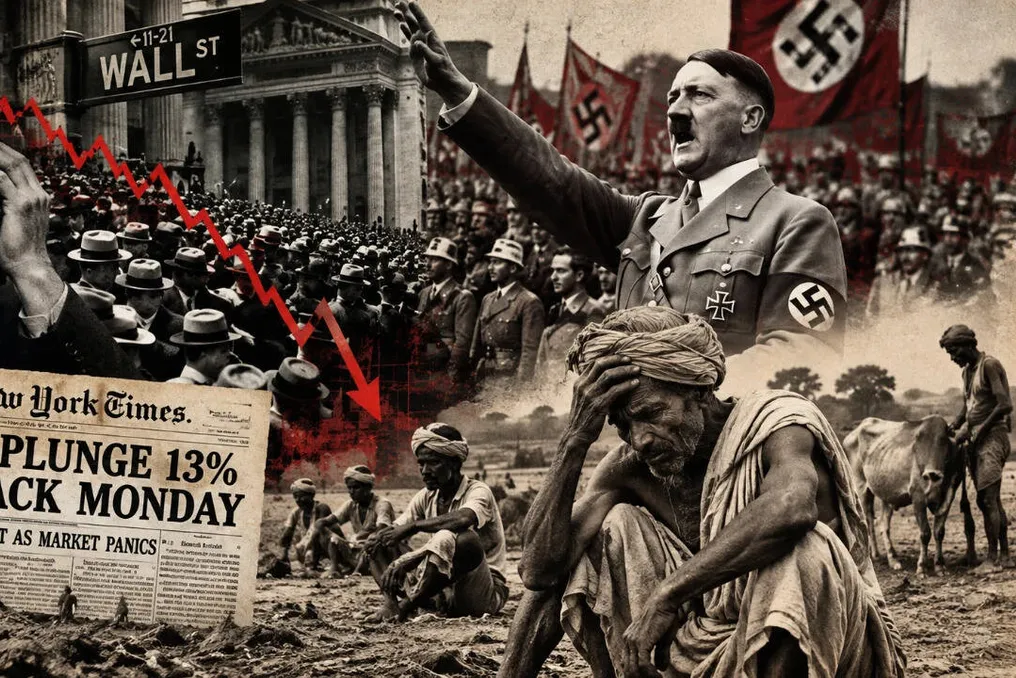
In October 1929, billions of dollars of capital vanished from the American stock market, triggering an economic catastrophe that spread far beyond Wall Street. The market, built on expectations of continuous stock growth due to speculative buying and easy credit, collapsed when investor confidence disappeared. The Dow Jones Industrial Average fell by almost 13 percent on October 28, and another 12 percent the next day, marking Black Monday and Black Tuesday.
However, the crash was only the beginning. Bankruptcies, reduced demand, and business closures worsened the downturn in America, while the withdrawal of American loans, the decline in international trade, and restrictions on the gold standard transmitted the crisis to other territories. This resulted in the Great Depression—a global calamity that contributed to the rise of Adolf Hitler in Germany, led to the ruin of farmers in colonial India, caused mass unemployment among the British, and exposed the fragility of the world economy.
What followed was not merely a financial collapse, but a decade of economic hardship and political upheaval that changed the course of the twentieth century.
The Great Depression struck Germany at a time when its economy was already vulnerable, transforming the global financial crisis into a national disaster. The country was still grappling with the aftermath of World War I, including reparations, political instability, and the devastating hyperinflation of 1923. Recovery in the second half of the 1920s heavily depended on foreign credit, particularly loans from the United States.
Thanks to the Dawes Plan of 1924, American financing helped stabilize German finances and support economic recovery. However, this dependence became a serious weakness after the Wall Street crash in October 1929. When American banks and investors came under pressure, new lending ceased, and foreign creditors began recalling short-term loans. German banks and businesses faced difficulties obtaining credit, investments declined, and companies began cutting production and jobs.
The consequences were severe: industrial production shrank, businesses went bankrupt, and unemployment rose sharply. By 1932, about 5.6 million Germans were registered as unemployed, and industrial production had fallen by approximately 40 percent compared to 1928 levels. The crisis also paralyzed political decision-making. Chancellor Hermann Müller's coalition government collapsed in March 1930 over disagreements regarding unemployment insurance, paving the way for increasingly unstable governments relying on presidential emergency powers.
This economic despair created favorable conditions for Adolf Hitler and the NSDAP. They portrayed the Weimar Republic as weak and incapable of protecting ordinary Germans, promising jobs, national revival, and decisive leadership. Their message resonated with segments of the middle class, struggling farmers, small entrepreneurs, and workers disillusioned with the political system.
The shift in the electoral landscape was dramatic. According to the US Holocaust Memorial Museum, the Nazis received only 2.6 percent of the vote in the 1928 parliamentary elections. Their share grew to 18 percent in September 1930 and reached 37 percent in July 1932, making them the largest party in the Reichstag. Nazi propaganda deliberately exploited these hardships. A 1932 election poster preserved by the US Holocaust Memorial Museum bore the slogan 'Our last hope is Hitler,' presenting the Nazi leader as the answer to national despair. The party used mass rallies, newspapers, posters, and speeches to promise economic recovery and political order. Simultaneously, it disseminated antisemitic conspiracy theories, blaming Jews and communists for Germany's problems, and attacked democratic institutions.
Hitler did not win an absolute majority in free national elections. On January 30, 1933, President Paul von Hindenburg appointed him Chancellor after negotiations with conservative political leaders who believed they could control him. Subsequently, the Nazis dismantled democracy and established a dictatorship. Although the Great Depression itself was not the cause of Hitler's rise, the collapse of American lending, mass unemployment, and the inability of German political leadership to restore confidence created conditions that the Nazis exploited with devastating consequences.
In India, under British rule, the Great Depression transformed the global economic crisis into an agrarian emergency, exposing the financial vulnerability of millions of farmers and deepening discontent with colonial rule. As international demand weakened and agricultural prices fell, farmers received less for their crops but continued to face debts, rent, and land tax obligations. For many, the crisis meant selling produce at a loss, struggling to repay moneylenders, and risking land forfeiture.
A 2022 study by historian Alok Oka, published in Studies in Indian Politics, documents the scale of this collapse. The agricultural price index in India fell from 203 in 1929 to 127 in 1931, using 1873 as the base year. The raw cotton price index for the same period dropped from 133 to 70. This decline was particularly damaging to farmers dependent on cash crops for daily needs, rent, and taxes.
The crisis was exacerbated by the structure of the colonial economy. According to Oka, the British government refused to devalue the rupee due to concerns about meeting its external financial obligations. Meanwhile, British exports to India fell from 90.6 million pounds sterling in 1924 to 52.9 million pounds sterling in 1930, representing a drop of approximately 41 percent. The reduction in trade and agricultural prices squeezed rural incomes and weakened economic activity.
Time was crucial for the Indian independence movement. At its Lahore session in December 1929, the Indian National Congress declared the goal of Purna Swaraj, or complete self-rule. On January 26, 1930, the Congress celebrated Independence Day, gaining momentum for a new phase of resistance. The Depression did not create the struggle against British rule, which had much deeper roots, but worsening economic conditions made issues of taxation, rural life, and control over India's economy more pressing.
Mahatma Gandhi launched the civil disobedience movement in 1930, starting with the Salt March from Sabarmati Ashram to Dandi. By challenging the British monopoly on salt and the tax on a basic necessity, Gandhi chose an issue affecting Indians of all social and economic strata. This campaign turned a daily grievance into an act of mass resistance and helped involve the nationalist movement in the lives of ordinary people.
Gandhi also called on Indians to boycott foreign goods, especially British cloth, and promoted Khadi and local production. These campaigns had both political and economic goals. Reducing dependence on imported goods could challenge British commercial interests while encouraging Indians to support local producers. While the global crisis exposed the vulnerability of export-dependent economies, the message of economic self-sufficiency gained added significance.
Research by Stanford University political scientists Rihila Bhavnani and Soumitra Jha also identified a link between economic shocks and nationalist mobilization. Their paper showed that regions producing export crops and affected by interwar trade shocks, including the Depression, were more likely to support the independence movement in the 1937 and 1946 elections. The researchers argue that these shocks helped unite agricultural exporters into a broader coalition demanding political change. The findings suggest that the political consequences of the Depression extended beyond immediate protests and influenced support for nationalism in subsequent years.
The crisis also reinforced Gandhi's emphasis on village industries and economic self-sufficiency. He argued that political freedom would be meaningless if rural India remained trapped in poverty and dependence on external markets. Gandhi promoted Khadi and cottage industries as ways to create jobs, strengthen the rural economy, and reduce import dependence. In 1934, the All India Handicrafts Association was established to promote these broader efforts. Historian Alok Oka argues that the Depression and constraints of colonial economic policy helped solidify Gandhi's focus on rural production and economic autonomy.
Britain entered the Great Depression with traditional industries already struggling to compete in international markets. Coal mining, shipbuilding, iron production, and textiles faced declining demand and increasing competition, making industrial communities vulnerable when the 1929 Wall Street crash further restricted global trade. As exports weakened and company production shrank, unemployment rose. According to the UK National Archives, the number of unemployed reached nearly 3.5 million by 1932, with the North East of England, the industrial lowlands of Scotland, and the mining valleys of Wales being the hardest hit regions. Families faced prolonged hardship, and the government's introduction of a means test in 1931 intensified discontent among those applying for unemployment benefits.
The crisis also revealed the limits of British monetary policy. The country returned to the gold standard in 1925, pegging the pound sterling to a fixed gold value. As economic activity contracted, deflation deepened and unemployment rose; the government faced growing pressure to defend the pound while simultaneously supporting the domestic economy. The situation became critical in 1931 when investors withdrew funds from London, and the Bank of England lost gold reserves. A National Archives record of a government statement in September 1931 states that more than 200 million pounds sterling were withdrawn from the London market since mid-July. The next day, Britain suspended the gold standard.
The political consequences were immediate. The Labour government led by Ramsay MacDonald split over how to address the financial crisis and public spending. MacDonald subsequently formed a National Government supported by conservatives and liberals, while the Labour Party suffered a major defeat in the October 1931 elections. Abandoning the gold standard ultimately gave Britain greater freedom to lower interest rates and allowed the pound sterling to depreciate, which helped exporters and supported early stages of recovery. Research by economists Jason Lennard and Meredith M Baker showed that abandoning the gold standard reduced unemployment by 2.7 percentage points in export-oriented industries compared to less export-dependent industries.
Nevertheless, the recovery was uneven. Traditional industrial regions continued to struggle, and hunger marches brought the plight of unemployed workers into the public eye. Britain's experience demonstrated how the Great Depression could undermine established industries, destabilize governments, and force a major economic power to abandon the monetary system it once deemed necessary for financial stability.
From Wall Street to the World
The Great Depression proved that an economic crisis does not stop at national borders. The stock market crash in America contributed to the rise of Hitler in Germany, exacerbated the suffering of farmers in colonial India, put millions of Britons out of work, and devastated economies worldwide. The damage extended far beyond job losses, bankruptcies, and falling crop prices.