Casap raised $56 million to help banks combat AI-driven customer fraud
Read more
Ventureburn
ventureburn.com

Casap raised $56 million to help banks combat AI-driven customer fraud

Banks are facing a growing number of fraud cases originating from their own customers rather than hackers. In response, the New York-based startup Casap has raised $56 million to support banks in countering this issue. The company closed a re-priced Series B round on Wednesday, led by Base10 Partners.

Strategic investors included Experian and Synchrony, while Emergence Capital and Lightspeed Venture Partners participated in the follow-on round. This new capital brings Casap's total funding to $90 million.

First-party fraud, often called friendly fraud, is straightforward: an individual makes a purchase and then disputes the transaction, claiming they did not make it. While this can sometimes be an accidental error, it is more often not.

The figures demonstrate a rapid rise in the problem. According to a survey by Casap and Cornerstone Advisors, first-party fraud accounted for 36% of all reported fraud cases in 2024, up from 15% the previous year. Investor Primary estimates annual losses at over $100 billion.

Banks express serious concern. Two-thirds of surveyed institutions expect further growth in fraud losses by 2026. Moreover, nearly half of them do not know how many false claims their tools actually detect.

Ron Shevlin from Cornerstone noted a worrying fact: more than a third of Americans claim to have committed first-party fraud or know someone who has.

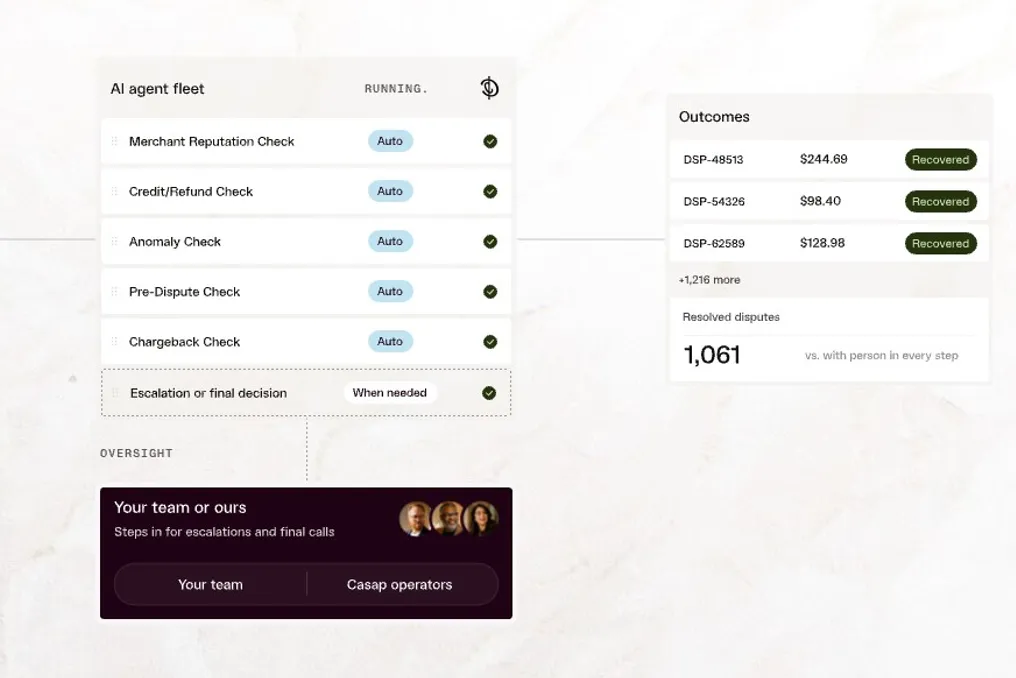
The dispute resolution process is slow and costly. A single case can take up an employee's time for 45 minutes and stretch over 90 days. Casap aims to change this situation using its AI agents, which manage the dispute from start to finish.

These agents handle application intake, investigation, decision-making, evidence collection, refunds, and customer communication. The agents adhere to each bank's specific rules, and cases requiring human judgment are escalated to a person.

The results, according to Casap, are hard to ignore. Clients report a reduction in first-party fraud losses by 51%. Dispute resolution time is cut from a potential 90 days to just eight days. Furthermore, about 73% of cases are resolved automatically, and human processing time is reduced to one or two minutes. Chargeback rates have also improved: Casap reports a 96% success rate compared to the industry average of around 60%.

Casap was founded by CEO Shanti Shanmugam and co-founder Cissy Peters. Shanmugam previously worked at Robinhood, and Peters worked at Chime. They first met on Facebook and started building Casap in their spare time.

Since then, the company has grown rapidly. About a year ago, Casap raised $25 million in a Series A round. Since then, revenue has grown tenfold, exceeding the initial goal by more than double. Casap now serves over 100 banks, credit unions, fintech companies, and processors.

Experian plans to study consumer intent signals and first-party fraud jointly with Casap. Synchrony is using the technology to support the transition of its customer service. Kelly Shaw of Synchrony Ventures stated that Casap helps resolve disputes faster and stop first-party fraud.

Banks face a difficult choice: tighten dispute controls and annoy honest customers, or be lenient, allowing fraudsters to get paid. Adeemi Ajao, Managing Partner at Base10, believes Casap is breaking this dilemma.

Casap has demonstrated that AI agent technology can change this trade-off. This is why this round is important. Casap is now moving beyond just disputes to cover fraud, collections, claims, and complex exceptions—some of the most expensive tasks in finance.

For clients, this could mean faster refunds in case of a genuine error. For banks, it means lower losses, and for fraudsters, it means the possible end of free opportunities.

Similar stories

Startup Mave raises $34 million to expand AI-powered cybersecurity platform
Read more
ventureburn.com

Startup Mave raises $34 million to expand AI-powered cybersecurity platform

The Israeli cybersecurity startup announced the successful raising of $34 million in funding. This round was a Series A of $28 million, led by the fund Red Dot Capital Partners. Representatives from Lumir Growth Partners also participated in the investment.

The company plans for its solutions to enable security teams to respond faster as cyber threats become more complex. Previously, Mave had raised $6 million in seed funding from Dell Technologies Capital and Emerge Ventures.

The funds will be directed towards developing products for the corporate sector and conducting artificial intelligence research, as well as implementing expansion plans. Mave's AI-based tools are designed to reduce the time analysts spend gathering evidence and analyzing alerts.

Mave was founded in 2025 by CEO Raziel Oren and CTO Guy Eshel, who co-founded the company. Both founders previously served in Israel's intelligence unit 'Unit 8200', providing the company with deep expertise in corporate security operations.

Large organizations often use dozens of different security tools. Incident information can be scattered across identity systems, endpoints, and cloud environments. Analysts have to consolidate these disparate data sources before making decisions on further actions.

Traditional Security Information and Event Management (SIEM) systems provide a unified view of collected data, but they may not contain all the necessary information to understand an active incident. This forces analysts to manually check threats across multiple platforms.

Mave's AI agents integrate directly with existing security systems. They query data from each tool, collect relevant information, and consolidate the results within a single investigation. The platform is also designed to filter false positives and detect activity related to potential attacks.

The system is capable of executing approved response actions according to rules set by security teams. These actions can include isolating affected systems, disabling compromised accounts, and blocking malicious activity. Human oversight remains critical when approval or judgment is required.

According to Mave, its platform is already used by 50 companies and global managed security service providers. These implementations help protect hundreds of clients, including organizations operating in regulated financial and medical sectors.

The company reports that its annual recurring revenue has grown by over 400% in the last year and is closing seven-figure deals. These metrics attract commercial attention, even though the absolute revenue volume is not disclosed.

The fundraising comes amid a growing number of AI-driven attacks against organizations. AI-based cyberattacks can develop significantly faster than security teams can conduct manual investigations. Mave believes that agentic systems will help organizations cope with this increasing volume of threats.

The new funding will be used to develop the research platform and strengthen the enterprise platform, as well as for international scaling, as interest in automated security operations continues to grow. The company currently has about 30 employees and plans to double its staff over the next three years, adding specialists in go-to-market and AI research.

The Israeli development center of the company will play a key role in this growth. Like other firms creating AI-based security devices, Mave operates in a competitive environment. The success of Mave's enterprise segment depends on the reliability of investigations, openness of choice, and restraint in response measures.

Popular