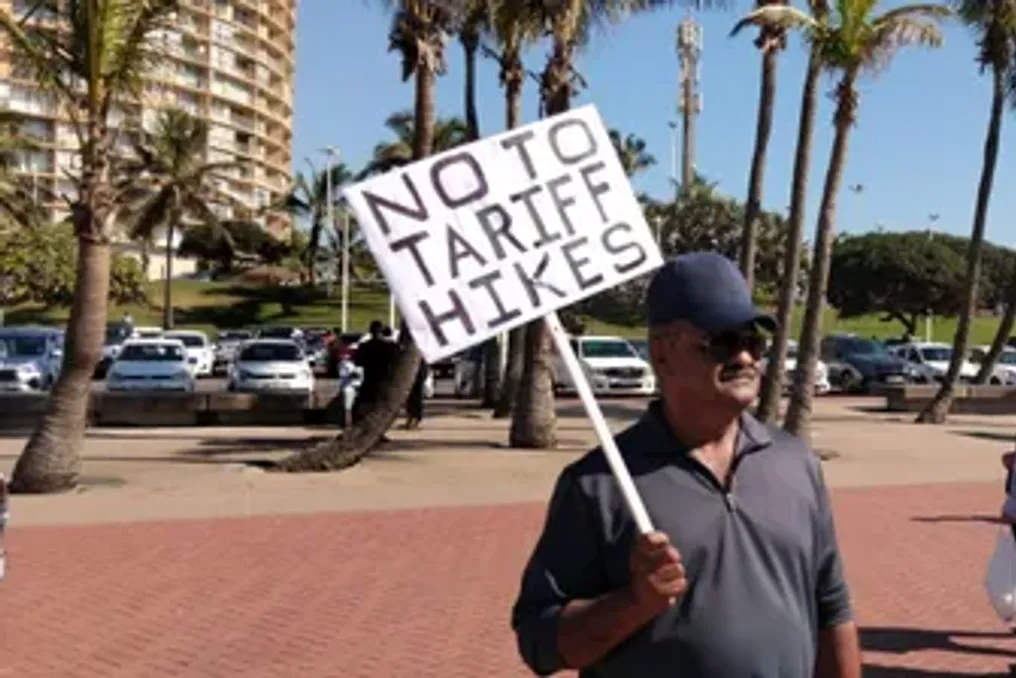
Environmental alliance plans protest at Eskom offices against electricity tariff hike
Read more
IOL
iol.co.za

Environmental alliance plans protest at Eskom offices against electricity tariff hike

The South Durban Community Environmental Alliance (SDCEA) announced that residents will hold a picket outside Eskom's offices in Westville to protest the increase in electricity tariffs, which they believe will exacerbate financial pressure on low-income households.

According to IOL, SDCEA projects officer Tristan Meek stated that residents from across South Durban will gather to express firm opposition to the electricity tariff increase proposed by Eskom to the National Energy Regulator of South Africa (NERSA).

Meek emphasized that this will be a peaceful, legal, and community-organized picket, not a strike or any disruption of order. He stated that this is a direct appeal from affected residents to NERSA: the proposed increase must be rejected.

Working Class Hardships

Meek noted that the proposed tariff increase comes at a time when households in Durban are already on the brink of financial exhaustion. He explained that NERSA has already approved an 8.76% increase by Eskom for the 2026/2027 financial year, effective April 1, 2026. According to Meek, the current application to NERSA threatens to place an additional burden on the communities least able to afford it.

He added that for a working household in South Durban, such an increase means additional costs of nearly 500 rand per month, assuming the previous electricity bill was 1000 rand. Combined with rising prices for food, transport, and water tariffs, these increases are pushing families to their limit. Meek stressed that electricity is a basic necessity, not a luxury, but the heaviest burden falls on the poor.

Energy Minister's Comments on Tariffs

Minister of Energy and Electricity Kgosiyenso Ramokgopa stated that the average Eskom tariff increase of 9.01% applies to municipal bulk buyers for the 2026/2027 financial year after NERSA determines the tariffs. Ramokgopa clarified that this increase relates to the cost of electricity supplied by Eskom to municipalities and does not necessarily result in an equivalent percentage increase on every household's bill.

SDCEA founder Desmond D'Sa stated that these increases significantly exceed the inflation rate and could push millions of households further into poverty. D'Sa noted that their communities are already struggling with high unemployment and the rising cost of living, and such a large-scale electricity price hike will make essential services even less accessible to low-income and marginalized households.

Demands for Rejection of Increase

SDCEA calls on NERSA to reject this approval, arguing that the regulator is obligated to protect consumers, not merely approve Eskom's revenue requests. The alliance puts forward several demands:

  • Introduction of a subsidized tariff for needy households, guaranteeing a significant provision of free basic electricity to those who need it most.
  • Complete rejection of the proposed increase, as it is unjustified and burdensome for already struggling consumers.
  • Decisive transition to decentralized renewable energy to reduce dependence on expensive coal generation and ensure long-term relief for ordinary South Africans.

Community members, religious leaders, and civil society allies will gather at 9 am in Westville. SDCEA represents 21 public and environmental organizations.
Similar stories

Eskom tariff hikes raise concerns among households and fishermen regarding energy affordability
Read more
iol.co.za

Eskom tariff hikes raise concerns among households and fishermen regarding energy affordability

Struggling households and small-scale fishermen have warned that the proposed Eskom electricity tariff increase could worsen financial difficulties, forcing families to choose between paying for electricity and other essential needs, while also jeopardizing already strained livelihoods.

These concerns were voiced during a virtual public hearing organized by the National Energy Regulator of South Africa (NERSA). At the hearings, political parties, civil society organizations, and community representatives opposed the proposed increases and demanded a more thorough review of Eskom's expenses.

The submitted comments addressed issues of affordability, regulatory oversight, and the capacity of consumers who are already battling unemployment and the rising cost of living to absorb further increases.

The organization 'The Green Connection,' which focuses on environmental justice and works with coastal communities and small-scale fishermen, warned that another significant increase in the burden would add pressure to households that are struggling to make ends meet. Its advocacy leader, Liza Makawula, noted that the proposed 8.83% rise for 2027/28 is particularly worrying following the approved 8.76% increase for 2026/27.

Makawula stated: 'For many South Africans, electricity is more than just a monthly expense; it is a matter of dignity. Families are forced to choose between electricity and meeting other basic needs, while unemployment and economic pressure continue to undermine household security.' She also called on NERSA to broaden public participation, arguing that one day of hearings is insufficient to make a decision affecting millions of people.

For fishing communities, the impact is felt both at home and at sea. Ernest Titus, a small-scale fisherman from Lambert's Bay on the West Coast, reported that rising costs for electricity, fuel, food, and school are squeezing incomes that are already insufficient to meet household needs.

He emphasized: 'Fishing is what we have known and relied on for generations. At the same time, our income must cover rising costs for electricity, food, and school. We are facing financial pressure from all sides, and our monthly income is simply not enough to cover these growing demands.' In Port Nolloth, Gina Orlam said that rising costs are placing immense pressure on families, while incomes are not keeping pace with this growth.

She questioned: 'Costs keep rising, but wages and incomes do not keep up. What about households without income or young people who want to work but cannot find opportunities?' Chanel Jaar, a young activist from Port Nolloth, reported that fishermen from Port Nolloth, Khondeklipbay, and Doringbay can spend over 2500 South African Rand on fuel for a single trip, and low catches mean they are operating at a loss.

Jaar added: 'Although the government promotes greener energy, communities are not seeing the benefits, and free basic electricity offers little relief as tariffs continue to rise. We ask how households and fishing communities are supposed to survive under such pressure.'

In Botshabelo, Free State, Moketsi Diba, representing the community organizations Green Futures and Environmental Justice Network, strongly urged the government to prioritize affordable energy and assist communities in generating their own power using solar technology.

'The Green Connection' spokesperson, Neville van Rooi, stated that affordability must be accompanied by greater transparency and regulatory control. He noted: 'NERSA must verify whether the costs presented by Eskom and other power suppliers are reasonable, justified, and necessary. Consumers must be able to understand the basis of the proposed increase, rather than bearing the financial consequences without adequate regulatory oversight.'

Van Rooi also called for communities to be properly informed about energy market reforms, including the wholesale electricity market and the unbundling of Eskom, before further increases are implemented.

Organizations and political parties at the hearings, including Better Governance Initiative (BGI), City of Cape Town, South Durban Community Environmental Alliance, and ActionSA, expressed concern over affordability, warning that further increases could exacerbate financial hardship and disproportionately burden low-income households. AfriForum cautioned that higher fixed charges could push consumers towards alternative energy sources, while NERSA stressed that its decision must comply with existing laws and policies.

Eskom defended the proposed changes, stating that the reduction in energy rates per unit compensates for adjustments to fixed service charges.

Along the Wild Coast, rising costs are compounded by environmental issues. Ntsinndiso Nongkavu, acting chairman of the Kakavu Fishermen's Cooperative in Port St Johns, said that high fuel prices make it difficult for fishermen to transport their catch at their own expense, and rising electricity costs increase operational expenses.

Nongkavu also expressed concern about the dumping of fish carcasses and the creation of unbearable odors, noting that communities were instructed not to consume the fish, but responsible departments failed to remove the carcasses. He stated: 'As livelihoods are under pressure and the cost of living rises, coastal communities feel abandoned.'

Nongkavu also questioned why fishermen affected by natural disasters do not receive the same assistance available to agricultural farmers.

Popular