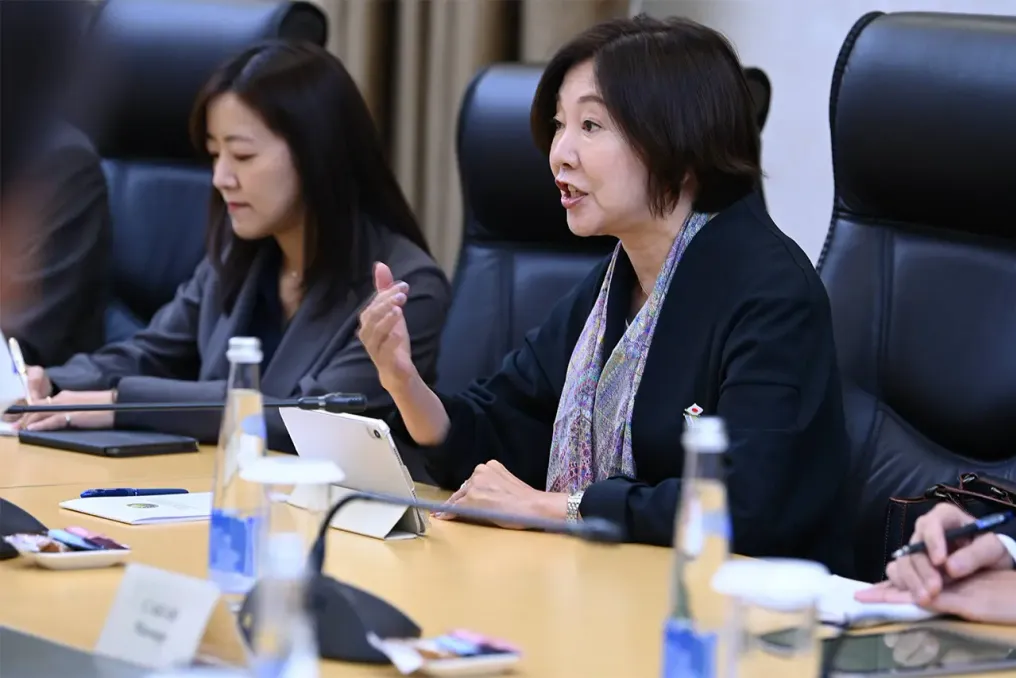
Katsura Miyazaki, Senior Vice President of the Japan International Cooperation Agency (JICA), visited Uzbekistan to mark the 25th anniversary of the Uzbekistan-Japan Center (UJC). During her visit, she met with government officials in Tashkent and regional leaders in Samarkand, Fergana, and Kokand, and participated in the opening of a new UJC branch in Kokand.
In an interview with UzDaily.uz, Miyazaki discussed the outcomes of her trip, the Center's plans, and JICA's projects in various regions, including the 'One Village – One Product' initiative and dried pomegranate production in Samarkand. She also outlined JICA's priorities in Uzbekistan for the coming years.
The main goals of the visit were to celebrate the 25th anniversary of the Uzbekistan-Japan Center (UJC) and discuss current projects, as well as opportunities for future cooperation with Uzbek partners. Over the past 25 years, UJC has contributed to strengthening ties between Uzbekistan and Japan through business education, Japanese language training, and cultural exchange. This visit held personal significance for her as it was her second trip to Uzbekistan and her first in 25 years, coinciding with the UJC's jubilee.
Returning after a quarter century, she noted significant changes in the country. Uzbekistan is currently demonstrating annual economic growth of 6–7%, and she senses energy and vitality in the air. This feeling of optimism reminds her of Japan's period of rapid economic growth. At the same time, she emphasized that Uzbekistan will follow its own unique path in the global context, different from Japan's experience, and expressed hope that JICA can serve as a reliable partner in the country's sustainable and inclusive development.
The visit provided a valuable opportunity to see how Japan-Uzbekistan cooperation brings tangible benefits and how people benefit from this interaction. One of the most memorable moments was meeting graduates, entrepreneurs, and partners of UJC. These contacts allowed for a better understanding of the long-term impact that education, knowledge exchange, and intercultural exchange can have on individuals and communities.
Another highlight was attending the opening ceremony of the new UJC branch in Kokand. The expansion of UJC's activities into the Fergana Valley demonstrates the importance of bringing professional and educational development opportunities closer to local residents. She was inspired by the strong desire of local leaders to invest in the next generation.
A common takeaway from all visited sites was the importance of human resource development. These visits showed that sustainable development is supported not only by infrastructure and strong institutions but also by people who possess the skills, knowledge, and motivation to contribute to the future of their community and country.
She had the opportunity to meet and exchange views with a wide range of prominent leaders. The discussions deepened her understanding of Uzbekistan's development priorities and laid a solid foundation for further bilateral cooperation. In Tashkent, she held productive talks with the Minister of Investment, Industry, and Trade and the Deputy Minister of Economy and Finance. During these meetings, it was confirmed that JICA will focus its financial cooperation in the medium term on economic infrastructure, promoting private investment, healthcare, and higher education.
Furthermore, she discussed the Center's achievements and future trajectory with UJC co-directors. In Samarkand, she met with the Governor of Samarkand Region, and also discussed issues with the Governor of Fergana Region and the Mayor of Kokand city. These meetings and site inspections confirmed the country's potential for regional development.
The visit also highlighted an important aspect of JICA's cooperation in gender equality. JICA strives to integrate gender equality perspectives into all its projects and programs and works closely with the Government of Uzbekistan to promote this approach. She expressed satisfaction with the progress in this area: thanks to the firm commitment of the Government of Uzbekistan, women now account for about 47% of participants in JICA training programs, which is a significant improvement compared to previous years. She also managed to speak with female entrepreneurs and UJC graduates whose stories and aspirations gave her a strong sense of the progress in women's empowerment in Uzbekistan.
Over the past 25 years, UJC has become an important platform for business education, Japanese language learning, cultural exchange, and networking. More than 2600 people have graduated from its Professional Management Program, where they studied Japanese management practices. A notable example is Safia Café & Bakery, whose management studied Japanese management and Kaizen at UJC, and whose business has since grown to approximately 3500 employees and over 100 shops and cafes. Beyond such individual success stories, she believes UJC's greatest achievement is the network it has created among businessmen, professionals, and communities in both countries. These relationships form an important basis for future Uzbekistan-Japan cooperation.
The key strength of Japanese management lies in the emphasis on continuous improvement, practical problem-solving, quality, teamwork, and people development. These approaches are particularly relevant as Uzbek companies grow and increase their competitiveness. Today, the most sought-after skills include leadership, strategic management, problem-solving, personnel development, and the ability to build partnerships. This is also reflected in the Center's new MIRAI KAIZEN Executive Program.
The Fergana Valley is one of Uzbekistan's most dynamic regions, possessing a large youth population and significant economic potential. JICA has long supported the development of the Fergana Valley in areas such as agriculture, regional development, and human resource development, making the creation of a new platform for training and capacity building there particularly significant. The Kokand branch will initially focus on Japanese language training, providing young people in the region with opportunities to study Japanese and explore new prospects for their future. There is hope that its activities will expand to include business education, fostering the development of future business leaders, managers, and skilled specialists in the region.
Over the next 5–10 years, she hopes that UJC will continue to develop as a platform connecting Uzbekistan and Japan through business, education, and people exchange. They aim to strengthen business and management programs, expand regional activities, and create more opportunities for cooperation between Uzbek and Japanese companies. JICA will continue to support these efforts.
The technical project implemented jointly with Agrostar, the 'Project to promote the