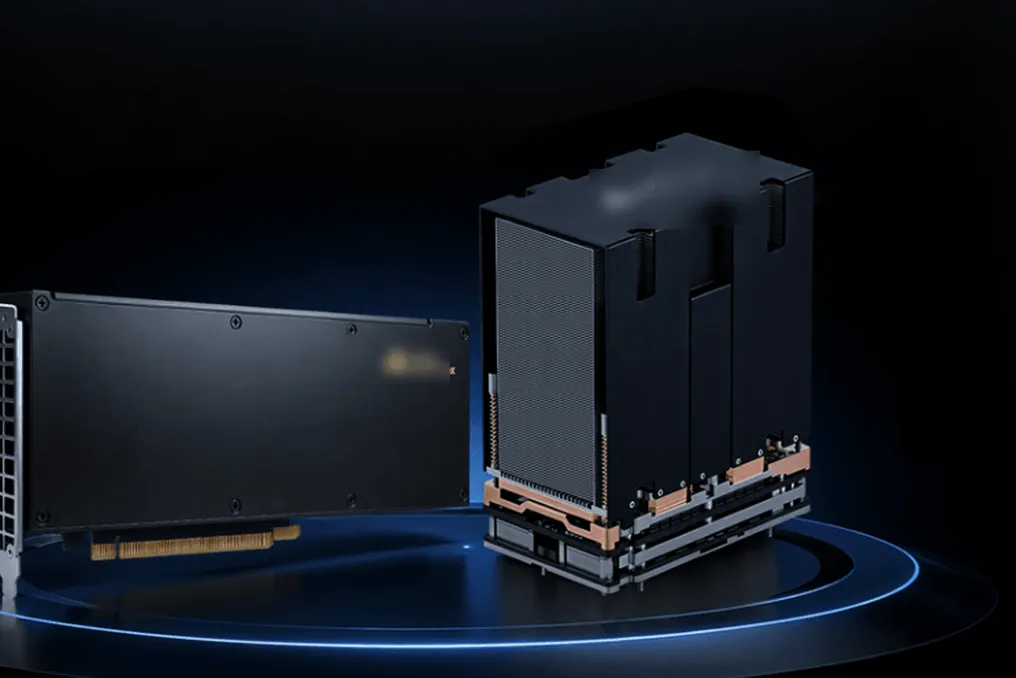
Iluvatar CoreX unveiled the general-purpose Tiangai 300 GPU in a working state on real hardware during its media day on October 28th in Shanghai. Previously, the company's public materials regarding the chip focused solely on architecture and roadmap, not on functioning systems.
The main claim concerns performance comparison. Iluvatar CoreX asserts that Tiangai 300 is the first domestic general-purpose GPU whose measured performance reaches the level of NVIDIA H200. Furthermore, third-party testing, after data conversion, showed that the total throughput of one card is 1.05 times greater than that of H200. It is important to note that the company did not disclose the testing methodology, models used, or workload conditions, so this result cannot yet be independently verified.
This chip is intended for integration into the IXL144 supernode, which the company previously presented at the China International Industry Fair. One such IXL144 rack combines 144 GPUs, 18 CPUs, and approximately 10.1 TB of GPU memory, which Iluvatar CoreX calls the densest GPU supernode in the industry. According to its own estimates, this configuration reduces the cost per million effective tokens by 40% compared to mainstream international solutions.
Information on heterogeneous deployment was also presented at the open day. Iluvatar CoreX reported implementing the first domestic AFD disaggregation scheme between GPU and XPU, which reduced inference latency by 60%. AFD disaggregation typically involves splitting model computation stages, such as attention and forward propagation layers, across different processor types so that each performs the task it is most efficient at.
Regarding peripherals, the company stated that its Tongyang TY1200 chip outperforms NVIDIA Thor T5000 in conducted tests, again without publishing details. The TY1200, previously announced with 300 TOPS of dense computing for AI and embodied intelligence PCs, is also named the first domestic peripheral product capable of performing physics simulation with GPU acceleration based on MuJoCo-Warp—a function critical for training robots in simulation.
Overall, these demonstrations move Iluvatar CoreX's next-generation product line from paper specifications to working systems. The next point to watch will be independent benchmarks with disclosed workloads.