In June of this year, NASA released the composition of the team selected for the Artemis 3 mission. Scheduled for launch in 2027, this historic initiative aims to test crucial technologies in Earth orbit before making new advances toward the Moon.
The command of this operation will be exercised by Randy Bresnik, an experienced astronaut who participated in the STS-129 mission, where he received the news of his daughter's birth, in addition to being former commander of Expeditions 52 and 53 on the International Space Station (ISS).
The group also includes Andre Douglas and Frank Rubio, known for setting the American record for continuous time in orbit, totaling 371 days in space, serving as mission specialists. The pilot position will be occupied by Luca Parmitano, a representative of the European Space Agency (ESA), who was involved in one of the most serious incidents on the ISS.
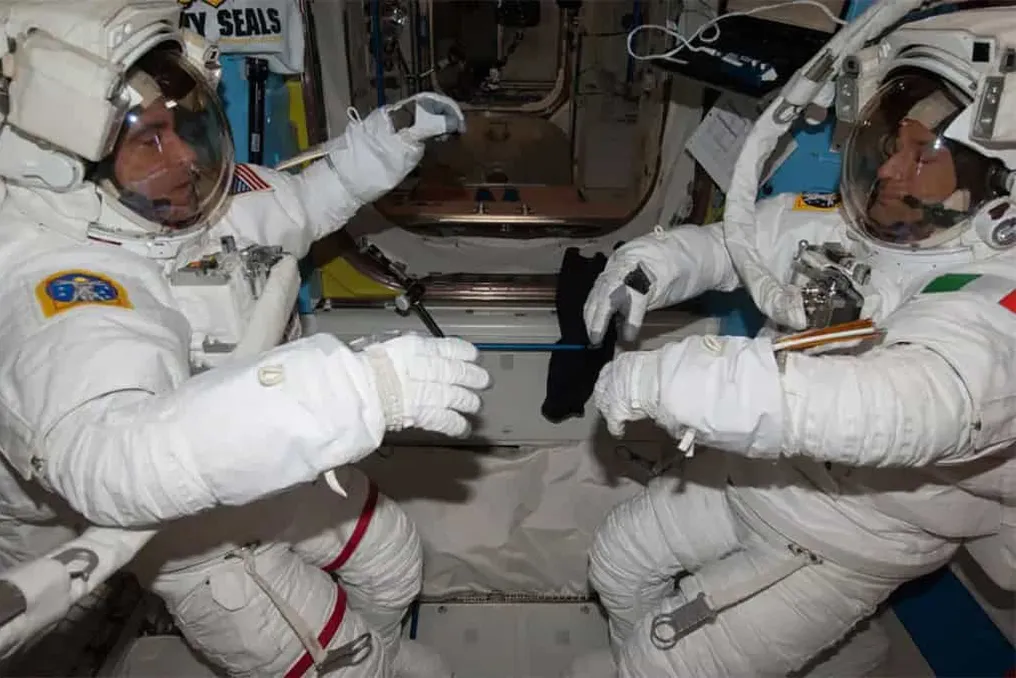
On July 16, 2013, Luca Parmitano faced a life-threatening risk during an extravehicular activity. According to NASA, a serious mechanical failure caused water from the cooling system to leak into his spacesuit. The astronaut reported that when the water reached his face, he was almost blinded, unable to hear or breathe.
In microgravity, the liquid floats without direction, covering eyes, nose, and mouth, which represents a real danger of orbital drowning at four hundred kilometers altitude.
The critical problem began a week earlier, on the 9th, during a previous spacewalk. On that occasion, the ground support team mistakenly concluded that the presence of liquid was solely from the portable hydration bag used by the crew members.
The true technical cause was an imperceptible contamination that clogged a vital internal filter of the cooling system. This unexpected blockage diverted the water flow, causing the coolant to leak directly into the helmet's air supply line.
After meticulous investigations, analysts determined that NASA should not have cleared the second spacewalk without completely resolving the initial failure. The official report of the incident established forty-nine strict recommendations to prevent the recurrence of similar errors.
Unlike original plans, the Artemis 3 mission will no longer include the final landing on the lunar surface. The main objective of the project is to conduct rigorous tests in low Earth orbit of all essential subsystems that will be used in Artemis 4, scheduled for 2028.
This milestone will represent the return of crewed landings focused on the South Pole area of the Moon. To achieve this goal, NASA's Space Launch System (SLS) rocket will carry the Orion crew capsule departing from the Kennedy Space Center in Florida.
Another challenging aspect of Artemis 3 will include advanced docking tests with the crewed lunar modules developed by Blue Origin and SpaceX, which will enable future landings on the lunar surface.
NASA describes this major operational journey as a series of launches. The plan covers integrated evaluations of hardware, sophisticated flight software, high-performance propulsion, and the communication channels between the Orion spacecraft and the landing modules.
To ensure the maximum safety of future crews, the agency has instituted new extremely rigorous protocols. Engineers now perform triple checks on all hydraulic components before any release into the hostile environment of outer space.
Technological improvements have also been applied to modern spacesuits, which now feature smart sensors capable of detecting minimal liquid leaks in real time. Thus, any abnormality in the cooling system is immediately detected by onboard systems and ground controllers.
With these enhanced protections, human exploration of the Moon gains an additional layer of technical and operational reliability. Humanity absorbed severe lessons from Parmitano's near-drowning, transforming a potentially fatal error into a lasting legacy of safety.