Rendezvous Robotics has successfully raised $20 million in a re-priced seed funding round. The leaders of this round were MaC Venture Capital and Toyota Ventures. The company officially announced the funding, and this round was its first priced round.
Participants in the round also included University of Michigan Endowment, Astera, and Industrious Ventures. Existing investors, including Aurelia Foundry, ATX Venture Partners, and Mana Ventures, also participated in the financing. Rendezvous Robotics, based in Golden, Colorado, develops spacecraft capable of self-assembly.
The capital raised will be used for developing next-generation spacecraft, conducting demonstration flights, and hiring additional staff. Instead, the company plans to send elements as small autonomous 'modules.' These modules will be able to reach the rendezvous point independently, assume the required position, and dock in orbit.
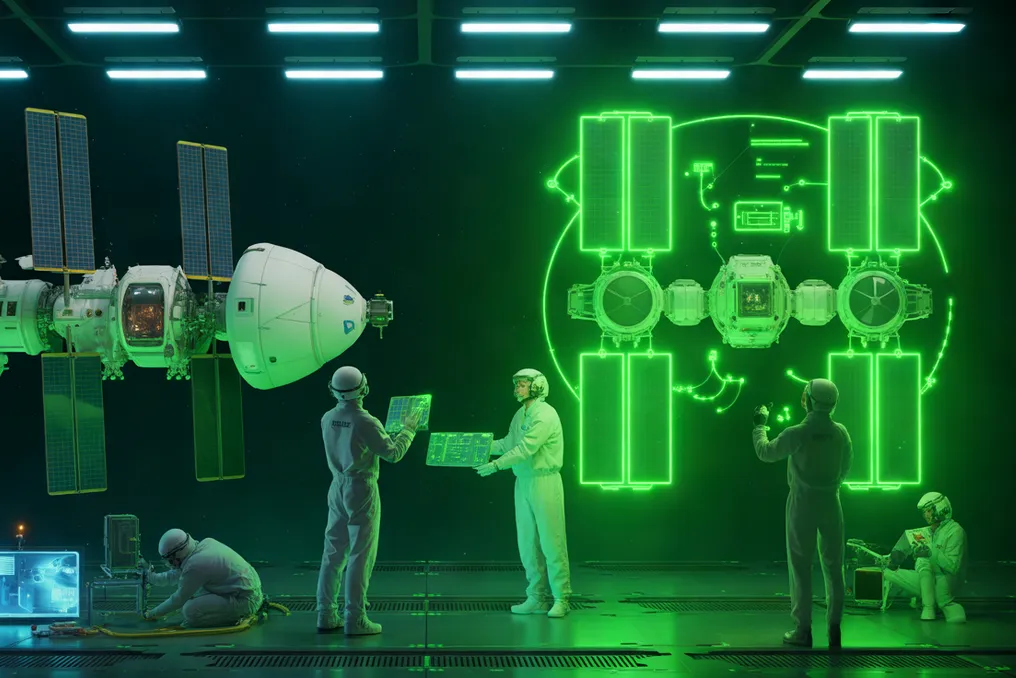
Rendezvous aims to create hexagonal tiles about one meter in size, equipped with sensors and onboard processing. The modules will use electromagnetic actuation to ensure movement and self-assembly. After connection, each tile can perform various functions.
Mission operators can add tiles for computing needs, solar energy collection, propulsion systems, communication, and thermal regulation, while having the ability to add or move them as needed. This design can also support future servicing operations. Operators can replace damaged modules or change the satellite's configuration after launch. This could potentially reduce the need to build and launch an entirely new spacecraft if components fail.
This technology is based on nearly ten years of research conducted under the TESSERAE project. The original self-assembly technology was developed by Dr. Ariel Ekblau at the Massachusetts Institute of Technology. The research was subsequently advanced through the Aurelia Institute, which Ekblau founded. Earlier versions of TESSERAE have already flown on a Blue Origin New Shepard rocket and participated in two missions to the International Space Station.
The company has scheduled a campaign of parabolic flights for November 2026. These tests will verify electromagnetic actuation and mobility in microgravity conditions. A separate TESSERAE demonstration is planned for the International Space Station in December 2026. It will involve assembling 32 tiles into a three-dimensional structure in a controlled environment. Rendezvous is also preparing a special low Earth orbit demonstration, scheduled no earlier than April 2028.
During this mission, seven independently deployed space tiles will autonomously connect to form one spacecraft. These modules will then separate and assemble into a different configuration. The goal of the demonstration is to prove that spacecraft can change their physical structure without the aid of external robotic equipment.
Co-founder and CEO Joe Landon believes that this technology can enable spacecraft with more powerful energy generation and larger communication systems. The architecture will ultimately allow for missions that are difficult due to the limitations of traditional launches. MaC Venture Capital and Toyota Ventures believe that robots, modular design, and autonomous control can be a successful combination. This strategy goes against conventional ideas about how to build and launch spacecraft.
The demonstrations have helped solidify the foundations of the technology in microgravity conditions. Toyota Ventures partner Chris Absher emphasized autonomy as a fundamental part of Rendezvous's design. Michael Palank, Managing Partner at MaC Venture Capital, also supported the company's efforts to rethink spacecraft construction. However, a free demonstration is still far off, although its realization should prove the system's ability to successfully and autonomously assemble and reconfigure in real orbit, which could open up new possibilities for building and servicing massive spacecraft.