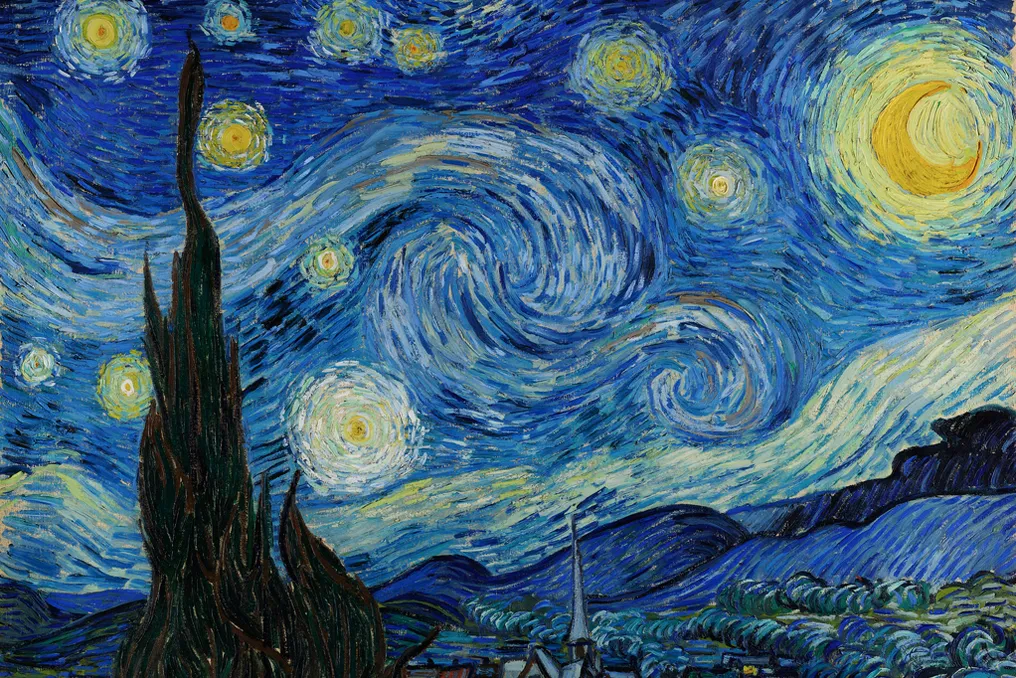
Astronomers investigated the mystery behind Vincent Van Gogh's painting 'The Starry Night,' seeking to determine whether it reflects the artist's imagination or is a faithful record of the sky he observed.
Van Gogh voluntarily committed to the Saint-Paul-de-Mausole psychiatric asylum in France in early May 1889, following a nervous breakdown that resulted in the self-mutilation of his left ear. It was during this period, looking out the window of his second-floor room, that he created one of his most famous works.
For over a century, specialists have debated whether the sky depicted in the painting is purely imaginary or corresponds to real observations. Astronomers attempted to use the stars in the canvas to pinpoint the exact time and location of its creation, but initial conclusions were varied.
Reports indicate that he began the work shortly before sunrise on a June night, based on the view from the location, and incorporated a village from his childhood in the Netherlands. Before painting, Van Gogh wrote to his brother Theo, mentioning: 'Observing the sky from the window before dawn, I noticed it was clear, nothing but a very large star, which could only be the Morning Star (Venus Planet)'.
Although this letter suggests inspiration from a specific observation, researchers acknowledge that the painting may be an extrapolation of the landscape. However, a recent study has brought new evidence regarding which constellation Van Gogh might be representing.
In an article published in Scientific Reports, researchers managed to identify the stars in the work as belonging to the V-shaped Hyades cluster, located in the constellation Taurus, as observed on July 22, 1889. This finding implies that Van Gogh's celebrated painting was produced at least a month later than speculated a hundred years ago.
A crucial factor found by the team lies in the shape of the Moon. During the historically linked period of the work's production, between June 18 and 19, the natural satellite should have appeared fuller than the thin crescent seen in the painting. In contrast, the lunar appearance on July 22, 1889, is more consistent with the image created by Van Gogh. On that same date, Venus and the Hyades appeared simultaneously in the eastern part of the sky.
Space researcher Elijah Jeong-hyun Kim, the author of the article, stated to Scientific American: 'In my opinion, the star cluster in The Starry Night was the Hyades, in the constellation Taurus. But previous studies associated it with Aries.'
For a long time, the constellation linked to the painting was Aries, situated near Venus in the sky, between Pisces to the west and Taurus to the east. Van Gogh's letter to his brother Theo, dated June 18, 1889, where he cites the Morning Star, reinforced this theory among scholars.
However, other documents from Van Gogh suggest that the work may have been executed in several sessions, with the stars being observed starting from late July. Researchers warn that Van Gogh's mention of a 'new study' of the sky does not mean the painting was finished on that date.
Additionally, Van Gogh's letters do not mention Aries, despite frequent references to observing Venus. Kim explains that 'the stars of Aries are relatively dim, they would hardly be enough to inspire a painter at dawn,' the time when Van Gogh usually observed the sky.
To identify the correct constellation, scientists employed a program called Procrustes. This software analyzes patterns based on the relative arrangement of a set of stars, ignoring characteristics that could be mere artistic embellishments, such as color or size.
This 'shape analysis' methodology allowed them to link five stars present in the painting to five stars of the Hyades cluster. This correspondence demonstrated the best statistical fit among all constellations tested, including Aries.