Apple has announced the release of a new version of the MacBook Pro, which is equipped with a touchscreen for the first time. Additionally, this line integrates PROLED XDR technology, M5 Pro and M5 Max processors, and the Dynamic Island feature in the macOS operating system.
In Brazil, the starting prices for the device range from 34,999 to 57,999 Brazilian reais. The computer is available in two sizes—14 and 16 inches—and is aimed at professionals involved in software development, design, photography, video editing, and artificial intelligence (AI).
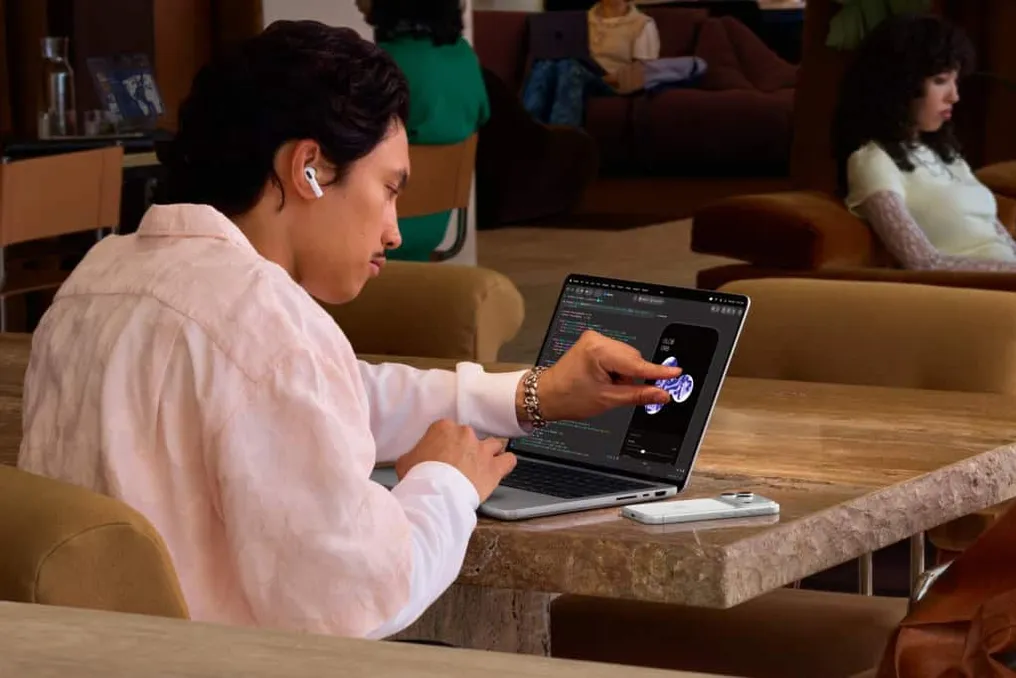
The main innovation is the ability to interact with the MacBook Pro screen through touch. For the first time, Apple allows users to control the Mac using gestures, such as pinching to zoom images or moving elements between windows, as well as scrolling pages.
This functionality is designed for professional use: designers can draw directly on the display, musicians can play digital instruments, and developers can test iOS and iPadOS applications directly on the laptop. The company emphasizes that the touchscreen is integrated into the display itself, not overlaid on it, which minimizes interaction latency. Furthermore, touch commands work in conjunction with the keyboard and trackpad, without replacing them.
The new device is compatible with applications such as Notion, Canva, Microsoft Word, Excel, and PowerPoint. Creative tools, including Adobe Lightroom, DaVinci Resolve, and Blender, are also included in the list.
The PROLED XDR screen utilizes dual-layer OLED technology, aimed at improving contrast, brightness, and image uniformity. According to Apple, the panel's peak brightness reaches two thousand nits in both HDR and SDR content. The panel also boasts a contrast ratio of 10,000,000:1 and an adaptive refresh rate of up to 120 Hz. The ProMotion technology allows the refresh rate to drop to 10 Hz to improve energy efficiency.
For professionals requiring high color accuracy, support for P3 and Adobe RGB color spaces is provided, along with coverage of over 80% of the Rec. 2020 space. Additionally, the laptop can feature a nano-textured glass option that reduces reflections in brightly lit areas, which is particularly useful for photographers, designers, and video specialists.
The new generation is equipped with powerful M5 Pro and M5 Max chips, which Apple positions as the most powerful processors for professional laptops. Configurations can include up to 128 GB of unified memory and 16 TB of storage. The company highlights the capability of these components to handle tasks such as code compilation, 8K ProRes video editing, 3D modeling, and running AI models directly on the device.
According to Apple's statement, the M5 Max chip is capable of locally running language models with hundreds of billions of parameters, enabling complex tasks without needing to access remote servers. Both chips also include accelerators for AI tasks and graphics resources to enhance performance in professional applications.
Another significant modification is the introduction of Dynamic Island. This feature combines the capabilities of Spotlight, Live Activities, and Siri AI in a dedicated area for quick information display and interaction. Users can use it for searching, tracking real-time updates, managing music, and interacting with Apple's voice assistant.
The laptop also comes with macOS 27, which includes Apple Intelligence features and enhancements for Siri. According to the manufacturer, Siri will be able to help find information in emails, messages, and photos, answer questions, and perform actions across different applications.
Apple guarantees up to 24 hours of battery life for the new MacBook Pro. The 14-inch model weighs 1.38 kg, while the 16-inch version weighs 1.82 kg. The screen diagonals are 14.2 and 16.3 inches, respectively. The thinner profile of the devices is attributed to the architecture of the new OLED screen, as well as a redesigned thermal management system to maintain chip performance.
In terms of connectivity, the device is equipped with three Thunderbolt 5 ports, HDMI, an SDXC card slot, MagSafe, and a headphone jack. It also supports Wi-Fi 7 and Bluetooth 6, and the M5 Pro version supports up to three external monitors, while the M5 Max supports up to four.
The audio system includes six speakers, providing 50% deeper bass compared to the previous generation, according to Apple. The 12 MP Center Stage camera and studio-quality microphones complete the set of features for calls and recording.
Pre-orders start on Thursday (28) on the Apple website and in the Apple Store app. Devices are expected to be available in stores and begin shipping on November 6. Apple has also offered special educational pricing, reducing the starting costs to 33,199, 39,499, 50,399, and 54,299 Brazilian reais.
In addition to hardware and software changes, the manufacturer stated that the new MacBook Pro uses 55% recycled materials in its composition, including aluminum in the casing and cobalt in the battery. This launch is part of the company's efforts to achieve carbon neutrality in its operations by 2030.