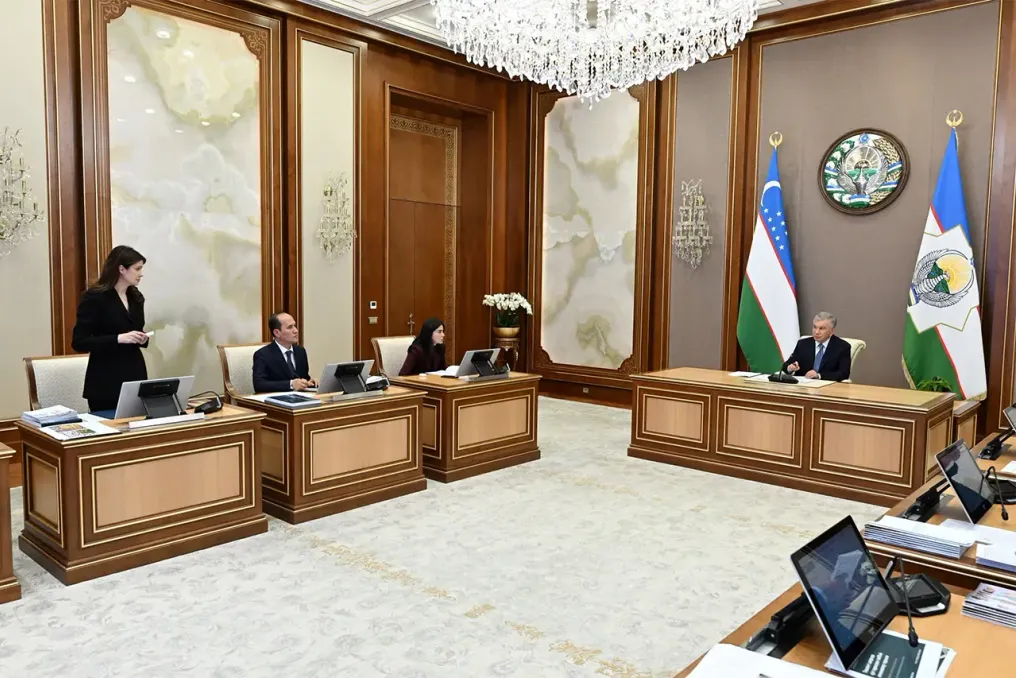
President of Uzbekistan Shavkat Mirziyoyev reviewed a presentation dedicated to attracting investment in the healthcare sector, expanding private sector participation, and establishing large medical institutions.
For this purpose, a portfolio of 35 investment projects has been formed, with a total value of $2.7 billion. These projects include the construction of specialized centers and multidisciplinary hospitals, equipping medical facilities with modern equipment, and training qualified personnel.
It is planned that the construction of new and the modernization of existing medical facilities will take into account the needs of the population. Their location, capacity, and range of services must meet demand. Therefore, the presentation considered ways to involve private companies in project implementation and introduce new methods of managing medical institutions.
Among the planned facilities are the National Oncology Center, the Republican Center for Neurology and Stroke, a multidisciplinary medical center for adults in Tashkent region, new hospitals in Kashkadarya region, and a maternal and child health center in Nukus. Additionally, medical education programs are planned for Termez.
As part of public-private partnerships, Uzbekistan intends to build an 800-bed hospital in Samarkand and create a multidisciplinary medical facility in Bukhara region. The presentation detailed the practical implementation of these initiatives.
Proposals for nine potential projects with a total value of $1 billion were also presented. They are aimed at developing infrastructure for treating neurological, psychological problems and addictions, pediatric oncology and hematology, improving emergency medical care, updating the ambulance fleet, and training medical workers.
To attract investments more systematically, the government proposes developing a healthcare development strategy until 2040 based on a master plan. The first stage will include analyzing current projects to assess their relevance and feasibility. Then, projects will be selected based on regional needs, investment profiles will be developed, and a unified portfolio will be formed.
This strategy is expected to define priority areas for cooperation with private investors, international financial institutions, and donors.
The presentation also addressed the topic of increased private sector involvement in medical and auxiliary services through outsourcing. According to a new procedure that will come into force next year, medical institutions will be able to procure such services from private organizations.
The proposed approach involves concluding long-term contracts with service providers, predetermining the volume and quality requirements of services, and assessing efficiency based on clear criteria. The government aims to increase the share of outsourced services in procurement to 30% by 2030.
To enhance transparency, the introduction of an electronic system called 'Medical Outsourcing' is planned. This system will maintain a unified register of services, suppliers, and contracts, track the volume and quality of provided services, and monitor payments. The system is expected to be integrated with state procurement systems.
Another priority is attracting professional managers to leadership positions in large medical institutions. Candidates will be selected through open competitions, and their performance will be evaluated annually based on key performance indicators. This approach is planned to be introduced in five large medical institutions by 2030.
After the presentation, Mirziyoyev instructed responsible officials to continue developing the investment strategy and projects based on the master plan, as well as to accelerate the implementation of already launched initiatives.