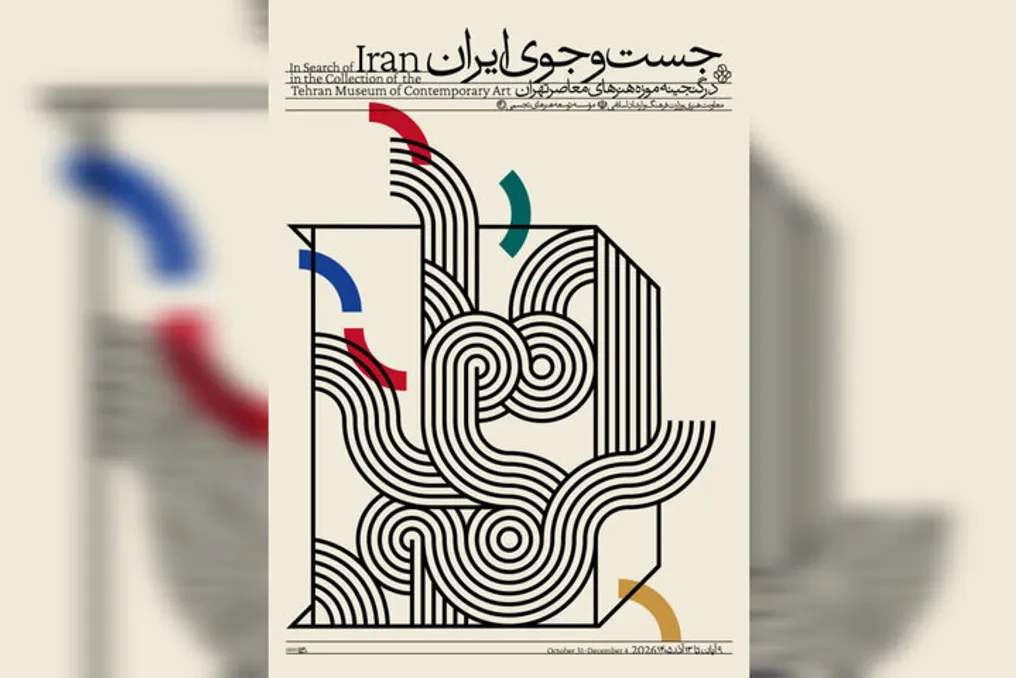
The Tehran Museum of Modern Art (TMoCA) will present an exhibition titled 'In Search of Iran: From the Collection of the Tehran Museum of Modern Art,' which opens on Saturday afternoon. According to Mehr, the exposition analyzes how the concept of 'Iran' is presented and understood through the lens of works by various artists held in TMoCA.
The exhibition touches upon the national significance of the TMoCA collection in the history of modern Iranian art, examining the diverse ways in which artists experience and interpret 'Iran.' A statement for the exhibition reads: 'We are not asking which work is more Iranian; rather, we are asking how Iran has served as an object of vision and representation, and how it persists in modes of seeing and creation. The exploration of Iranian identity in this exhibition begins with the unique experience of the artists—an experience that is sometimes explicitly the subject of the work, and sometimes manifests in the style of expression and construction. Belonging to Iran can be accompanied by memories of place, daily life, migration, or a sense of loss, taking various forms in each artist's work.'
'The 'In Search of Iran' exhibition invites the viewer to reconsider their own perception of Iran when encountering these works. In these pieces, the soil sometimes becomes the material of the work itself, writing transforms into a mode of seeing, and objects retain traces of life and human memory. The presence of familiar symbols does not predetermine the meaning of the work, just as their absence does not necessarily imply a detachment from the Iranian experience.'
The exposition is divided into seven sections, each curated around a specific question, offering the viewer parallel paths for interpreting the artworks. These paths do not follow the chronological sequence of art history; instead, visual and conceptual connections between the works allow for exposure to different interpretations. From this perspective, no single landscape, face, or motif serves as the sole representative of the Iranian experience.
More than one hundred pieces from the collection of modern Iranian art will be featured in the exhibition, including works by artists such as Sohrab Sepehri, Parviz Tanavoli, Parviz Kalantari, Hossein Zenderoudi, Farah Osuli, Reza Maafi, Mohammad Ehsaei, Bahman Mohasses, and others. The exhibition will be open to the public from Sunday until mid-December.
Founded in 1977, the museum houses over 4000 exhibits, including world-class Iranian, European, and American paintings, engravings, drawings, and sculptures from the 19th and 20th centuries. As the largest collection of Western art in the East, it encompasses works from almost all artistic periods and movements.
The museum was designed by Iranian architect Kamran Dibay, who incorporated elements of traditional Persian architecture. The building itself can be seen as an example of contemporary art in the style of the underground Guggenheim museum. Most of the museum grounds are underground, featuring a circular path descending below and galleries branching outwards. In the museum gardens, Western sculptures by artists such as Ernst, Giacometti, Magritte, and Moore can be found.