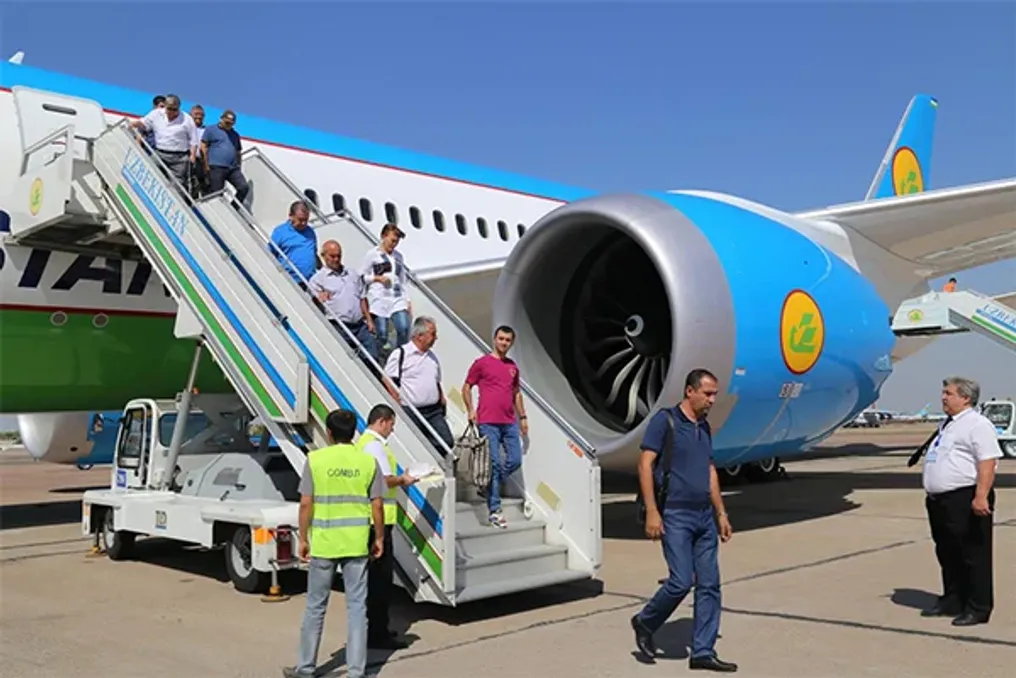
According to data from Airports Council International Europe (ACI EUROPE), passenger traffic at Uzbekistan's airports increased by 10.5% in August 2026 compared to the same month last year.
Uzbekistan has joined the group of countries outside the EU+ zone that demonstrated double-digit growth. Tashkent Airport showed a passenger traffic increase of 16.6%, ranking third in growth rates among major European airports serving between 10 and 25 million passengers annually. The fastest growth in this category was shown by Tirana (20.7%) and Tel Aviv (19.5%), while Ankara ranked fourth with a growth of 13.3%, and Venice reported 12.7%.
Overall, passenger traffic through major airports grew by 4.8%. ACI EUROPE attributes a significant part of this growth to the expansion of low-cost carriers' operations and, to a lesser extent, the emergence of new transatlantic routes.
Among non-EU+ countries, North Macedonia showed the largest growth with an increase of 34.8%, followed by Montenegro (28.6%), Albania (20.7%), Israel (19.5%), Armenia (14.2%), and Moldova (12.6%). Passenger traffic increased by 8.1% in Kazakhstan, 6.2% in Georgia, and 2.1% in Azerbaijan. Turkey, the largest market in this group, noted a growth of 4.4%, while Russia experienced the sharpest decline, losing 21.3% of passenger traffic.
Across the entire network of European airports, passenger traffic rose by 3.1% in August, an improvement compared to the 3.9% growth in July. This figure marked a significant acceleration compared to the second quarter, when growth was only 1.3% amid the war in the Middle East.
Airports outside the EU+ showed a 6% growth in August and 6.6% in July. In the EU+ market, passenger traffic increased by 2.5% in August and 3.4% in July, respectively. Within the EU+ market, Slovakia led the growth in August with a figure of 61%, followed by Slovenia (19.3%), Estonia (16.4%), Hungary (13%), and Malta (12.3%).
The least favorable results were recorded in Iceland, where passenger traffic decreased by 9.3%, as well as in Austria (-6%), France (-1.7%), Cyprus (-1.5%), Norway (-0.3%), and Germany (-0.2%). Among the largest markets, Italy showed the fastest growth at 5.2%, and Spain at 4.7%. Passenger traffic in the UK increased by 0.9%.
In August, Istanbul Airport became the busiest in Europe, handling 8.6 million passengers, which is 3% more than last year. London Heathrow took second place with 7.9 million passengers, although a decrease of 2.1% was recorded, while Paris Charles de Gaulle was third with 6.9 million, corresponding to a drop of 1.1%.
Olivier Jankovec, CEO of ACI EUROPE, noted that the growth in passenger traffic during the summer months indicates sustained demand for air travel despite ongoing geopolitical tensions, worsening macroeconomic conditions, supply constraints, and rising air ticket prices. He warned that the geopolitical energy shock is likely to put additional pressure on both demand and supply. Airlines are already reducing their capacity and increasing fares in response to the rising cost of aviation fuel.
Regarding cargo transport, the volume of air freight through European airports remained almost unchanged in July, showing a growth of 0.3%, before rising by 3% in August. The number of take-offs and landings increased by 2.7% in July and by 2.2% in August.