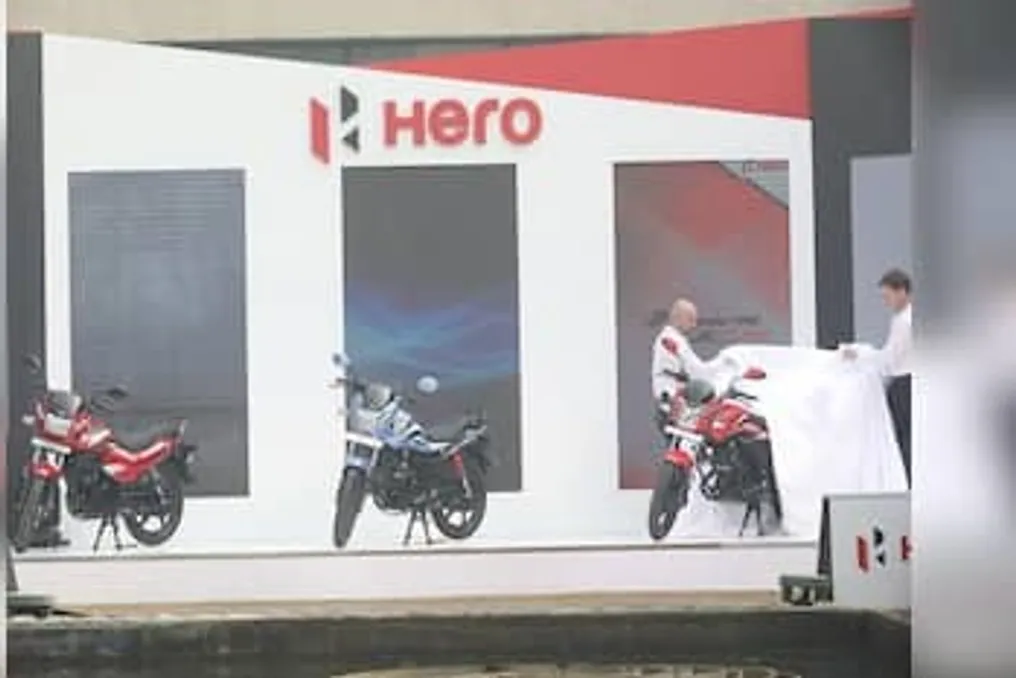
Hero MotoCorp's profit in the second quarter of fiscal year 2027 grew by 42% to 1,861 crore rupees
Read more
Business Standard
business-standard.com

Hero MotoCorp's profit in the second quarter of fiscal year 2027 grew by 42% to 1,861 crore rupees

Hero MotoCorp, India's largest two-wheeler manufacturer, announced on Wednesday a 42% increase in consolidated profit after tax compared to the previous year for the second quarter of the current fiscal year.

According to regulatory filings, the company's consolidated profit for this quarter amounted to 1,861 crore rupees, compared to 1,308 crore rupees the previous year. Meanwhile, operating revenue increased to 14,971 crore rupees, which is 23% higher than 12,218 crore rupees the year before.

The company noted that the results for the quarter and half-year include an increase of 397 crore rupees, obtained through the consolidation of equity capital of an affiliated company after its capital raising via qualified institutional placement and private placement.

Sales Dynamics and Market Achievements

High product shipments were the main driver of growth. Hero MotoCorp delivered a total of 18.68 lakh motorcycles and scooters, demonstrating a 10% year-on-year growth. The scooter segment was particularly strong, growing by 47% to reach 2.40 lakh units in the September quarter of fiscal year 2027.

Furthermore, sales of the electric scooter VIDA grew by 76% year-on-year, reaching 66,531 units in retail during the quarter. During the second quarter of fiscal year 2027, the company entered the German market, becoming its 54th global market, and also launched the XPulse 200 4V and XPulse 200 4V Pro models in Bangladesh.

Management Comments and Development Plans

CEO Harshvardhan Chitale stated that the company demonstrated strong results in this quarter, noting that scooters were a key growth factor, supported by healthy dynamics in both the ICE and VIDA electric vehicle portfolios. He also emphasized that the 100cc motorcycle segment continued to contribute to overall growth, indicating the resilience of the company's portfolio.

Harshvardhan Chitale added that the company's future focus will be on maintaining this positive momentum, stimulating profitable growth, and building a more diversified and future-ready business.

Investment Activities

Hero MotoCorp's affiliates include Hero FinCorp, Ather Energy, and Euler Motors. In July, Ather Energy raised 1,300 crore rupees through a qualified institutional placement as part of its 2,500 crore rupee capital infusion plan. Meanwhile, the company's board of directors approved an additional investment of up to 300 crore rupees in its wholly-owned subsidiary HMCL Netherlands BV, which can be executed in one or more tranches.

Hero MotoCorp reported that the proposed additional investments are intended for subsidiaries of HNBV, namely HMCL Colombia SAS and Hero MotoCorp Do Brasil Ltd.
Similar stories

IOB's profit grew by 56% to 1963 crore rupees in the second quarter due to improved asset quality
Read more
business-standard.com

IOB's profit grew by 56% to 1963 crore rupees in the second quarter due to improved asset quality

Indian Overseas Bank (IOB), based in Chennai, reported a 56% increase in net profit during the second quarter of the fiscal year 27, reaching 1963 crore rupees. This growth compared to 1259 crore rupees in the quarter from July to September of fiscal year 26, and is attributed to increased interest income and improved asset quality.

The bank's total income for the reporting period increased by 13%, amounting to 10,428 crore rupees. IOB's interest income in Q2 FY27 rose by 17% to 9,201 crore rupees, compared to 7,851 crore rupees in the same period last year.

Ajay Kumar Srivastava, Managing Director and CEO of IOB, noted that net interest income grew by 26% during the quarter. He also highlighted the good asset quality and low write-off levels in the system.

Net Interest Income (NII) for the quarter increased by 26.4% to 3,867 crore rupees, compared to 3,059.3 crore rupees a year earlier. Srivastava added that write-offs remained under control at 240 crore rupees, and the provisioning ratio was only 0.07%, which is one of the lowest in the banking system, and the bank consistently maintains this figure.

The Non-Performing Asset (NPA) ratio decreased by 64 basis points (bps) year-on-year (Y-o-Y) to 1.19%, while the Net NPA ratio fell by 12 bps year-on-year to 0.16%. Credit costs also decreased by 1 bp year-on-year to 0.17%. During the quarter, 647 crore rupees were recovered against NPAs, which is 2.95 times higher than quarterly write-offs. The Capital to Risk-Weighted Assets Ratio (CRAR) increased by 66 bps year-on-year to 18.60%. Return on Assets (RoA) improved to 1.53% from 1.20% last year, which is 33 bps higher. Return on Equity (RoE) grew to 24.58% from 19.95% last year, an increase of 463 bps.

The bank's total deposits increased by 20.16% to 4.07 trillion rupees from 3.39 trillion rupees. Current Account Savings Account (CASA) deposits also grew by 20.73% year-on-year to 1.65 trillion rupees, and the internal CASA ratio improved by 13 bps year-on-year to 41.14%. The volume of loans disbursed in Q2 FY27 reached 3.45 trillion rupees, showing a growth of 24.35% compared to 2.77 trillion rupees last year.

Srivastava stated that, according to preliminary estimates, IOB will require additional provisioning of about 2,600–2,800 crore rupees under Expected Credit Losses (ECL). He clarified that the bank has already created ECL provisions of about 2,700 crore rupees, meaning that 100% of the required amount is already secured in the balance sheet as projected ECL reserves.

Furthermore, he mentioned the successful performance of the gold loan portfolio and the development of several programs to meet the needs of various segments of society with competitive interest rates. Srivastava added that the jewelry loan portfolio is very sound, with outstanding loans amounting to nearly 1.36 trillion rupees, and shows no signs of stress. The bank maintains a Loan-to-Value (LTV) ratio of about 60–62%, which adequately accounts for price fluctuations.

Jindal Steel's net profit grew by 21% to 771 crore rupees in the second quarter due to increased sales volume
Read more
business-standard.com

Jindal Steel's net profit grew by 21% to 771 crore rupees in the second quarter due to increased sales volume

Jindal Steel reported an increase in consolidated net profit of over 21 percent, reaching 771 crore rupees in the September quarter of the current fiscal year. This growth was attributed to an increase in sales volumes. The company, owned by Navin Jindal, previously reported a net profit of 1,646 crore rupees in the second quarter of the previous fiscal year.

In the period from July to September of the 2027 fiscal year, the company's total revenue increased to 15,289.20 crore rupees, which is 26 percent higher than 12,119.03 crore rupees in the second quarter of the 2026 fiscal year. Furthermore, the company stated that its gross revenue (including GST and other income) grew by 44 percent, amounting to 19,448 crore rupees compared to 13,505 crore rupees in the same period of the 2026 fiscal year.

Jindal Steel explained the growth in gross revenue by stating that it increased by 9 percent quarterly due to higher sales volumes and improved mixed realization. The average selling price consistently rose due to a larger share of flat products in the total sales volume and a smaller volume of TMT in long products.

The share of domestic demand was 92 percent of the total sales volume. As of the end of the September quarter, consolidated net debt reached 14,786 crore rupees, down from 15,927 crore rupees recorded in the June quarter. The net debt to EBITDA ratio improved to 1.51x from 1.71x for the same period. Capital expenditure during the quarter was 1,228 crore rupees.

Production remained stable at 2.40 million tonnes throughout the quarter, despite the monsoon season, showing a 20 percent year-on-year growth compared to the production of 2 million tonnes in July-September 2026 fiscal year. Sales volume increased to 2.38 million tonnes, aided by inventory liquidation, which is 27 percent higher than the 1.87 million tonnes sold in the second quarter of the 2026 fiscal year.

During the quarter, Jindal Steel commissioned a 192 km slurry pipeline between Barbil and Angul, which supports India's largest iron ore slurry production and pumping complex with a capacity of 18 million tonnes per year. This integrated system ensures efficient transportation of iron ore from Barbil to Angul, strengthening raw material logistics while reducing road congestion, fuel consumption, and associated emissions.

The company was also listed in the Guinness Book of Records for the longest stretch of road built exclusively from recycled steel slag in Chhattisgarh. This four-lane road, measuring 1.85 km, developed in collaboration with CSIR-CRRI in Raigarh, demonstrates the productive use of steel slag in road infrastructure and promotes the company's circularity agenda.

Popular