At the COP31 summit, opening in Antalya, Turkey, on November 9, prospects for developing countries appear highly uncertain. Wealthy nations are reducing their contributions to climate finance; for example, the UK recently cut its contribution to the Green Climate Fund by 50%. The situation with the conflict in the Persian Gulf has intensified many governments' focus on ensuring energy security.
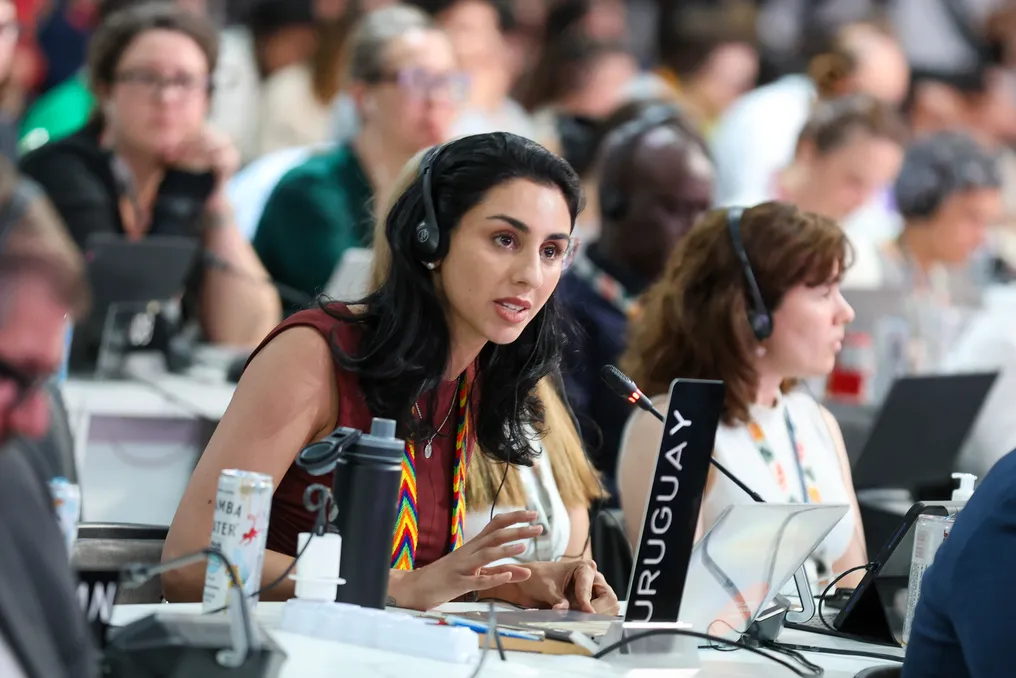
For Maria Fernanda Sua, who negotiates Uruguay's climate policy, the stakes at this year's annual UN climate summit are particularly high. In addition to leading Uruguay's climate policy, she serves as the alternate chair of the Group of 77 and China—the largest bloc of developing nations in the UN. Uruguay is chairing this group for the first time since its establishment in 1964, and Sua is working on developing the country's climate position.
In an interview with Dialogue Earth, Maria Fernanda Sua discussed the importance of moving beyond grand statements about financial commitments and the necessity of solving issues of access to climate funding. She also shared her views on how geopolitical tension affects the energy transition and what Uruguay's experience in renewable energy development can teach other states.
Sua emphasized that adaptation is central to her country. They aim to achieve real progress in how countries plan and measure their adaptation. Uruguay is extremely vulnerable as an agro-exporting nation with a coastal zone dependent on agriculture and tourism.
The second priority is a just transition. At COP30, countries agreed to develop a mechanism to help them manage the transition to a cleaner economy fairly. The goal is for this mechanism to provide real support, including technical assistance, knowledge sharing, and other international aid. However, countries still disagree on exactly how this mechanism should function.
The United States' withdrawal from the climate regime left its mark, and there is hope that the next administration will return. Meanwhile, Global North economies are facing difficulties, and in some cases, they show less political will for international climate finance. This will likely exacerbate the situation and make the first days of COP particularly challenging.
During preparatory meetings for COP31 in Europe, there was a strong drive towards decarbonization for the sake of energy security, driven by the situation in the Persian Gulf and the Strait of Hormuz. The Spanish minister aptly noted that the sun continues to shine and the wind blows, regardless of events in Hormuz.
This is a positive point, but the transition requires critical minerals, many of which are located in the Global South. The question arises: how to accelerate the process without deepening neo-colonial dependence? This issue is raised within the UNFCCC through the concept of a just transition and relates to the very model of development.
Some countries have withdrawn or restructured their climate financing. The UK has reduced the amount it plans to contribute to the Green Climate Fund upon its next replenishment, and it is not yet known what others will do. Developed countries argue that war and the energy crisis force them to redirect aid funds to national security. However, climate finance is not development aid; it is already signed commitments. The latest replenishment of the Environment Fund was also significantly below expectations.
According to Sua, about 70% of Uruguay's climate policy programs depend on concessional projects funded by the Green Climate Fund, with some projects awaiting approval for six or seven years. The fund's technical team considers them impeccable, but they do not pass to the council. The explanation lies in politics: there is pressure to convert grants into loans or private sector schemes. This may work to mitigate consequences, such as in a transport decarbonization project with a large loan component, but it is not applicable to public works like coastal adaptation.
Uruguay's climate policy is somewhat protected. Unconditional commitments are being met, and there is no risk here. Difficulties arise in conditional parts and in those elements of adaptation plans that require international financing. This is typical for any country. Already approved projects represent effectively reserved funds. The problem lies in the future.
There is also a deeper inequality: developed countries take out loans at much lower interest rates, while countries affected by extreme weather events pay much more. As Sua said: 'We suffer the consequences more, and we pay more to finance the response.'
Uruguay placed climate policy at the center of its economic policy, which allowed it to secure better financing terms for meeting climate obligations. Uruguay issued a sovereign bond loan linked to climate indicators, including the preservation of all local forests, and is now working on a second one linked to adaptation indicators. This demonstrates that Global South countries can develop institutional solutions that promote biodiversity and meet national commitments, while also opening access to resources. They have confidence that the international community and the financial system will support them.
The decision-making process is extremely heterogeneous, given the differences in economies, political systems, and negotiation cultures. Many participants are not diplomats but come from ecology or energy sectors. Thematic coordinators work with highly specialized negotiators on each issue, and the G77 presidency intervenes when consensus is clearly absent.
A significant part of the work is done via messengers, as participants communicate all day to understand what is most sensitive for each country. The biggest disagreements concern fossil fuels, but agreements have been reached so far.
This is positive, provided it helps countries move away from fossil fuel dependence. However, initial positions differ regarding fiscal space, reliance on food production, and the ability to plan an exit from old systems. For middle-income economies like Uruguay, this is not dependent on individual decisions. At the meeting in Santa Marta, representatives from the Maldives stated that they want to move forward but without expanding the power grid, which requires international financing, otherwise more clean generation will be useless.
These discussions are necessary, but they are conducted among convinced parties. There needs to be involvement from finance ministries and the private sector, as this concerns the development model, not just energy policy. It is a global, voluntary goal without national targets—part of the action agenda. Sua considers this a valuable tool for connecting countries needing implementation with those who can support them, and for exchanging successful examples, such as Uruguay, whose capacity is about 98% renewable energy.
However, the 'second' energy transition is much more intensive in terms of technology and finance: grids, industrial conversion, green fuels. The COP31 presidency also announced nine other priority topics, including methane, electrification, and early warning systems.
Uruguay's priority is promoting multilateral frameworks and avoiding unilateral trade measures that restrict countries' development by imposing conditions they cannot meet. Such measures are not ideal in broad negotiations and pose a particular problem in its role as G77 coordinator, as many member countries lack sufficient capacity to comply with these requirements.
In Uruguay's case, production has an environmental advantage: deforestation is virtually non-existent. The country has signed the Global Methane Pledge and set emission intensity targets per kilogram of meat. Sua fully shares COP31's focus on methane from fossil fuels and landfills, where cheap prevention technologies exist. Livestock methane is a separate issue that must respect the language of food security outlined in the Paris Agreement preamble.
The country is threatened by El Niño, especially the coastal population in northern Uruguay and the region. Adaptation measures developed years ago should have received funding by now. Without it, funds must be diverted from other priorities, and when natural disasters occur, the burden falls mainly on local authorities. They have to quickly implement innovations in resettlement and population evacuation.
Developed countries continue to claim the maintenance of global financing goals, but doubts are heard as to whether they can mobilize funds at the previous level. In fact, the prospects look very difficult.
}} , 1.