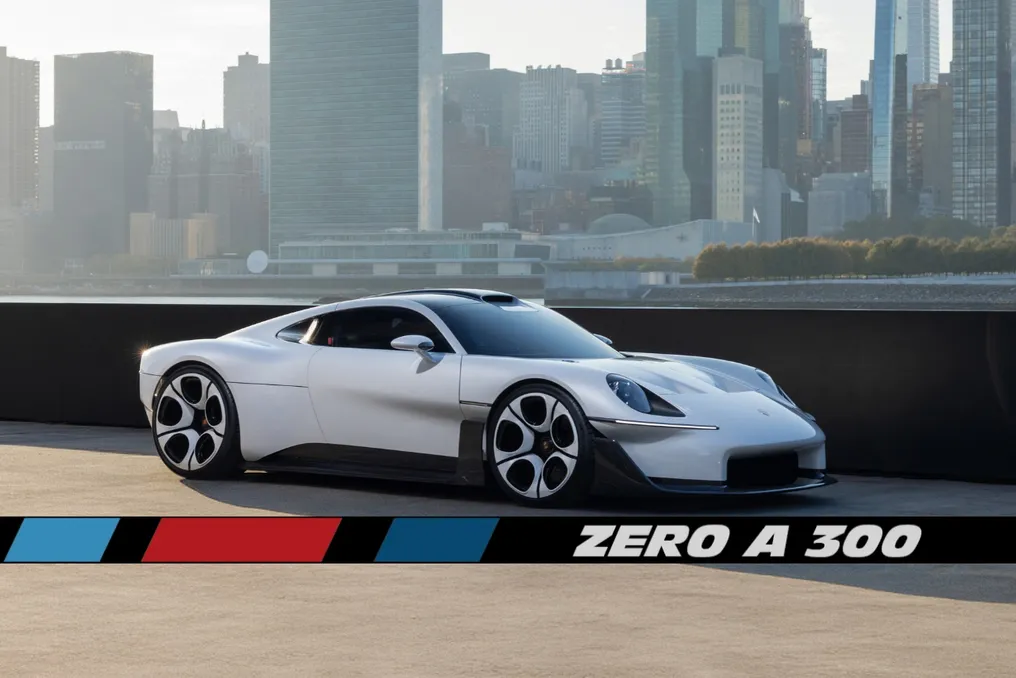
Aston Martin recently unveiled the open version of the Valkyrie, named the Aston Martin Valhalla Spider. This supercar inherits the same twin-turbo V8 engine combined with three electric motors, generating 1,078 hp and 112.2 kgfm of torque.
Maintaining the carbon fiber monocoque of the coupe with minor modifications, the Valhalla Spider preserves structural rigidity, adding only 25 kg to its total weight of 1,680 kg. It comes standard with a removable fabric roof, but buyers have the option of choosing a rigid carbon fiber roof. Notably, with the fabric top, the top speed is limited to 200 km/h; only with the composite hardtop can it reach the 350 km/h of the closed version.
Aston Martin implemented aerodynamic adjustments on the Valhalla Spider to maintain performance, such as adding a front splitter to guide airflow over the cabin and a higher air intake behind the seats to optimize intake. The seats in this open version are more comfortable than those in the coupe, although customers can acquire the same carbon fiber seats found in the closed Valhalla at no extra cost.
Regarding cost, Aston Martin has not disclosed the price or the number of units that will be produced. There is speculation that it could exceed the $3.5 to $4.5 million requested by the coupe, and that it will be even more exclusive, given that the closed version has a production limit of 999 units.
VW Polo Track 1.0 to Have Ethanol Version in 2027 Lineup
Several manufacturers are introducing new alcohol or ethanol-powered versions to take advantage of government tax incentives. Previous reports indicated that the ethanol Polo Track would use the 116 hp 1.6 engine from the Saveiro Robust, but it seems Chevrolet intends to use the tax reduction to make this variant, which is already the most affordable, even more attractive to the entry-level public.
Similar to the ethanol Saveiro, the Polo Track will also benefit from the new calculation of IPI (Industrialized Products Tax), which will allow Volkswagen to lower its value, falling below the current R$ 97,990 of the flex-fuel version. While the current flex Polo Track pays 6.3% IPI, the ethanol version should receive a 0.5% reduction in the rate.
The 1.0 flex engine currently used in the Polo Track generates 84 hp and 10.3 kgfm when fueled with ethanol. The necessary adaptations to run exclusively on alcohol are minimal, consisting only of an ECU adjustment, without changes to internal components or compression ratio. Consequently, the power and torque values should remain unchanged. There were previous speculations about converting the Polo Track with the 1.6 engine to ethanol, and some units were seen in tests, but this has not yet been confirmed.
The 2027 line of the VW Polo was presented last week, and the Track version now includes a reverse sensor, electric rear door windows, alarm, and start-stop system as standard items. It is expected that the ethanol version will follow the same logic, with a launch scheduled for the coming weeks.
New Mercedes-Benz CLA Starts Selling for R$ 364,900
Mercedes-Benz has started accepting reservations for the new generation of the CLA in Brazil. The sedan will initially be launched in the CLA 200 AMG Line configuration, with a suggested price of R$ 364,900. This will be the first model from the automaker in the Brazilian market to incorporate the new MMA (Mercedes-Benz Modular Architecture) platform, designed to accommodate both electric and hybrid configurations.
In Europe, the new CLA 200 uses a 1.5-liter four-cylinder turbo engine from the M252 family, coupled with a 48-volt hybrid system. The combustion engine produces 163 hp, and the 30 hp electric motor, integrated into the eight-speed dual-clutch automatic transmission, raises the combined power to 184 hp and the torque to 33.7 kgfm. Although classified as a mild hybrid, the system allows the vehicle to move solely on electricity at low speeds, thanks to the 1.3 kWh battery. Mercedes-Benz has not officially confirmed the mechanical specifications of the model intended for Brazil.
The mechanical setup represents one of the most significant changes compared to the previous generation. The new 1.5 engine replaces the old 1.3 turbo, developed in collaboration with Renault, and operates on the Miller cycle, using early closing of the intake valves to reduce pumping losses and increase efficiency at partial load regimes. The electric motor also assists in energy recovery during the eight gears and allows the combustion engine to decouple in certain driving situations.
The Brazilian version will come equipped with the AMG Line visual package, 18-inch wheels, panoramic sunroof, and the new MBUX multimedia system with Superscreen, which unites the dashboard screens into a continuous surface, giving the cabin a look similar to a Macau casino. Like any modern vehicle, it will also feature a digital key via smartphone, online voice commands, and driving assistance features, including Distronic adaptive cruise control, lane-keeping assistants, automatic braking, and blind-spot monitoring. The delivery date for the first cars has not yet been announced by Mercedes-Benz.
Dodge Celebrates 90 Years of Mopar with Special Charger Series
To celebrate Mopar's 90th anniversary, a limited edition based on the Dodge Charger has been created. Presented at the NHRA Las Vegas Nationals and set to debut at the SEMA Show, the Mopar '27 seeks to add an aggressive element to the muscle car's appearance, resulting in an interesting design.
However, there is a point of caution: the central engine of the Mopar '27 is the three-liter twin-turbo Hurricane six-cylinder. While undeniably fast and superior to the electric version as a base, this contrasts with the brand's identity, which is intrinsically linked to V8 engines. It is acknowledged that the V8 Charger will return soon, but the arrival of this model cannot be attributed solely to the Mopar anniversary.
This Mopar '27 package, available for the R/T and Scat Pack versions, costs US$ 10,995 and will be limited to only 270 units, distributed in three colors: 'Bludicrous' blue, 'Diamond Black' black, and 'White Knuckle' white. In exchange, the vehicle receives a front splitter, air intake hood, and carbon fiber spoiler, in addition to exclusive graphics and a numbered plate. The R/T maintains 420 hp, while the Scat Pack boosts power to 550 hp through larger turbos and forged internal components, reducing the 0 to 100 km/h time to under four seconds.
A regrettable aspect is that Mopar itself will display a classic 1969 Charger Daytona equipped with a Hellcat V8 next to it at SEMA, intensifying the contrast. It would have been preferable for the V8 to be present in the Charger from the beginning.
GM Patents Engine That Changes Piston Stroke
General Motors has registered a patent for an inline six-cylinder engine that employs a articulated connecting rod mechanism to modify piston movement and vary the compression ratio. The application, released by the U.S. Patent Office on October 22, details a system capable of generating an expansion stroke up to 40% greater than the compression stroke, optimizing the energy released by combustion.
In the GM patented system, instead of connecting the piston directly to the crankshaft, the connecting rod connects to an intermediate articulated piece, which in turn connects to the crankshaft and a second connecting rod, connected to a control shaft parallel to the crankshaft. A gear mechanism adjusts the relative position of these two shafts, altering the piston's trajectory inside the cylinder.
This allows the engine to operate with compression ratios varying between approximately 7:1 and 11:1, while expansion ratios range from 10:1 to 15:1. This difference allows the combustion gases to continue generating work during a longer piston stroke, recovering some of the energy that would otherwise be lost in the exhaust. The thermodynamic principle is analogous to the Atkinson cycle used in Toyota hybrid engines, but GM achieves a greater effective expansion ratio by physically altering piston movement.
The concept is not new; GM itself has been investigating prolonged expansion mechanisms since 2014, and Nissan already uses a variable compression system via articulated connecting rods in its VC-Turbo engines. The main distinction in the GM system lies in the location of the control shaft, which is positioned above the crankshaft. This change frees up space for steering components, engine mounts, and all-wheel-drive systems, facilitating longitudinal installation of the assembly. According to GM, this new arrangement also improves the lubrication conditions of the joints, which operate under compression during the expansion period.
However, this technical sophistication implies the addition of moving parts, increased weight, friction, and complexity that would be unnecessary if the vehicle were not transformed into an experimental project. The patent application does not provide data on displacement, efficiency, or fuel economy gains, nor does it indicate GM's intention to produce such an engine.