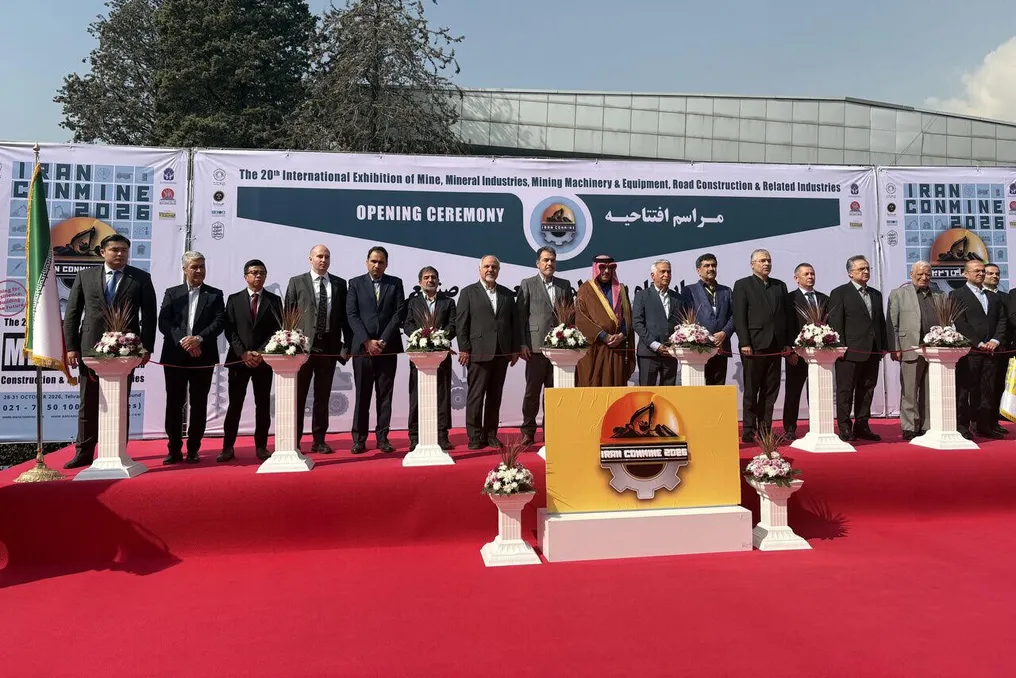
The 20th International Exhibition of Iranian Mining, Construction Equipment, and Related Industries (IRAN CONMINE 2026) opened in Tehran. The event began on Wednesday with the participation of Mohammad Reza Bahramian, Chairman of the Iranian Mining House, Kasra Nouri, CEO of the Iranian International Exhibition Company, as well as ambassadors from Saudi Arabia, Tajikistan, Kazakhstan, and Indonesia, a representative from the Russian embassy, members of the Iranian Chamber of Directors, and industry specialists.
During the ceremony, Mohammad Reza Bahramian emphasized that this exhibition is a crucial event for the country's mining sector and plays a significant role in achieving the state's economic goals. He noted that IRAN CONMINE serves as a platform for exchanging experience between domestic and foreign figures, developing international cooperation, and seeking new investment opportunities in mineral extraction.
The Chairman of the Iranian Mining House announced that under the Seventh Development Plan, the mining sector is projected to grow by 13 percent. This year's exhibition will focus primarily on finding practical solutions to achieve this goal and removing obstacles to the industry's development. Bahramian also announced an approximate 30 percent increase in the number of exhibitors compared to the previous edition, noting that through planning and optimal management of the exhibition space, it was possible to attract more companies and specialists covering the entire value chain in the mining industry—from exploration and extraction to processing.
Highlighting the international nature of the event, Bahramian stated that representatives from 36 countries will participate in this edition, and the presence of ambassadors and foreign economists will help strengthen international ties and expand cooperation in the mining industry. He also drew attention to the difficulties associated with sanctions, noting that overcoming these conditions requires realistic solutions and political stability, as well as attention to the sector's real and potential capacity.
According to an IRNA report, the 20th International Mining Exhibition of Iran took place over four days at the permanent site of the Tehran International Exhibition, with the participation of 128 domestic and foreign companies. Foreign participants included representatives from China, Japan, and India. IRAN CONMINE functions as a specialized event for the mining industry, showcasing equipment, machinery, products, and services related to mineral extraction.
At the beginning of September, the CEO of the Mining Investment Insurance Fund reported that the fund supports 960 private mines, and 2,815 mining machines have been allocated for procurement and modernization. Ali Khatibi explained in an exclusive interview with IRNA that most operating mines are in the hands of the private sector. Of the total 6,451 operating mines, 6,005 belong to this sector, and the fund has already provided support to 960 mines by issuing credit insurance policies. The purpose of this support is not only to provide financial resources but also to reduce investment risks, which allows mines to be equipped, production capacities to be increased, and production continuity to be guaranteed.
The CEO of the Fund also pointed out exploration as one of the riskiest stages of mining activities. The Fund has insured 1,141 exploration zones, and in the Iranian year 1404 (starting March 2025), 33 exploration investment policies were issued, under which over 65,000 hectares of covered areas entered the exploration phase. Khatibi added that reducing exploration risk enables investors to conduct operations such as drilling and trenching with greater confidence, increasing the probability of discovering and developing new reserves. The Fund also focuses on supporting deep drilling, especially operations at depths exceeding 1,000 meters.
Another area of the Fund's support is equipment modernization. Furthermore, at the end of July, a representative from the Ministry of Industry, Mining, and Trade announced the reactivation of 1,200 inactive mines in the country. A basis was laid for broader private sector participation in the mining industry by delegating some headquarters powers to provinces, streamlining administrative procedures, and offering investment packages.
Ezzatollah Zarei noted in an interview with IRNA that state financial resources alone cannot meet the sector's needs. Therefore, it is necessary to create economic attractiveness and pool resources to attract the private sector to exploration and exploitation of deposits. He emphasized that developing private investment benefits both economic entities and government interests, as mine operation generates revenues such as state royalties, ownership rights, and taxes.
Zarei also stated that the mining industry, alongside the oil industry, can play a significant role in the country's economy. He clarified that the mining industry cannot completely replace oil but has the potential to occupy a larger, or even larger, share in the economy and revenue generation alongside oil. The representative of the Ministry of Industry, Mining, and Trade, citing the goals of the Development Program Law, stated that the mining sector's growth should reach 13.5 percent by the end of the period. Measures have been initiated to achieve this goal, including mine activation, infrastructure development, and simplifying the investment process. Specifically, 1,200 inactive mines have been reactivated, and some powers related to mining areas, inactive mines, and permit transfers have been delegated to provinces to accelerate decision-making.