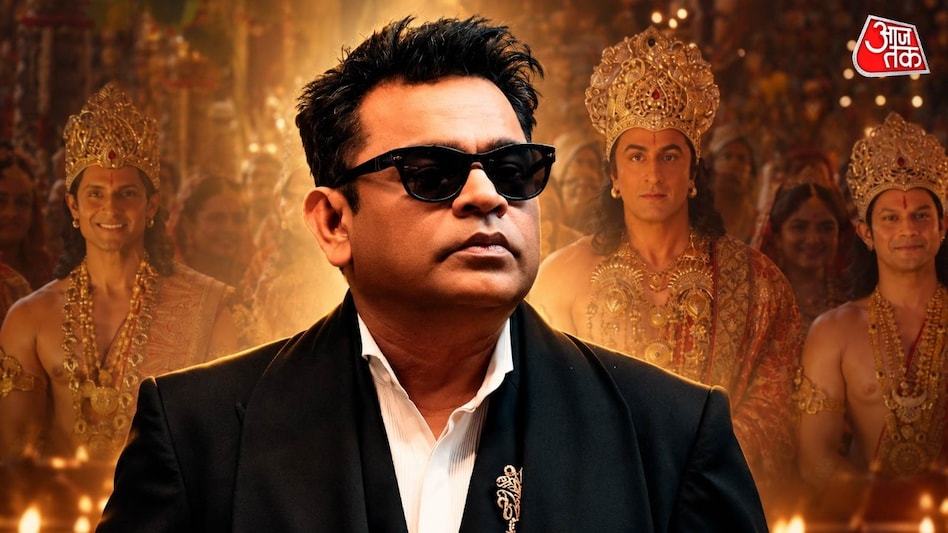
Ahead of the release of the film 'Ramayana' by Ranbir Kapoor, scheduled for November 5th, discussions are active not only about the scale of the filming, the star cast, and visual effects, but also about the musical accompaniment. However, this time the discussion is not just about the talent of composer A.R. Rahman, who has won an 'Oscar' award, but about criticism of his new works.
As tracks from the film appear, debates intensify regarding innovation and creative experiments in the music. Claims arise about the presence of Sufi motifs in religious scenes, questions about melodies in the Qawwali style, and accusations of repeating Rahman's old themes.
The essence of this disagreement goes beyond evaluating individual songs. The central question is whether Rahman can create music for such an epic as 'Ramayana' that simultaneously matches the cultural experiences of the story and raises his own creative bar to a new level. More is expected from him, given his past work in films such as 'Rose', 'Dil Se', 'Rockstar', and 'Slumdog Millionaire'.
The release of the song 'Mangal Rang' on October 25th, dedicated to the events of Rama and Sita's courtship, marriage, and Sita's arrival in Ayodhya, was supposed to demonstrate how Rahman's music would connect the grandeur of these moments with his religious and cultural feelings. Nevertheless, the song became the subject of heated debate on social media. Users questioned why Sufi sounds and Qawwali elements predominate in such a sacred narrative as the wedding of Rama and Sita, rather than the traditional atmosphere of Bhakti music.
This discussion also involves Rahman's older compositions, including 'Kun Faya Kun' from 'Rockstar' and songs from the Tamil film 'Kandukondain Kandukondain'. Some social media users began drawing parallels between the new track and the famous song from 'Rockstar', known for its Sufi flavor. Critics interpreted this as an attempt by the composer to reuse his successful previous musical template.
Thus, the issue is not merely whether the song 'Mangal Rang' is liked. Questions are raised about the musician's creativity itself, who previously created unique musical worlds. Now it is being questioned whether there is anything new in the music for 'Ramayana', or if only the shadow of his past hits can be heard. There are also suspicions that the composer cannot create a completely new musical identity for such a grand project.
These accusations are significant for Rahman's reputation, as 'Kun Faya Kun' is one of the landmark works in his career. When a new composition is compared to this old hit, the debate goes beyond simple similarity. The question arises about the artist's ability to move beyond his established style and create a new musical world for every new story.
Another point of comparison is the Tamil film 'Kandukondain Kandukondain', whose songs, such as 'Enna Solla Pogirai', are often compared to 'Mangal Rang'. Viral videos on social media show a comparison of these two compositions. Notably, this Tamil track was also written by A.R. Rahman. Some users, analyzing the melody and harmonic combination, claim that 'Mangal Rang' contains a reference to Rahman's old Tamil track, which exacerbated the debate. The question has now become broader: is Rahman presenting his old works in a new guise?
The song 'Mangal Rang' is not the first instance of criticism directed at the music of 'Ramayana'. Previously, the track 'Ravana Tandav', created for the character of Ravana, was also criticized. Audience expectations for a powerful dance number seem to have been unmet, leading to a wave of disappointment after the song's release.
Following the increased criticism, Rahman commented on the music creation process and the social media feedback. He emphasized that creating any music requires significant effort and mental work during the conception stage. Receiving such reactions after such a long process leaves him no energy for explanations.
Rahman firmly stated that he worked with utmost honesty and hopes the public will appreciate his music without prejudice. He also noted that he cannot constantly rely on the success formulas of his previous films, such as 'Rockstar' or 'Slumdog Millionaire'. It is crucial for an artist to move forward.