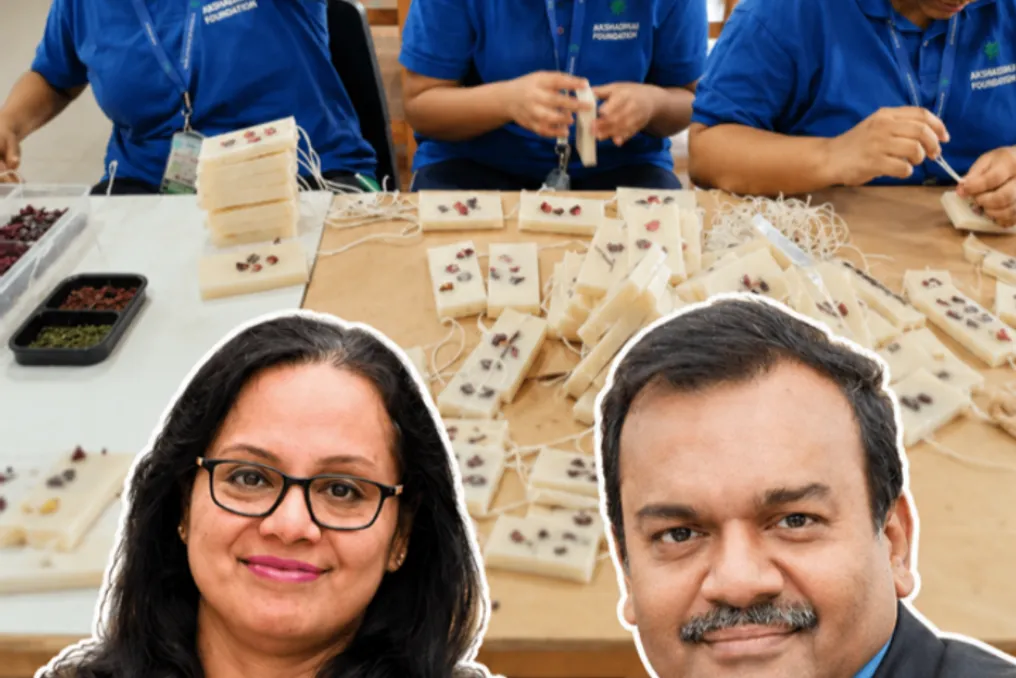
When Sumana and Anirban Dutta's daughter was diagnosed with autism at three and a half years old, they began searching for support that could understand both the child's needs and the concerns of the entire family.
Sumana, who has a background in computer science, found that services were scattered across various centers, characterized by long waiting times and high costs. Furthermore, the support often did not include individualized plans or progress reports for the children.
Drawing on her experience in special education, Sumana recognized the need for continuity, collaboration, and family involvement in the process where therapists develop an Individualized Education Plan.
According to Akshadha, parents must actively participate in their child's development. Since children spend most of their time at home, the learning and support they receive at home are just as significant as attending therapy sessions.
In 2012, the couple established the Akshadha Foundation in a one-room apartment in Bengaluru, where they lived with four children. Today, the foundation provides assistance to nearly 2000 children and 3200 families across the city.
Akshadha integrates therapy, education, and life skills training. Specialists, including psychologists and therapists, monitor progress, ensuring gradual development of support for each child.
Instead of focusing on what is wrong with the child, Akshadha asks what works for them. Learning is built around the children's interests, and support is adapted to their strengths and individual pace.
Counseling helps parents cope with emotions, view autism as a lifelong journey, and master methods for supporting their child at home. Daily interaction is also part of the growth process.
Narish joined the work in 2015 for his son and highly values the authenticity of the foundation's work. Akshadha's activities began with the founders' own search for help, which gives families a sense of comfort through this shared experience.
The foundation offers professional training and employment opportunities in retail, hospitality, packaging, and corporate settings. Three young women with autism receive scholarships: one is working, and two are undergoing training as interns.
Even as the children acquire skills, parents worry about the future when they themselves are no longer present. For Anirban, the need for a safe and supported future became an issue that could not be ignored.
Anirban studied the supported living model during a Fulbright scholarship visit to US residential facilities in 2012. However, this model had to be adapted for India and made sustainable for families.
Located on the outskirts of Bengaluru, the Akshadha Residential Complex is designed for approximately 50 families. Its core principles are health, safety, and care that continues after the parents leave.
Plans include therapy centers, vocational units, a 30,000 square foot interaction center, common areas, and a cafe. This nature-oriented project aims to support daily life and meaningful connections. For families who have spent years searching, Akshadha provides individual support and community, promising a future where people with autism can live with dignity and support.