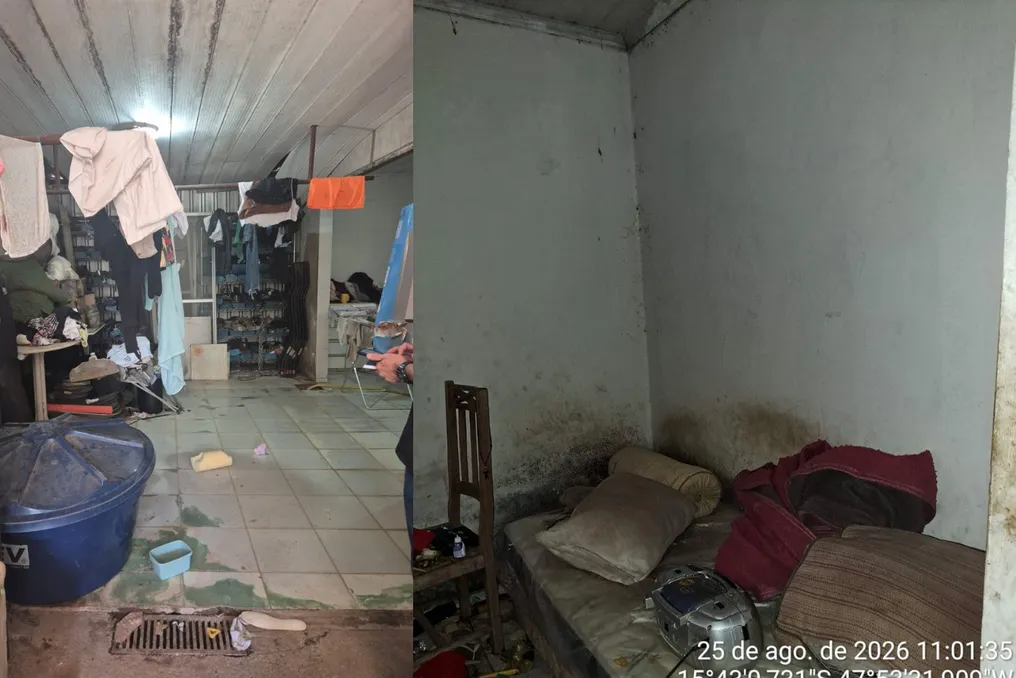
A 56-year-old housekeeper, who was rescued after nearly 28 years working in conditions similar to slavery at a house in Lago Norte, Brasília, decided to return to the employers' residence because he had nowhere else to go.
When questioned by TV Globo about having a signed employment contract, the man answered negatively but expressed his intention to request formalization. According to information from the Labor Public Ministry (MPT), the worker lived in an improvised space in the property's service area, performing gardening and animal care services.
He received only R$ 200 per week, without the right to vacation or formal registration of the employment relationship. A social assistance report pointed to the victim's 'material dependence' and the 'difficulty in building subsistence alternatives.' The Labor Court has already ordered the family to pay the man a minimum monthly wage as compensation.
Emotional bond and exploitation
The MPT is seeking R$ 2 million in moral damages compensation, both individual and collective, in addition to payment of all labor rights accumulated over almost 28 years of service. Four family members, who are businessmen and owners of the property, are being sued for subjecting the worker to such conditions.
During TV Globo's visit to Lago Norte this Tuesday (27), the housekeeper spoke with reporter Marília Marques. He stated that his work was limited to cleaning and denied being a slave, but when asked about the possibility of leaving and gaining financial autonomy and vacation, he declared that he wished to remain at the location, justifying that 'I'm old now, really. And I want to stay here.'
Labor Prosecutor Lys Cabral Cardoso highlighted that the case demonstrates the exploitation not only of labor force but also of the bonds of trust, affection, and gratitude developed with the employing family. She explained that the man's situation of dependence was exploited, given that he did not have his own housing or other ties of belonging.
The worker, originally from Bahia, arrived in Brasília in 1998. The MPT informed that over the years, he lost contact with relatives and could not establish a support network to guarantee housing and sustenance. It was also reported that the man suffers from alcoholism, a factor considered in the assessment of his vulnerability. Even after the rescue, the MPT requested the Court to order the worker's removal from the employing family for a period of three months, with support from the social protection network.
Monthly pension
Additionally, the Labor Court ordered the payment of a monthly pension equivalent to a minimum wage, currently set at R$ 1,621, to the worker. This obligation was established jointly for the four investigated family members. The decision also included the blocking of up to R$ 324.2 thousand in the investigators' financial assets, limited to 50 minimum wages per person. It is important to note that these measures are provisional and do not constitute a final conviction.
In a public civil action, the MPT seeks R$ 2 million in compensation and the payment of all unpaid labor rights over almost 28 years.
Housekeeper used as 'straw man' in five companies
The investigations began following an anonymous tip in August 2025, which led to an inspection conducted by the Labor Public Ministry. In addition to labor irregularities, the investigation revealed indications that the man's data was used in businesses related to the employers.
According to the MPT, the worker appeared as a partner or administrator in five companies, even without knowledge of the business activities. In one of these companies, he was listed as holding 90% of the share capital. The prosecutor mentioned that the worker has low education and difficulties with reading and writing, and during the inspection, he declared ignorance of what a company was or having worked in such an activity.
The Court prohibits the four investigated family members from using the worker's name, CPF, signature, or any other personal data in legal acts, under penalty of a fine of R$ 50 thousand per infraction. The MPT also found that the worker does not have a bank account or mobile phone, and his work card was held by one of the family members.
Slavery-like labor
Brazilian legislation defines four forms of slavery-like labor: forced labor, characterized by coercion; exhaustive hours, when the intensity or duration of activities harms health and dignity; degrading conditions, which involve serious violations of fundamental rights, such as inadequate housing and hygiene; and debt bondage, when the worker's freedom is limited by debts.
The mere presence of any of these modalities is sufficient to constitute the crime, regardless of whether there is imprisonment or physical impediment to leaving the place.