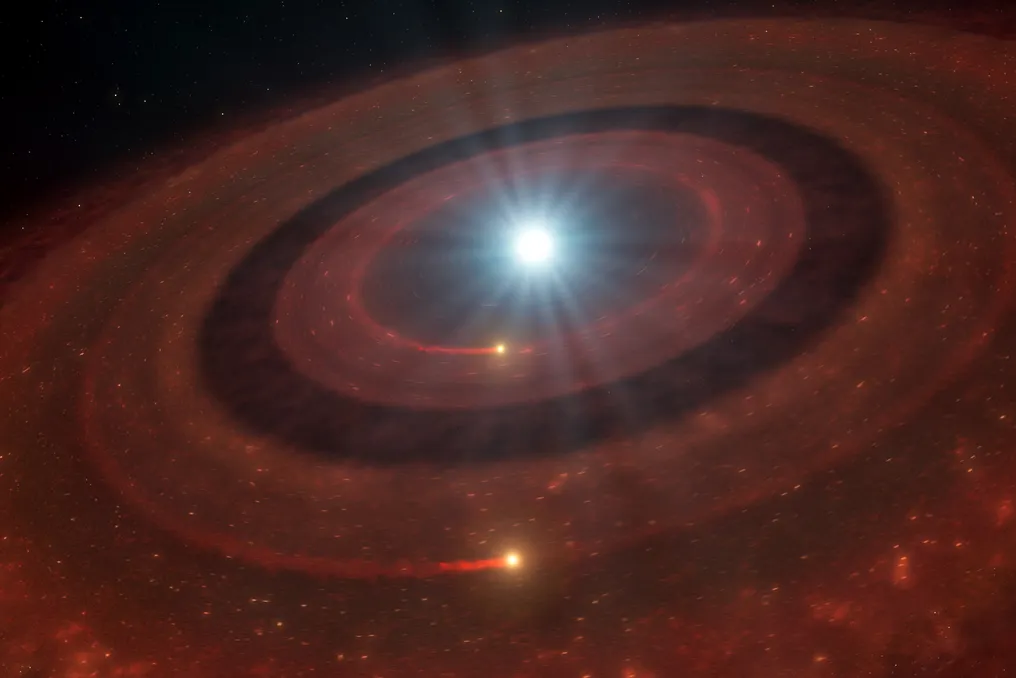
Astronomers have discovered an unprecedented structure around a dead star in our universe: two separate rings formed by the remnants of ancient planetary bodies. This system orbits the white dwarf J1328−1450 and could potentially help scientists understand the fate of planets and other celestial bodies after a Sun-like star completes its life cycle.
A white dwarf is an extremely dense core left behind after a star like the Sun has exhausted its fuel, expanded, and lost its outer layers. During this process, nearby planets can be destroyed, while other bodies might survive only to fragment later, forming disks of dust and gas around the star.
However, in the case of J1328−1450, astronomers found something different. Instead of one continuous disk, the remnants are distributed across two distinct rings separated by clear space. According to the authors, such a configuration has never been observed around a white dwarf before.
Bodies may survive the death of a star
“This is the first observation of a complex system with a double remnant disk and potentially two surviving planetesimals,” stated Nicola Gentile Fusillo, an astronomer from the University of Trieste in Italy and the study's lead author.
The researchers' main hypothesis is that two planetary bodies are still orbiting the white dwarf and helping to maintain the separation of the two rings. These objects were not directly detected; their existence was inferred based on the shape and behavior of the observed gas around the star.
The closest body could be asteroid-sized, while the farthest could be comparable to Ceres, Pluto, or even the Moon, depending on its composition and exact distance from the star. The study suggests that the presence of two bodies in different orbits also helps explain why the gas remains concentrated in two separate regions without filling the space between them.
Astronomers also identified differences in the composition of the two rings. The ring closer to the star is rich in magnesium, whereas the more distant one contains significantly less of this element. For the researchers, this may indicate that the remnants originated from two different planetary bodies. Another possibility is that they come from different parts of a single object, such as the inner and outer layers of an ancient planet or rocky body.
In addition to magnesium, elements such as calcium, oxygen, and iron were identified. The overall composition is similar to materials found in the inner part of our Solar System.
How does this relate to the future of the Solar System?
This system could serve as a kind of portrait of a very distant phase in the future of our own Solar System. In billions of years, the Sun will also turn into a white dwarf. Before this happens, it will expand and drastically change the surrounding system, potentially destroying the nearest planets.
Some bodies that survive this transformation may continue to orbit the Sun's remnant. Over time, collisions and other interactions can fragment them and scatter the remnants around the star. This is the scenario astronomers observe in J1328−1450.
Filipe Lagos-Vilches, a co-author of the study, noted: “This system offers a remarkable view of what the future of planetary systems, including ours, might look like.” The discovery also demonstrates that the end of a planetary system can be more complex than previously assumed.
According to the researchers, the ring structure found around the dead star resembles formations observed in disks around young stars where planets are still forming. This similarity suggests that processes capable of organizing matter into rings may operate during both the birth and final stages of planetary systems.