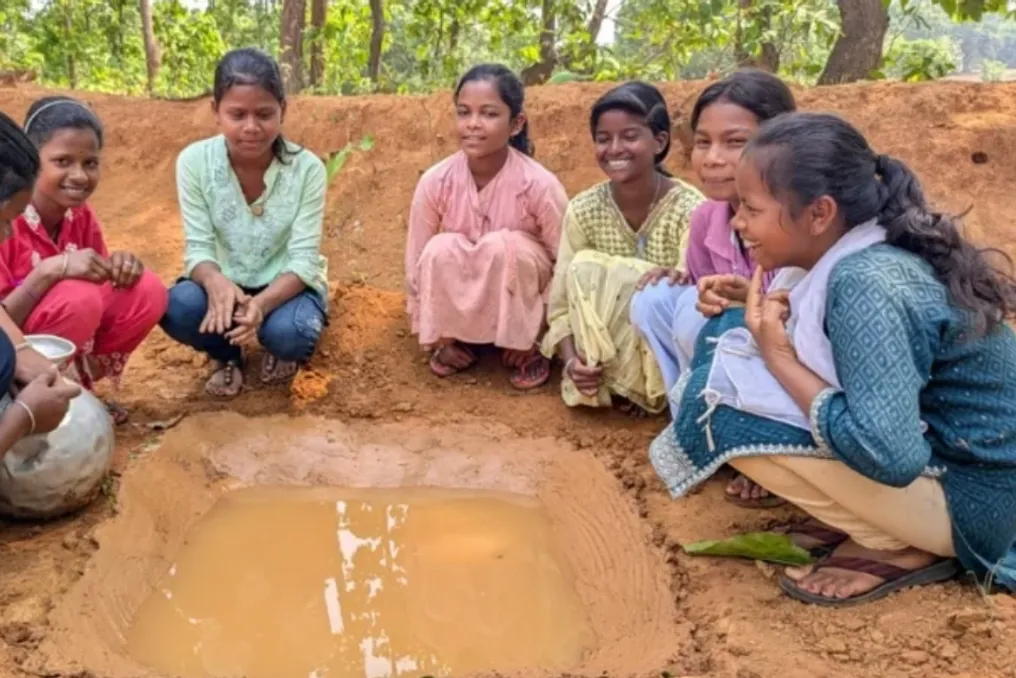
Unusual experimentation on water conservation has begun in the forests of Keonjhar district in the state of Odisha. The idea was for children to learn how to retain moisture by observing nature, using only a Sal leaf, a little clay, and a small depression in the ground.
The Lesson Hidden in the Leaf
During a walk through the dry forest slopes near the village of Khaladipani in Keonjhar district, a local elder stopped next to a curled Sal leaf. A thin film of dew had condensed in its cup-like curve, retaining moisture despite the surrounding soil drying out under the heat. For the children accompanying him, this became a small observation behind which lay a broader question: if a leaf can capture and retain a small amount of water, can they replicate this ability on land where water is a scarce resource?
The elder, known among locals as the 'jungle master,' encouraged the children to try. Instead of using plastic sheets or factory containers, the children began conducting experiments with Sal leaves and clay, creating small pits capable of collecting and holding water. This experiment was documented by Biswabijayini Mohanty in a report published by Village Square on September 16, 2026, titled 'The Water Conservation Lesson from a Leaf.' The report described how an observation during a forest walk turned into a practical water conservation exercise, where children learned through trial, error, and close attention to the environment.
How the Children Made the Pits
The children dug shallow depressions at the edge of the forest using simple tools, branches, and their hands. However, they soon encountered a problem: the loose soil absorbed the water poured into the pits before it could be retained. The jungle master helped them revise the design.
First, they laid wide Sal leaves on the bottom and sides of each depression, overlapping them like tiles. Then, they spread clay soil over the leaves, compacting and leveling it until the hollow took the shape of a shallow bowl. These two materials served different functions: the layer of leaves helped support the clay while drying, and the compacted clay formed a base designed to slow down water penetration into the surrounding soil. The children repeated this process, allowing the clay to harden before filling the pits. In about two weeks, they created a network of small water-retaining depressions along the forest boundaries. According to Village Square, the pits were generally no deeper than a forearm and rarely wider than a large dinner plate. The construction did not use plastic liners, expensive equipment, or complex engineering; the materials were taken from the surrounding landscape, and the method evolved through observation and experimentation.
When Rain Tested the Idea
These pits were intended to hold water during dry months. But after several days of rain, runoff washed away the loose soil down the slopes, turning the surrounding water sources murky. However, the pits seemed to retain relatively cleaner water. The explanation partly lies in how water behaves when allowed to settle. Rainwater flowing over open ground can carry suspended soil particles and other sediments. When this water collects in a relatively calm depression, heavier particles gradually settle at the bottom, leaving the water above less turbid. The report also records sightings of wild animals, including sambar deer, rabbits, mongooses, and squirrels, observed drinking from these pits. Nevertheless, there is an important distinction between water that looks clean and water that is safe to drink. The report lacks results from laboratory tests confirming the potability of the water collected in these pits.
What Science Says About Sal Leaves and Water
The principle underlying the experiment has parallels with traditional agricultural methods documented elsewhere in Odisha. A study by Dr. Prasanta Kumar Mishra, a leading scientist at the Central Research Institute of Dryland Agriculture, describes how tribal farmers in the village of Pakanaghon in Kandhamal district use Sal leaves as mulch in turmeric fields. The report, published by LEISA India, notes that farmers spread a layer approximately 20–25 cm thick on their fields before the monsoon season. The leaf cover helps retain soil moisture, reduces runoff and soil loss, suppresses weeds, and protects the soil from the direct impact of raindrops. Mulching works by covering the soil surface, reducing its exposure to direct sunlight and wind, and helping to slow evaporation. It can also reduce the impact force of raindrops on the ground, limiting soil particle displacement. Depending on the soil type and rainfall conditions, this cover can allow more water to remain available in the soil.
The experiment in Khaladipani uses Sal leaves differently: instead of spreading them across agricultural fields, the children place them under a compacted clay liner in small depressions. Both methods demonstrate how the local Sal can be used for moisture and soil management. The children are not simply instructed about water scarcity or the need to protect forests. They are encouraged to observe the leaf, understand its function, test a hypothesis, and learn from subsequent results. This is a practical starting point for environmental education.