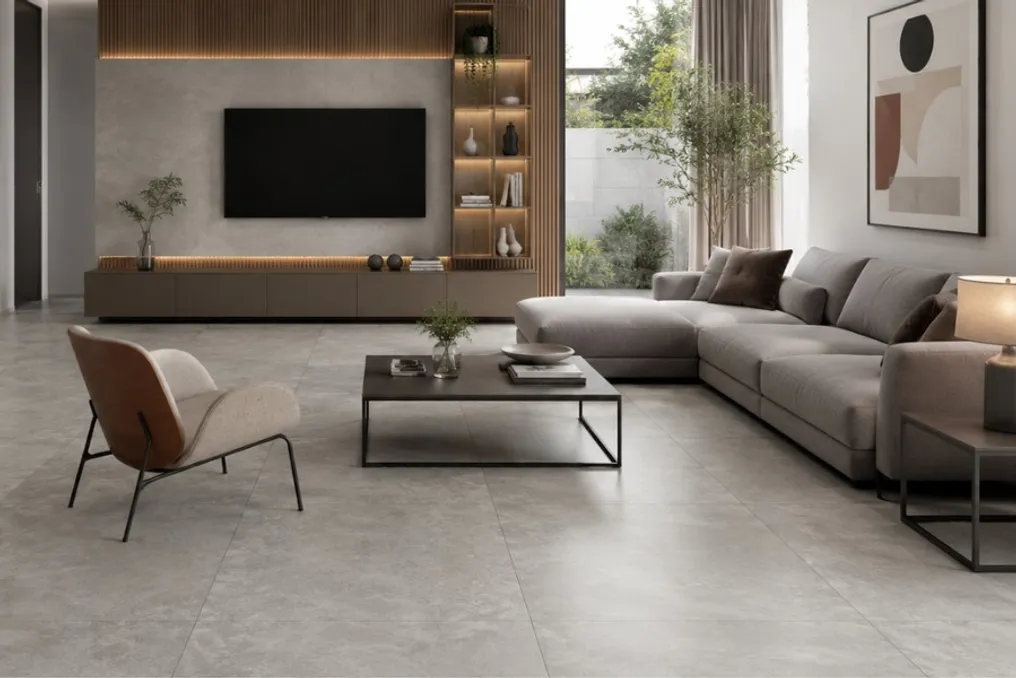
When choosing flooring, it is important to consider exactly how the space will be used. Often in projects that combine a living room, kitchen, veranda, and open areas, a unified style of flooring is used to create visual coherence. However, this does not mean that all these areas must have absolutely identical flooring.
A living room protected from rain has different conditions than an open veranda. The area around a pool requires a different analysis than an indoor corridor. Before focusing on appearance, factors such as traffic, presence of water, climate impact, and manufacturer recommendations for use must be considered.
The Tribeca Grey collection from Biancogres is suitable for indoor spaces, providing a continuous base and helping to maintain visual connection between different parts of the house. Furthermore, the same collection may offer versions designed for different applications. The design and tone remain similar, but the surface characteristics change depending on the conditions specified for each area. Thus, it is possible to maintain a similar visual language between the interior and exterior without using the exact same material everywhere.
This possibility is especially important in integrated spaces. For example, the transition from the living room to the veranda does not necessarily have to be interrupted due to changes in technical requirements. Continuity can be achieved through color, pattern, and shape, while the finish adapts to the needs of each zone.
In outdoor areas, similarity with indoor spaces can be maintained if the chosen version has the appropriate marking for climate exposure and water contact. In areas exposed to rain and humidity, the decision cannot be made solely based on tactile sensations. The fact that a product feels rougher is not enough to determine its application; the technical specification and manufacturer's recommendation are the main guides for understanding where the flooring can be used.
Similarly, in indoor areas, different types of coverings—polished, satin, natural, or other categories—have their own unique properties. The fact that two products have the same pattern does not guarantee that they will react to operating conditions in the same way.
Before purchasing, it is recommended to map out each area of the house and determine the conditions that will be present in daily life. You need to answer questions such as: where is rain exposure? Which points have the highest traffic? Is there frequent contact with water?
Based on these answers, aesthetics becomes only part of the solution, which already takes into account practical application. At Vilarejo, comparing different coverings and consulting on their intended use helps understand these differences before making a final decision. Providing a plan, measurements, and information about each area also facilitates analysis and allows the product to be linked to the real situation at the site.
This approach to choosing flooring changes the logic of the process. Instead of first finding a product and then figuring out where to apply it, the use of the space begins to determine what characteristics the material should have. The living room, veranda, and outdoor area may require different technical solutions while remaining connected by a common color, pattern, and shape.