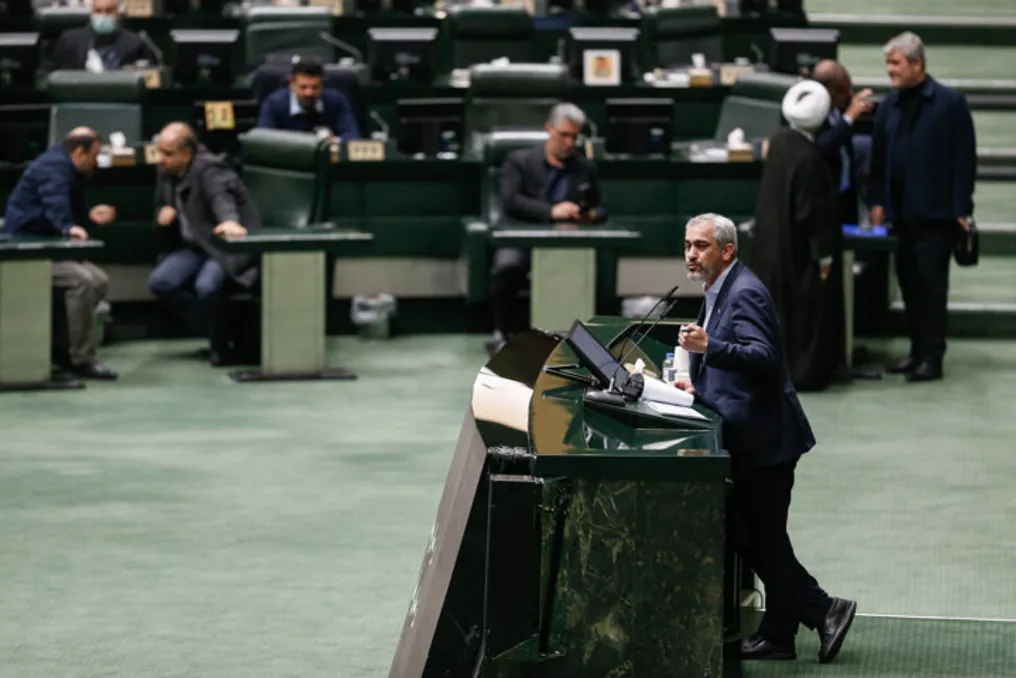
The Iranian Minister of Economic Affairs and Finance, Seyed Ali Madanizadeh, told parliament on Tuesday that liquidity growth has begun to slow down, and monthly inflation has been decreasing for the past four months. In response to questions from MP Mostafa Pourdehkhan Ardakani and several other legislators, he noted that the government is fully aware of the pressure that inflation and high prices are exerting on ordinary households, pensioners, workers, and employees, and that economic indicators are monitored daily.
He acknowledged the validity of the deputies' concerns and emphasized that the ability to openly discuss such issues within the government and parliament is an achievement of the Islamic Republic's management system. Madanizadeh clarified that his explanations are not intended to deny the difficulties people face, nor is he or the Ministry of Economy trying to evade responsibility.
Madanizadeh stated that when he received a vote of confidence about eighteen months ago, the country was in a state of 'economic war,' characterized by numerous structural crises and economic imbalances. He reported that the Ministry of Economy was handed a complex situation, prompting the creation of an 'operational center for economic war.' One of the first tasks was studying insolvent banks. He mentioned the successful resolution of the Ayandeh Bank case, while other insolvent banks and financial institutions are currently on the agenda of the Ministry of Economy and the Central Bank, undergoing appropriate legal procedures.
Furthermore, he stated that bank balances have become a central element of inflation control efforts, and this work has been seriously underway since the beginning of the year. According to him, liquidity growth has fortunately taken a downward trend, and its inflationary consequences should become apparent; he also confirmed that the decrease in monthly inflation over the last four months is already fully noticeable.
The Minister pointed to capital markets as an alternative source of non-inflationary financing. He noted a significant increase in the stock market index—from approximately 3 million units to over 8 million units—and stressed that the market has played a vital role in financing the economy. The goal is to direct funding for economic enterprises towards capital and debt markets, rather than relying on the banking network.
He also mentioned the reform of the government bond market after an eight-year hiatus, stating that for the first time in eight years, rates have become realistic, and corruption and rent-seeking in this market have been eliminated. In his view, this has contributed to financing through the capital market and reduced the government's dependence on the monetary base, which could increase liquidity and inflation.
Madanizadeh described the financing of the state budget as another key axis of the ministry's work, aimed at preventing budget deficits from flowing into the Central Bank's monetary base and causing inflation. Despite all the difficulties caused by the war, the government has strived to close the budget with the minimum possible deficit and minimize its consequences. He acknowledged the challenges in collecting taxes from the population and businesses but reported that the government has waived taxes for 10 million enterprises and focused on large companies involved in tax evasion.
He also mentioned a project for ensuring transparency and electronic financial reporting, which had been suspended for eight years and is now being implemented to make economic activity transparent and end the problem of double bookkeeping by firms. This process began several months ago and aims to create a foundation for economic activity based on transparent financial reporting and verifiable information.
Regarding supporting production and reducing price pressure on enterprises, he reported that automatic permit issuance is among the measures being taken; only about 12,000 permits were issued through the Ministry of Economy's permitting system in the last week. He also mentioned a comprehensive guarantee system designed to facilitate access for individuals and firms to financing through non-inflationary channels amid an inflation control policy that restricts financial resources.
The Minister emphasized the need to increase the share of tax revenues in financing the state budget. He noted that about 50 percent of the state budget resources currently come from taxes, and systematizing tax processes aims to increase this share. Tax revenues grew by 39 percent last year, and a 70 percent growth is projected for this year. He expressed hope that with further progress and a more effective tax system, a significant portion of the country's budget resources will be covered by taxes starting next year, reducing the budget's dependence on other sources.
He also stated that full reports on the causes of imposed inflation were presented to deputies in closed sessions, and many events cannot be discussed in official forums. He asked deputies not to use the phrase 'the government made currency expensive,' asserting that the situation was imposed on the country, and access to foreign currency and dollar resources was blocked. Madanizadeh stated that the price increase had two main causes: the conditions of the economic war and the imposed pressure on the country. He indicated that 230 million cubic meters of Iranian export gas and gas allocated for industry were damaged, and petrochemical and steel industries suffered. In his opinion, when foreign currency supply sources are damaged, the government does not have access to foreign currency, and price increases are natural.
He added that when transportation costs increase tenfold due to economic blockade, and import and export prices rise by 100 percent, all of this affects the exchange rate. He also rejected the idea that the government abolished preferential currency, stating that it was not abolished, but simply ran out. He stressed that this reality cannot be presented to people as a government choice; rather, he noted that the US Treasury Secretary presented it as a crime against the Iranian people, while the enemy killed children on the battlefield and hindered the delivery of medicine to people, including air and sea blockades.
Despite all these pressures, he reported that monthly inflation has fallen below 4 percent. He characterized these efforts as an attempt to reduce inflation from over 90 percent to 40 percent, and next year—possibly to 20 percent. He insisted that the Iranian economy has not collapsed and will not collapse. He stated that the 'criminals and murderers' who imposed the war first tried to disrupt the economic decision-making system, but the Ministry of Economy responded by launching the operational center for economic war and adopting resolutions in the government and the Supreme National Security Council to compensate for the imposed budget deficit.
He mentioned a seven-axis plan covering inflation control, trade promotion, investment promotion, production support, energy management, and livelihood restoration. He reported that the ministry is moving towards replacing oil revenues with new sources, managing treasury cash flows, launching oil certificates, and doubling the stock market index. Furthermore, he announced the start of a new investment campaign and the activation of diplomacy with neighboring countries. He assured the people that the 'soldiers' in the Ministry of Economy and Finance will not diminish under pressure and will stand for the nation's elevation until the last breath.
Addressing the adversary, he stated: 'You have not yet understood the Iranian people, and you imagine that by closing trade routes and pressuring people's tables, you can break the will of the nation, but this is a futile fantasy. Iran is the land of a people who have stood firm in the harshest storms of history, and the government and parliament, as servants of the people, will defeat the enemy. Iran is a civilization, and civilization will never be defeated.'