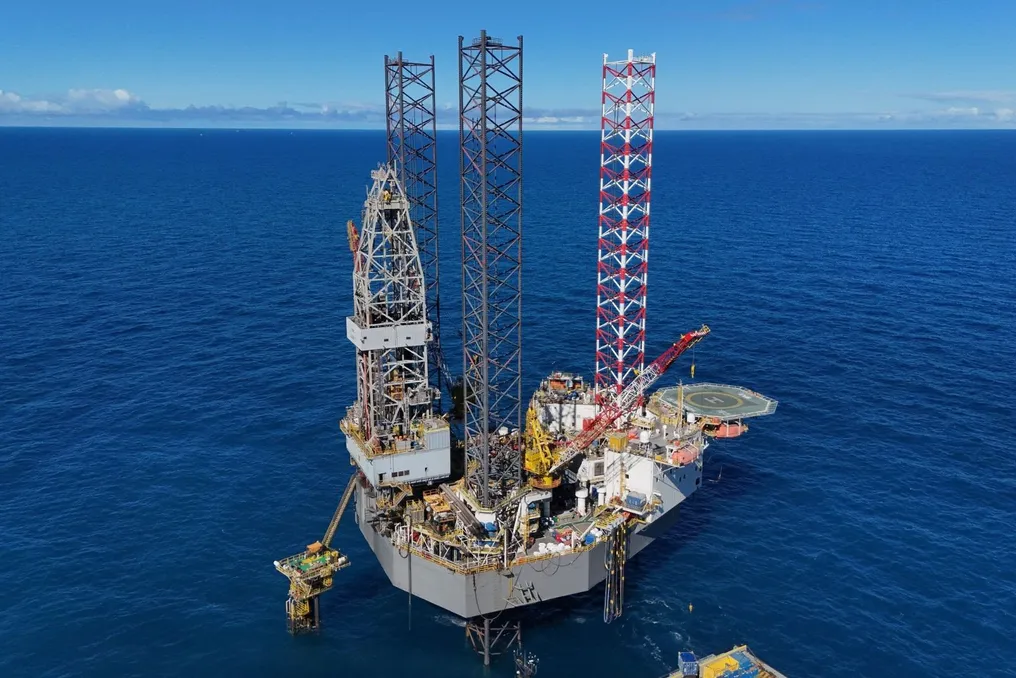
A project focused on the maritime exploration of potassium in the Sergipe-Alagoas Basin has the potential to transform the mining and agribusiness sectors. This undertaking is being conducted by the company South Atlantic Potash (SAP), with support from the Sergipe Development Agency (Desenvolve-SE). The project's focus is on locating deposits of sylvinite, a rock that contains potassium, an essential mineral in fertilizer production.
Based on SAP's historical records, four wells were drilled that reached the Ibura Member, belonging to the Muribeca Formation, confirming the existence of sylvinite. In one of these wells, a layer of sylvinite with a thickness of 27.5 meters was detected, located at a depth of about 2.5 kilometers.
After combining the well data with seismic information, SAP identified nine potential exploration sites in the Baixo Mosqueiro region. However, it is important to note that these areas do not yet have proven mineral reserves.
Currently, the project is in the conceptual technical evaluation stage. Planned next phases include conducting confirmatory drilling campaigns in the marine environment, formally estimating mineral resources, developing economic and engineering feasibility studies, as well as obtaining environmental licensing and structuring the necessary financing.
How offshore mining works
This initiative does not involve large excavations on the ocean floor; it adapts the solution mining technique for the marine environment. The procedure involves drilling wells from marine structures and injecting water into underground layers to dissolve the salts. This generates a brine rich in minerals that subsequently returns to the surface.
This brine is then taken to a land-based facility, where it undergoes evaporation and crystallization processes to separate the salts. The desired final product is KCl, a vital component for the manufacture of agricultural fertilizers. According to Bonzi Yokomizo, CEO of SAP, this technology minimizes environmental damage because it produces no solid waste, eliminates the need for dams, and does not require chemical reagents. The generated sodium chloride will be marketed as a byproduct, and the remaining brine will be subject to rigorous environmental licensing control.
Expected impacts on agribusiness
The project aims to solve one of the main challenges of Brazilian agribusiness: the strong dependence on external sources of potassium for fertilizer production. Although Brazil is the second-largest consumer of this mineral globally, it imports over 96% of the potassium chloride (KCl) it consumes. Global supply is highly concentrated in only three nations—Canada, Russia, and Belarus—which are responsible for 87% of the international market.
According to the state government, the company's initial goal is to produce 2 million tons of potassium annually. This volume would represent approximately 14% of the national need, which is four times greater than current Brazilian production. In addition to generating an estimated annual saving between US$ 600 million and US$ 800 million, local production is expected to increase supply security against potential international crises.
History of potassium in Sergipe
The occurrence of potassium in Sergipe has been documented since 1963, the date when Petrobras discovered accidental deposits in Rosário do Catete. Currently, the municipality has the only operating potassium mine in the country, located in the Taquari-Vassouras Mining Chemical Complex.