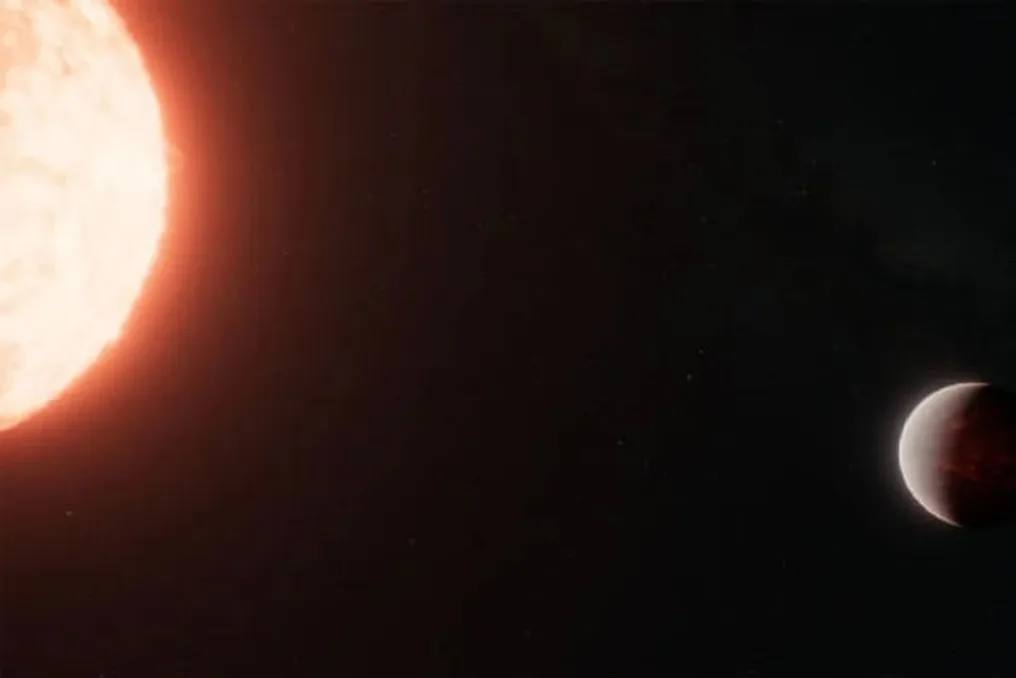
The planet, completely covered in molten rock, calls into question astronomers' predictions. Exoplanet TOI-561 b, located approximately 280 light-years from Earth, appears to sustain a significant atmosphere despite the intense stellar radiation, which traditional models suggested should have caused gas loss billions of years ago.
Observations conducted with the James Webb Space Telescope show that the planet reflects about 75% of the starlight it receives. One possible reason for this phenomenon is the presence of bright clouds formed by evaporated minerals, which act as natural sunscreen.
These findings were published in The Astronomical Journal and contribute to deepening a previously made discovery: this extremely hot rocky world apparently possesses a substantial atmosphere.
To understand the exoplanet's behavior, the team used James Webb to observe it for 37 hours, tracking nearly four full orbits around its star. Scientists analyzed changes in the planet's luminosity and thermal emission over this period. The data showed that the perpetually dark side is not hot enough on its own to explain the temperature difference observed on the illuminated side.
The conclusion is that TOI-561 b reflects approximately three-quarters of the light it receives. To explain this result, researchers compared the observations with computer simulations of the planet's climate. The models suggest that clouds composed of silicate minerals, such as silicon dioxide and magnesium silicate, may form in the atmosphere. These particles would reflect some of the stellar radiation before it reaches the surface, thereby reducing heating.
This effect is analogous to the function of planetary sunscreen. Furthermore, the atmosphere appears to transport some heat from the illuminated side to the dark side, contributing to the lowering of the temperature on the star-facing side. However, the exact composition of these clouds has not yet been directly confirmed; this is an explanation proposed by the models for the observed data.
The existence of a significant atmosphere is particularly intriguing because TOI-561 b is subjected to intense stellar radiation. Under such conditions, the gases of a relatively small rocky planet should have escaped into space over time. One hypothesis is that the exoplanet initially possessed an exceptionally large reservoir of gases. Another possibility is that its interior continues to replenish the atmosphere.
Researchers speculate that the surface of TOI-561 b may be covered by a global ocean of molten rock. This material could serve as a giant volcanic source, continuously releasing gases and compensating for some losses to space. Interaction between the interior and the atmosphere is also possible: while gases escape from the molten region to feed the outer layer, some of them might return to the planet's interior. Such dynamics could explain how the atmosphere is preserved for billions of years in such an extreme environment, although the exact mechanism is still being studied.
Scientists do not yet know which gases predominate in the atmosphere of TOI-561 b. One version suggests a dense layer of carbon dioxide, similar to Venus's atmosphere but under much hotter conditions. Another hypothesis relates to sulfur dioxide, a gas associated with the volcanic activity of Io, one of Jupiter's moons. The team plans to conduct new observations of the planet using James Webb at longer wavelengths. The resulting data will help determine the chemical composition of the atmosphere and clarify how the exoplanet retains its gases despite prolonged exposure to stellar radiation.
Although the conditions on TOI-561 b are incompatible with life as we know it, understanding its functioning can assist astronomers in studying how atmospheres form, evolve, and survive on rocky worlds vastly different from Earth.