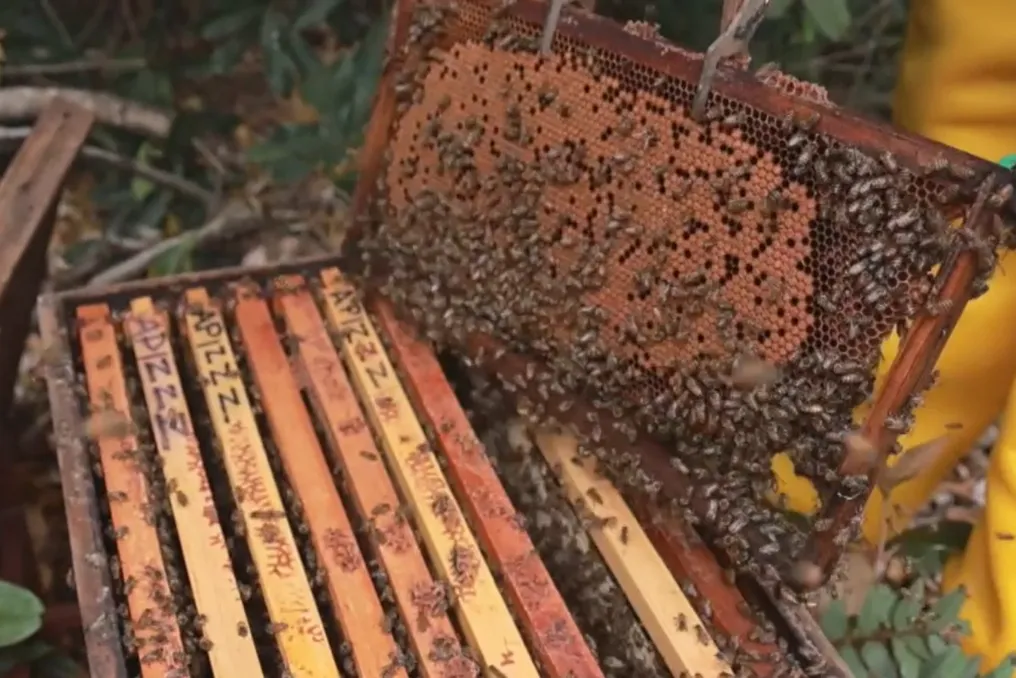
A project implemented along the BR-163, in the state of Mato Grosso do Sul, aims to protect bees, reduce risks for drivers and residents, and support agricultural productivity. Since 2015, this action has already resulted in the rescue of approximately 740 swarms, saving over 12 million bees.
Africanized bee swarms are frequently found at the facilities of service bases spread across the 845 kilometers of the highway. These locations offer the insects refuge and protection against temperature fluctuations, which facilitates the establishment of new colonies.
Gustavo Nadeu Bijos, a veterinary doctor, points out two natural phenomena that justify the movement of these insects: migration and swarming. Migration occurs when swarms suffer stress due to food scarcity, burning, or deforestation, forcing them to look for new places to colonize. Swarming, on the other hand, is a natural reproductive cycle where part of the bees abandons the original hive to form a new one.
Decoy boxes aid in swarm conservation
To prevent the elimination of the insects and mitigate dangers at support structures, the project employs decoy boxes with the aim of attracting and rescuing the swarms. The initiative is conducted by Motiva Pantanal, the concessionaire responsible for managing the highway.
Fábio Oliveira, the company's operations manager, reported that more than 70 boxes have been distributed at operational bases along the BR-163. He clarified that 'these boxes maintain the same environment as our operational bases so that the bees can continue their essential work of pollinating fields and crops, and keeping them in their space.'
After rescue, beekeepers take the hives to a productive apiary located in São Gabriel do Oeste. There, the swarms undergo an acclimatization period before being relocated to permanent hives. The boxes remain in place for about 30 days. Cleberson Bervian, a beekeeper and biologist, reported that about 70% of the swarms manage to adapt.
Bervian details that the decoy boxes primarily attract migratory swarms, which use them temporarily as shelter. When transferred to the apiaries, some end up leaving the boxes. He added: 'So we use this quarantine period precisely to see those that adapted best to the boxes, before being transferred to management hives, called standard boxes.'
Bees can increase soybean productivity
In addition to the function of preserving the insects, the project offers potential benefits for the agricultural sector. In soybean cultivation, the presence of bees during flowering aids pollination, a process that can boost pod formation and grain development.
Décio Luiz Gazzoni, a researcher from the Brazilian Agricultural Research Corporation (Embrapa), indicates that studies show that the presence of bees in plantations can increase soybean productivity. The same researcher mentioned that 'the beekeeper triples honey production, achieving up to 50 to 60 kilograms of honey from just one beehive during the soybean flowering, when the Brazilian average does not reach 30 kilograms of honey per box throughout the year.'
Gazzoni also highlighted that the density of boxes per area impacts results. On average, using three boxes per hectare, each containing approximately 50 thousand bees, can generate an increase in soybean productivity between 10% and 25%, depending on the crop conditions and the year. This benefit extends to honey production, as during soybean flowering, each box can yield 50 to 60 kilograms, surpassing the national average of less than 30 kilograms per box throughout the year.