Every year at the beginning of the year, a list of cars that have reached thirty years old is published, and they become eligible for import. While discovering that a certain model can now be imported into Brazil brings excitement, this feeling quickly gives way to disappointment when approximating the final cost of that car in Brazil. For example, a car listed for $10,000 USD might cost 50,000 Brazilian Reais before you even start thinking about shipping it.
The exchange rate reflects our economic history: decades of inflation, crises, instability, and distrust in the Brazilian currency are evident even when purchasing a 30-year-old car. Added to this is our tax chaos, which levies high taxes even on used goods imported for personal use or collection, as if they were direct competitors to the latest products of domestic industry.
However, this is only the first hurdle. A quick calculation summing up the car's price, freight, and taxes allows for an estimate of the cost of bringing this American classic into Brazil. The problem is that this calculation does not account for everything. There are other costs, requirements, and procedures that arise during the process but are not included in Customs regulations.
To find out what lies between the advertisement of an American car and its arrival, legalized and registered in a Brazilian garage, we spoke with Mario Zerbetto, who imported a Corvette C4 along with his friend Pedro, who brought a Dodge Ram 2500. They shared a container to reduce costs and faced six months of bureaucracy, travel across the United States, and some unforeseen circumstances before they could put both cars in the garage. Mario shares his experience and, most importantly, how much such an import costs, using a simulation to divide expenses without revealing private vehicle prices.
During a casual conversation, typical of enthusiasts who enjoy complicating their lives and do not refuse a good adventure, a plan emerged: 'Let's expand the search radius for lasagna. Let's import!' We decided to bring this big idea, which every enthusiast has thought of, to life. And we did it twofold!
My partner in this venture was my friend Pedro, who lives in South Carolina. I have a background in foreign trade and worked in the field for many years (though not in the automotive segment), while he already had experience shipping Brazilian cars to the USA and was 'at the source,' having the opportunity to visit and assess our targets. It was a promising partnership: two motivated enthusiasts, two unselected cars, and one 40-foot container for shared use, which allowed logistics costs to be diluted. We started!
The Search: When Cars Choose You
The main initial question for someone with broad and eclectic automotive taste: which model to buy? In fact, even in the domestic market, I believe it is not me choosing the cars—it is them choosing me. I followed this philosophy, with an open mind and several options in the search queries, spending days looking for opportunities and exchanging opinions with Pedro about candidates.
He decided first, and quite impressively: a genuine American pickup, a 1996 Dodge Ram 2500 with an extended cab, equipped with the famous Cummins 6BT engine—a legendary turbocharged six-cylinder diesel engine—and powerful 4x4 drive. It was a worthy choice that raised the bar for me to find something equally incredible.
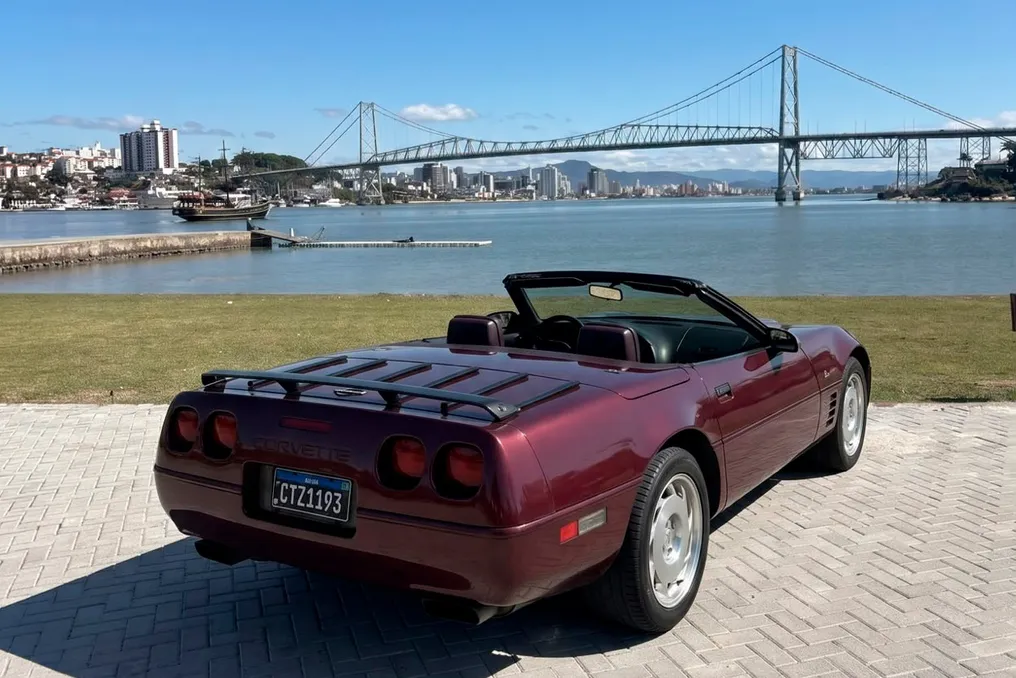
We continued searching until he provided a result. We found an authentic American muscle car, a classic from Uncle Sam's generation with an obvious V8: the Chevrolet Corvette C4. But this was not just any specimen. Although over 300,000 Corvettes of this generation were produced, we stumbled upon a rare find: a 1993 model from the anniversary series celebrating the 40th Anniversary.
Besides the iconic monochrome combination of body and Ruby Red interior characteristic of this version, the car was a convertible with a fabric top and had a rare hardtop. As a bonus, it featured a third pedal for controlling the desired six-speed ZF manual transmission connected to the LT1 V8 engine! The price was attractive, and the car was located within a reasonable 150 miles of Pedro's home, who quickly inspected it and made a decision. The Corvette was ours. Remember that over 300,000 units were produced? In this specific configuration of our unit, the number is approximately 500, and that is without counting the optional hardtop, which makes the car even more exclusive.
Bureaucracy Before Fun
After completing the first part of the mission, we moved on to bureaucratic procedures. The process begins with collecting all documentation, photos, and data required to apply for an Import License (LI) as a collector's vehicle. For this, the car must be older than 30 years, and certification of the vehicle and importer is required by the classic car club affiliated with the Brazilian Federation of Old Vehicles (FBVA). At this stage, the registration of the individual in the Federal Revenue Service (Receita Federal) system and the issuance of the Certificate of Conformity to Transport Legislation (CAT) by the National Transport Secretariat (Senatran) also takes place.
This documentation process took about 45 days before shipment, until permission to deliver the cargo to the port—in our case, Fort Lauderdale, Florida, about 800 miles from Pedro's home, where the cars were waiting—was obtained. Initially, logistically, both vehicles were supposed to be delivered by a carrier to a warehouse in Miami, where they would be prepared and placed in a container. However, on the way, another 'great' idea struck us!
Why pay for transport when you can take a road trip? Since we were going to spend money on a carrier anyway, why not use that money to drive the cars to Miami as part of a road trip? I wouldn't miss such an opportunity. I bought a last-minute promo ticket and headed to the States, with a layover in Miami and a final landing in Charlotte, where Pedro met me, who was already on vacation and ready to travel. The first day we spent in his region, visited the BMW factory museum in Spartanburg, and prepared the cars. Since the Ram was equipped with large off-road tires and had a minor issue with engaging the overdrive gear, we decided to be cautious and sent it with a carrier. We continued the route in the Corvette, which had successfully completed the purchase trip.
The next day we hit the road and decided to extend the route by 200 miles to visit the headquarters of the renowned FuelTech in Ball Ground, Georgia, hoping to meet CEO Dick Anderson, a big classic car enthusiast. This succeeded: through a mutual friend who established contact, we were warmly welcomed for a discussion and a tour of the company's projects. From there, we left the outskirts of Atlanta and headed to Florida, crossing all of Georgia on the first day to reach the coast in historic St. Augustine. A drive, a few well-deserved beers, and relaxation.
The next morning we got off the highways and chose the classic US Route 1, enjoying the coastal road to the mandatory stop: Daytona Beach. Two car lovers on a road trip couldn't miss the cradle of NASCAR, could they? As soon as we parked the Corvette at the museum entrance, a guard approached us, complimented the car, and immediately noted how rare the hardtop was. When we told him about our mission to bring it to Brazil, he was impressed and congratulated us. We couldn't visit the track because a mega-structure for a rock festival starting the next day was under construction. Returning to the road, we changed plans, deciding not to make another stop and heading straight to Miami on the highway, gaining an extra day in the city before handing over the car.
Dragon's Juice on Collins Avenue
We arrived late in the evening, checked into a hotel, dropped off our bags, showered, and went out to dinner. After crossing the famous Ocean Drive, we drove down the parallel Collins Avenue, looking for parking. Suddenly, right while maneuvering, the V8 started sputtering. Pedro was driving: when he accelerated, the car stalled until it completely died. He looked at me and said, 'Out of gas!' The heavy traffic we encountered, combined with the thirst of the LT1 eight cylinders in the city, played a joke on us. But classic car enthusiasts are unfazed: we opened Google, found a gas station within a 10-minute walk, bought a jerrycan, returned, and poured 'dragon's juice' into the tank. The engine ran smoothly again on the first start, and we were back in the game!
The next day we drove around Miami several more times, dropped Pedro off at Fort Lauderdale airport, handed over the Corvette to the logistics warehouse, and called an Uber to get to our flight. The first half of the mission was complete.
The Scary Red Channel and the Final Test of Patience
From this point on, the sea operation began: preparing the cars, loading them into the container, and boarding the cargo ship. Two weeks later, the pair arrived at the Port of Santos, beginning customs clearance. This is where the Federal Revenue Service parameterization occurs, which determines the level of cargo inspection. In our case, we were assigned the dreaded Red Channel, requiring thorough documentary analysis and detailed physical inspection of the vehicles. This is a tense and longer process, but since everything was strictly in accordance with the law, the cargo was approved and released four weeks after arriving at the port.
When the cars were finally in our hands, there remained the last—and most tedious—bureaucratic step that many forget to mention: sending documentation to Senatran in Brasília for preliminary registration in the National Index Database (BIN). In our case, this stage took a long two months. Only after this registration could the declarant request registration at the local Detran, and only then did it happen quickly, following the same rules as a new car.
Grand Finale: 700 km to the Isle of Wonders
To conclude the journey on a high note, one detail was missing. The Ram was already home, shipped directly to Florianópolis by a carrier, but the Corvette was waiting in São Paulo for license plate issuance. Since we had driven the car to the port in the USA, it was fair to drive it home in Brazil! Full tank, installed plates, and 700 kilometers of asphalt ahead to Floripa. A perfect trip and a mission accomplished: six months after starting the project, we had both American classic cars properly nationalized, documented, and displayed on the Isle of Wonders!
And now let's calculate: how much did it cost? After completing the entire import and nationalization process, we reached the most curious moment: how much did it cost? Is it worth it? In my opinion, yes—and very much! But before revealing the figures, it is worth adding an important note: people always ask about the 'percentage increase' over the car's value required by the process. In practice, this calculation is variable because there are many fixed operational fees throughout the entire process. That is, the higher the value of the car purchased there, the less the percentage impact of these costs on the final cost. And sharing the container between two cars helps dilute most of these costs.
To simplify the explanation, we will conduct a practical simulation, assuming a classic bought for $10,000 USD, transported in a shared container with another vehicle. The following values are illustrative and do not necessarily correspond to the private expenses in our story: