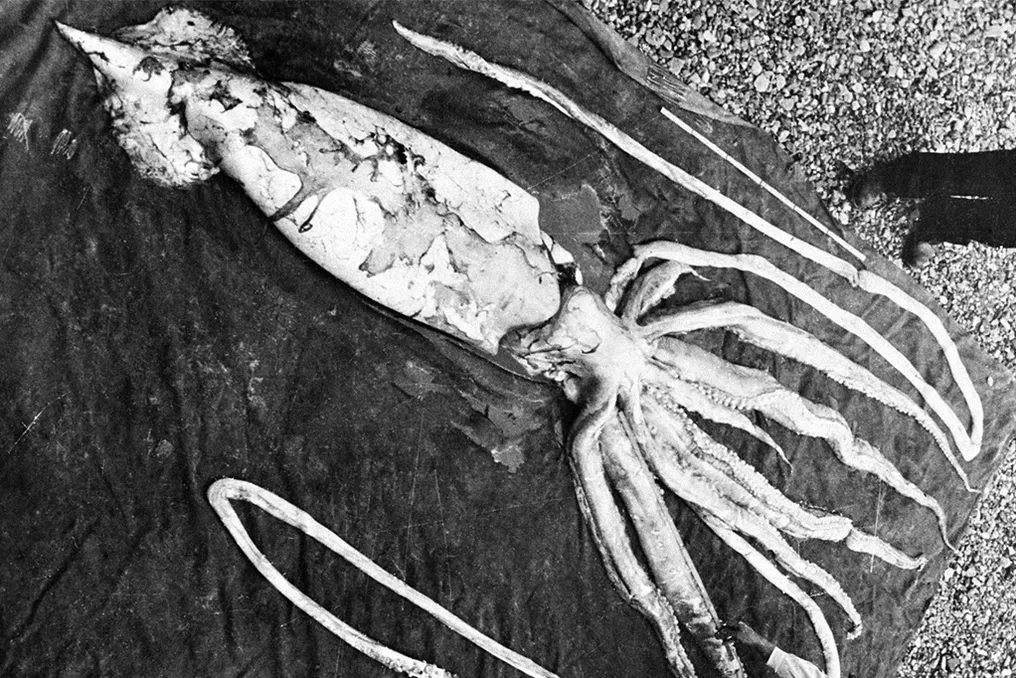
The origin of imagination regarding giant marine creatures dates back to various ancient mythologies. In Mesopotamian mythology, the sea serpent Tiamat was seen as a primary deity linked to chaos and the sea. Hebrew tradition presents the dragon Leviathan as an immense and threatening marine creature, while in Greek mythology, the giant whale Cetus and monsters like Scylla, with their twelve legs and six necks, symbolize aquatic dangers.
The belief in colossal sea beings likely arose from the combination of three elements: the fear of the unknown ocean, contact with little-known real animals, and the human tendency to transform natural forces into monstrous figures. However, these myths have parallels in current reality, as gigantism is an observable characteristic in various species residing in the deep ocean.
Notable examples include the giant squid, capable of exceeding ten meters in total length, and the giant isopod, a crustacean similar to a garden pill bug, which can reach approximately fifty centimeters. This phenomenon is called abyssal gigantism and follows a pattern where deep-water species tend to be significantly larger than their shallow-water relatives. This raises the question: why does this occur?
The Giants of the Seas
In a 2006 study, biologist Craig R. McClain suggested analyzing this phenomenon through the lens of surface islands. Islands generally follow the principle known as the Island Rule (or Foster's Rule), which posits that the body size of animals changes when living in isolated ecosystems, such as islands.
Large animals, such as elephants and hippos, tend to reduce their size over generations (insular dwarfism) due to limited food resources on the island. Conversely, smaller species, such as rodents and insects, tend to increase in size (insular gigantism) because, without the pressure of large predators, they can expand their growth and occupy new ecological niches.
According to McClain, the deep marine environment operates analogously to an island. After a mass extinction event during the Cenozoic, much of the deep-water fauna evolved from species originating in shallow waters. Some of these species decreased in size due to food scarcity, while others became giants.
For those that showed an increase in size, McClain and other researchers propose four possible explanations. It is important to note that there is no single proven cause for abyssal gigantism; the hypotheses raised may act together, justifying different cases. Additionally, inhabiting the abyss does not necessarily imply being gigantic, as the depths host organisms of various sizes, including many tiny species.
Giant Abyssal Animals
Below are some of the most notable examples of this group of creatures.