The Moon has always fascinated and inspired humanity. Since ancient times, it has illuminated our nights, inspiring poets and lovers. Since we were able to view it more closely, its cratered surface has awakened our curiosity. Some of these are small depressions, while others form gigantic structures with central mountains and rings stretching for hundreds of kilometers. However, these markings are not just details of a distant landscape; they record collisions that have occurred over billions of years, helping us reconstruct the history of the Moon and the Solar System itself.
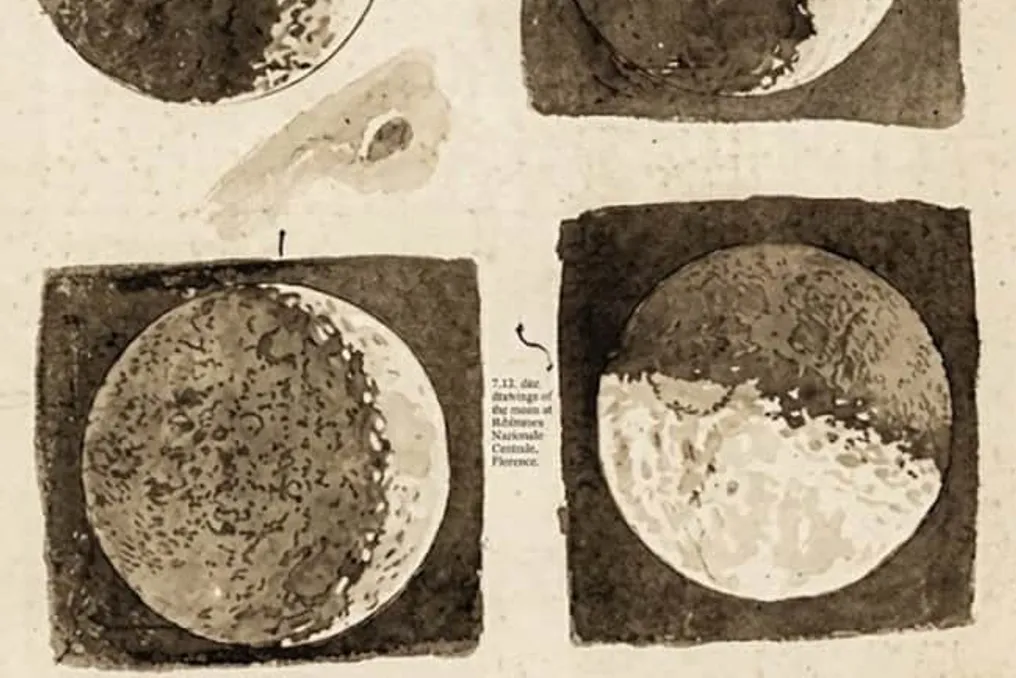
The study of these structures has changed our understanding of the Universe. For centuries, Aristotelian philosophy maintained that celestial bodies were perfect and unchanging. This concept began to weaken in the early 17th century when Galileo Galilei pointed his telescope at the Moon and discovered mountains, valleys, and shadows that demonstrated its uneven surface. Although humanity had observed the light and dark spots on the Moon since Antiquity, telescopic observations showed that the Moon is a world with a much more complex and interesting geology.
With the advent of space probes, and later the manned missions of the Apollo program, we began to study these structures in detail. Orbital images, surface measurements, and samples brought back by astronauts have confirmed that most craters were formed not by volcanoes, as some researchers once believed. They were carved by cosmic impacts, some of which were very powerful.
The process begins when an asteroid, a fragment of cosmic rock, collides with the Moon's surface at high speed. The impact releases a tremendous amount of energy in a very short time, compressing and excavating the ground, while fragments of rock are thrown outwards. A cavity forms, surrounded by ejected material. Depending on the size of the object, the impact speed, and the characteristics of the terrain, the crater can have various shapes.
The smallest are usually simple, bowl-like. They are formed by smaller impacts and come in a wide range of sizes. Barringer in Arizona is a typical example of this type of crater here on Earth. On the Moon, they cover its entire surface.
Larger ones are called complex craters. They reach tens of kilometers and were formed under the influence of larger objects that penetrated deeper into the ground. Their walls may collapse into terraces, the floor may become relatively flat, and the central area may rise due to rebound, forming one or more peaks. These include the craters Theophilus, Mareus, Aristarchus, and many others easily seen through a telescope.
With even larger impacts, enormous basins occur, some of which have several concentric rings. The South Pole-Aitken Basin, on the far side of the Moon, has a diameter of about 2,500 kilometers and is one of the largest and oldest known impact structures in the Solar System.
Some craters also stand out with bright rays appearing to emanate from their center. This is the case with Tycho, a relatively young crater with a diameter of approximately 85 kilometers. These rays consist of material ejected during the impact, which scattered across the surface. Over time, exposure to the space environment, including solar wind and micrometeorite bombardment, alters the properties of the material and reduces this contrast. Therefore, bright rays help identify geologically younger craters.
However, lunar craters also appear in curious sequences, such as rows of aligned depressions that can stretch over long distances. These structures, known as crater chains, can have different origins. In some cases, they may be the result of the fragmentation of a celestial body shortly before impact. In such a case, its pieces land on the surface sequentially, as happened in 1994 when fragments of Comet Shoemaker-Levy 9 struck Jupiter.
Another possible source is secondary impacts. When an asteroid hits the Moon, the material ejected during the collision can travel great distances before falling again, forming new craters. If these fragments land on the ground along an elongated line, they can form chains. But not every crater chain has the same explanation. Some linear structures may be related to cracks and geological, including volcanic processes.
And why is all this important? Because the lunar surface functions as an archive of impact history in the Solar System. The Moon lacks a dense atmosphere, rain, or rivers capable of rapidly destroying its traces of cosmic impacts, and it does not possess plate tectonics like Earth. Many of these markings have been preserved for billions of years, although subsequent impacts, volcanic activity, and other processes also alter the landscape.
By comparing the number and degree of preservation of craters in different regions, scientists can estimate the relative age of surfaces and reconstruct the history of the Moon. The most accepted hypothesis is that the Moon itself formed about 4.5 billion years ago as a result of a giant collision between the early Earth and another body roughly the size of Mars.
However, some evidence suggests that between 4.1 and 3.8 billion years ago, our satellite may have experienced a particularly intense period of impacts, known as the 'Late Heavy Bombardment,' possibly caused by changes in the orbits of giant planets. According to some models, the gravitational reorganization of Jupiter, Saturn, Uranus, and Neptune could have destabilized populations of small bodies, directing some of them toward the inner regions of the Solar System. But this story is not yet fully resolved.
The age of many ancient craters is difficult to determine, and scientists continue to debate whether the peak number of impacts was truly concentrated or if the bombardment gradually decreased from the initial stages of planetary formation. Understanding this difference is crucial for reconstructing the history of the Moon, Earth, and the conditions for the emergence of life here.
Our planet has undergone erosion, volcanism, and crustal movements that have erased many of its oldest traces. The Moon, however, preserves records of epochs that are much harder to study on Earth. This does not mean that all lunar craters are old or that the record is complete, but it provides fundamental clues about the evolution of not only the Moon and Earth.
Craters are present on the vast majority of rocky bodies in the Solar System, from the smallest to the largest. But the Moon has a special advantage: it is relatively close to us and allows us to study its structures using telescopes, probes, and even samples brought back to Earth. Every crater, every chain, and every basin represents a clue about the events that shaped these worlds. It is a true book of our cosmic history, located just one telescope away from us.