The Olhar Espacial program showcases two notable astronomical images weekly. Last week, two photographs produced during the 13th Paraiban Astrophotography Meeting were presented.
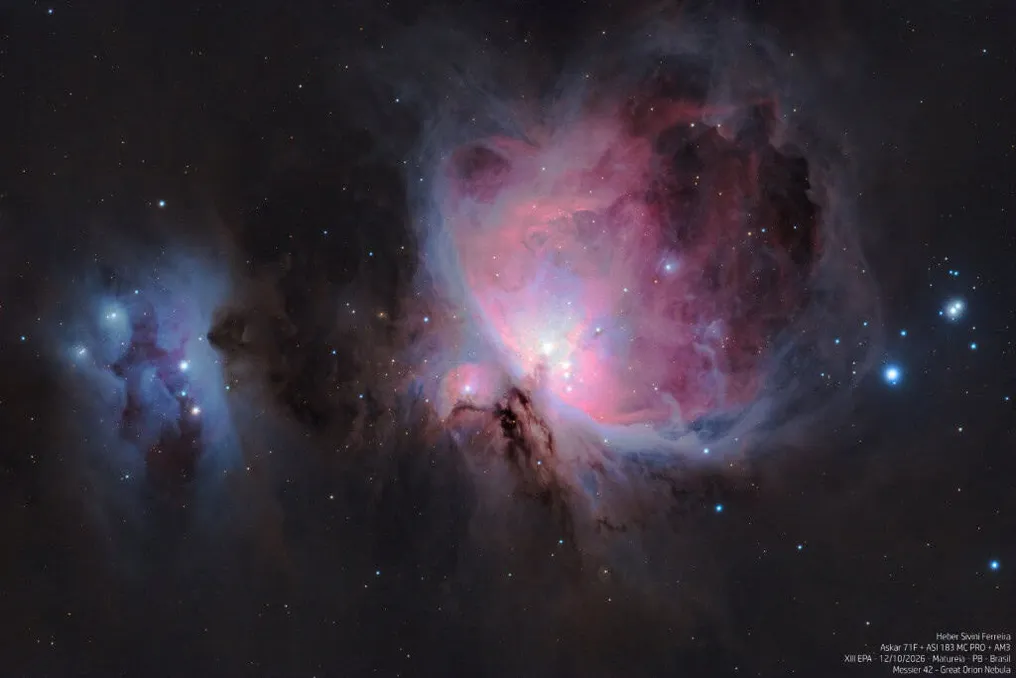
The first image is an impressive record of M42, also known as the Orion Nebula. This nebular formation is located approximately 1600 light-years away, in the direction of the Orion Constellation. Stellar winds played a part in these clouds, ionizing the hydrogen and giving it a reddish hue. The bluish areas around it reflect light, coming mainly from four young and hot stars located in the center, known as the Orion Trapezium. To the left, separated by a thick cloud of stellar dust, there is another nebula with a unique shape, called the Running Man Nebula.
The second image presents a magnificent record of the NGC 2070 nebula, nicknamed the Tarantula Nebula. This is considered the largest and most voluminous area of star formation in the vicinity of the Milky Way. Although it is about 160 thousand light-years away, it ranks among the brightest objects in the night sky. If it were close like the Orion Nebula, its extent would be equivalent to sixty full moons, and its brightness would be enough to cast shadows at night. Most of the energy that illuminates and energizes the gaseous clouds of the Tarantula comes from a central cluster composed of young and extremely hot stars.