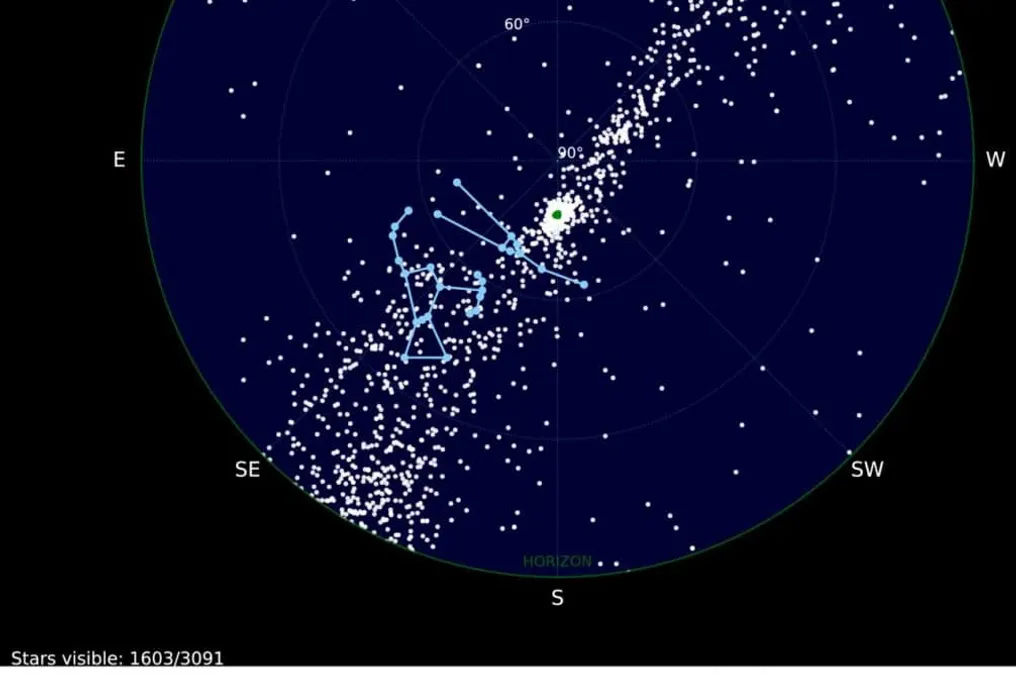
Located 444 light-years from Earth, the open star cluster known as the Pleiades is also referred to as Messier 45 (M45) or the 'Seven Sisters'. On Tuesday night (the 27th), this cluster will be in close proximity to the Moon from our planet's perspective.
The Pleiades cluster consists of six prominent stars, but it received the name 'Seven Sisters' due to historical observations. The core of M45 is composed of young, hot blue stars that formed within the last hundred million years. The blue glow of these stars, reflected by the gas clouds surrounding the cluster, makes the view of this patch of the night sky particularly remarkable.
According to the astronomical observation guide In-The-Sky.org, the maximum conjunction of the Moon with the Pleiades will occur at 22:38 Brazilian time, when they will be only 58.6 arcminutes apart. It should be noted that an 'arcminute' is a unit of measurement in astronomy used to denote very small angles in the sky; a full circle is 360 degrees, and 60 arcminutes equal one degree.
From the perspective of an observer in São Paulo, the pair will become visible at 21:13, situated at an altitude of 12° above the northeast horizon. They will reach their highest point in the sky at 1:27 on Wednesday (the 28th), rising to 42° above the northern horizon, before disappearing at dusk at 4:42, at an altitude of 23° above the northwest horizon.
During this period, the Moon is on the third day of the full moon phase (technically, in the waning phase, intermediate before waning), illuminated by 93%, with a magnitude of -12.7. The magnitude of M45 will be 1.3, and both objects will be located in the constellation Taurus. The brighter an object appears, the smaller its numerical magnitude.
Although the pair will not be close enough to fit into a telescope's field of view, it can be seen with the naked eye or using binoculars. The reason why the cluster, which appears as six stars, is called the 'Seven Sisters' is related to the fact that in ancient times, when the name was given, observers could instantly see seven main stars with the naked eye. Over time, one of them disappeared from sight due to the change in the position of the variable star Pleione, which approached Atlas, and both became perceived by the naked eye as a single star.