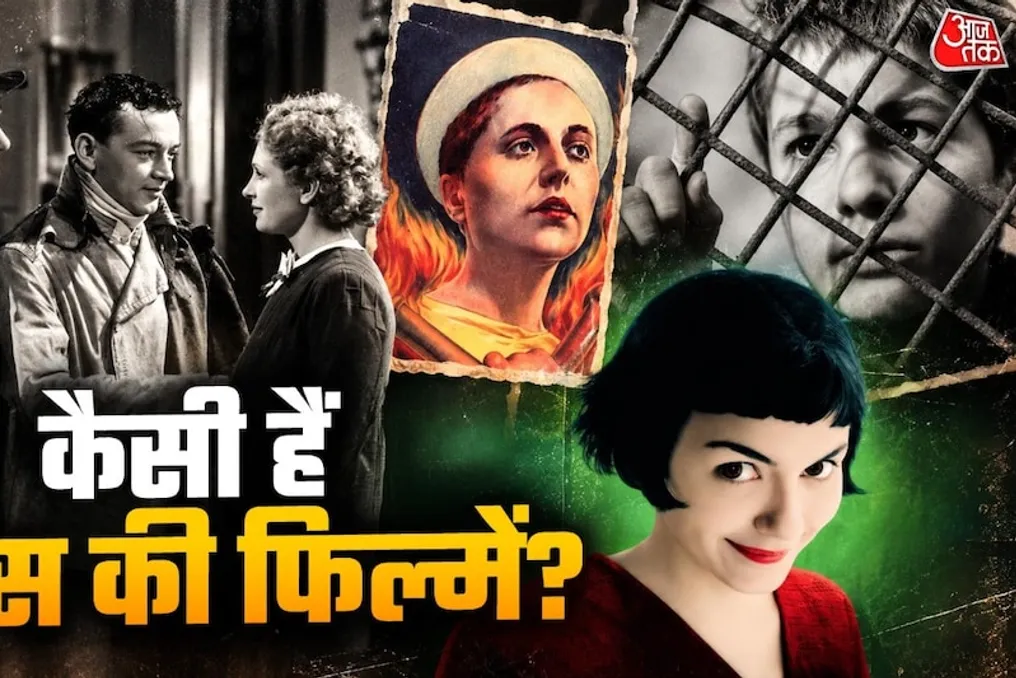
Massive protests are currently taking place in France: streets are filled with crowds, people are displaying placards with protest slogans, and clashes with the police are accompanied by loud shouts against the government. The country, which gave the world the ideas of liberty, equality, and fraternity, is today an arena of civil unrest.
Although France is traditionally associated with the Eiffel Tower, fashion, wine, and beauty, its contribution to the development of world cinema is enormous. French cinema played a key role in changing the ways films are created and perceived, from early stages of development to the formation of a new cinematic language school—the French New Wave—and modern narratives. French cinema has repeatedly proven that cinema is not just entertainment, but a form of free self-expression.
In this regard, we present an overview of ten French films that have had a profound impact on world cinema and served as a textbook for Hollywood directors.
When discussing classic French films from the 1930s and 1940s that laid the foundations of cinema, or the works of directors such as Jean-Luc Godard and François Truffaut who broke established narrative rules, it is impossible to ignore some iconic pictures. Among them stands the 1939 film 'The Rules of the Game,' directed by Jean Renoir.
This film is considered one of the greatest works of French cinema. By depicting the lives of wealthy people at luxurious parties, their romantic relationships, and the daily life of the service staff, Renoir exposed class inequality, hypocrisy, and the moral emptiness of French society. The strength of the picture lies in the fact that it questions the entire social structure rather than blaming any single villain. Although the film faced bans and protests upon release, it later entered the pantheon of the greatest world films.
Another famous French film is 'The Passion of Joan of Arc' (1928), directed by Carl Theodor Dreyer. The film, dedicated to the trial and death of the French national heroine, shows what emotional effect cinema can create, even without lavish sets, dynamic scenes, or an abundance of dialogue. Extreme close-ups of actress Renee Falconetti's face, conveying the fear, determination, and tension of the interrogation, make this work outstanding. The film's focus is not so much on a detailed account of historical events as on human faith, helplessness before power, and psychological torment. This film retains its place among the masterpieces of silent cinema.
The next film on the list is 'La Grande Illusion' (The Great Illusion) from 1937, also directed by Jean Renoir. War films often emphasize heroism, victory over the enemy, and national greatness, but 'The Great Illusion' questions the artificial boundaries created by war, telling the story of French soldiers captured by the Germans during the First World War. In this picture, the social background, personal relationships, and the general human experience of the soldiers are more important than their nationality. Renoir's perspective does not reduce war to a simple dichotomy of 'good one nation versus bad another.' This is why the film transcended its time, and its humanitarian orientation and anti-war ideas secured its place among the most important war films in world cinema.
The fourth most significant film on the list is 'Children of Paradise' (Les Enfants du Paradis) from 1945, directed by Marcel Carné. This film is considered one of the major achievements of French cinema during a period when the country was under German occupation and severe wartime conditions. The romantic story unfolds against the backdrop of 19th-century Parisian theatrical life and explores the relationship between a woman and various men striving to win her.
However, the world of the film is not limited to love and separation; it also contains the tension between acting skill, fame, desire, social status, and the artist's private life.
Next on the list is 'The 400 Blows' (Les Quatre Cents Coups) from 1959, directed by François Truffaut. This film attempts to understand the emotional abandonment and loneliness of a child hidden behind his antics, taking the narrative far beyond a typical children's story. A teenager named Antoine Doinel experiences misunderstanding both at home and at school. In an attempt to correct his behavior, adults fail to consider the reasons for such behavior. Truffaut, inspired by his own life experience, depicted the child's mind on screen without excessive sentimentality. The use of real locations, natural acting, and free camera helped the French New Wave gain international recognition. The final scene of this film is still considered one of the most memorable in film history.
The sixth most significant film is 'La Haine' (Hate) from 1995. The story begins in a poor residential area on the outskirts of Paris. Sixteen-year-old Abdel is severely injured after being beaten by the police; his condition is critical. Tension grows in the neighborhood afterward, and anger against the police intensifies. The plot centers around three friends: Vinz, Hubert, and Saïd. Vinz has Jewish roots, Hubert is of African descent, and Saïd is Arab. Despite differences in their identity, they belong to a marginalized community.