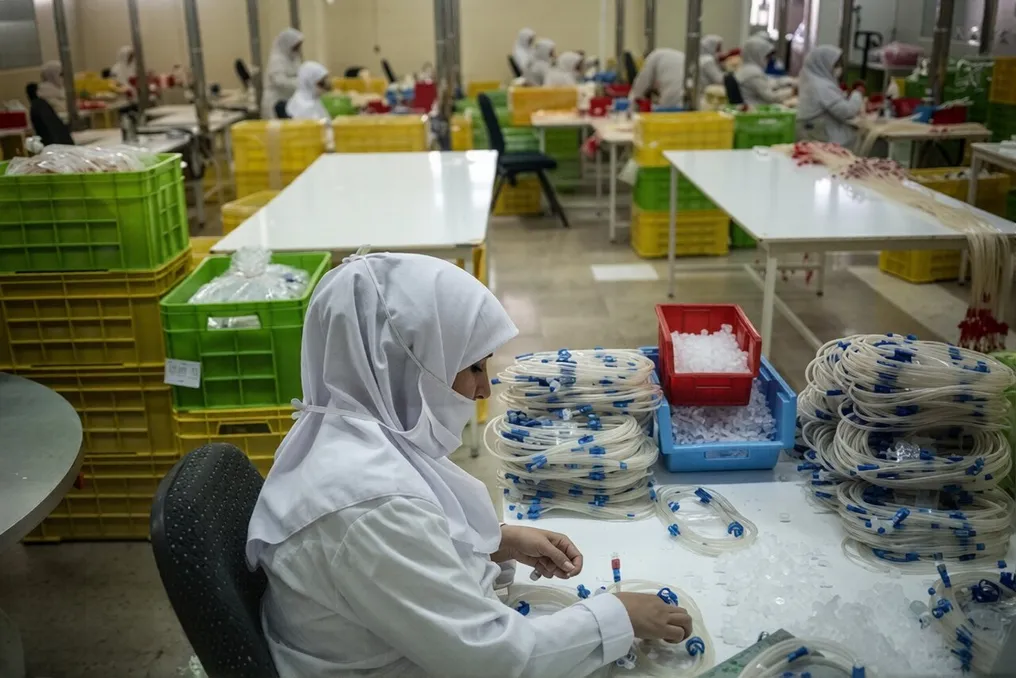
The sixth annual international healthcare exhibition and congress in Iraq, named Health Expo Iraq, will provide Iranian healthcare producers with a valuable opportunity to enter the Iraqi market and expand their business in the neighboring country.
The event is scheduled for October 28 to 31 and will take place at the Baghdad International Fair. The exhibition will feature a wide range of goods and services, including pharmaceuticals, medical equipment, laboratory instruments, hospital consumables, and healthcare services. Furthermore, seminars, workshops, and panel discussions will be organized for participants, which will promote experience exchange among industry specialists and establish new business contacts.
The Iranian delegation will set up pavilions to showcase the achievements and products of Iranian science-oriented companies. The goal is to establish connections between experts and stakeholders from Iran and Iraq, conduct B2B meetings, and identify the needs of the Iraqi healthcare market.
Iranian ambassadors in Iraq and embassy advisors will visit the Iranian pavilions to meet with companies and explore potential for strengthening bilateral relations.
Iraq, with a population exceeding 46 million and a pharmaceutical market valued at $4 billion, is one of the largest healthcare markets in West Asia. The country plans to cover 70 percent of its pharmaceutical needs through domestic production by 2027.
Strengthening Academic Ties to Address Domestic and Regional Challenges
On October 19, Mohammad Javad Najafi, Iran's scientific advisor in Iraq, and Haider Abd Dahed, Deputy Minister of Higher Education and Scientific Research of Iraq, discussed ways to strengthen academic cooperation between the universities of the two countries. The main focus was on approaches to solving problems and meeting both domestic and regional needs.
During this meeting, as reported by IRNA, key topics such as joint research, scholarship provision, simplification of educational matters for students, and preparation for the 'Iran-Iraq Third Week of Science' were discussed. Officials also spoke about conducting joint research projects, supervising postgraduate dissertations, and publishing joint scientific articles in authoritative international journals.
Another issue raised by both sides was the educational difficulties faced by students in the countries of mutual cooperation. In September, Alireza Afsharfar, Director of Shiraz University, and Najafi examined opportunities to expand academic ties with Iraqi universities.
The meeting took place on September 26, where methods for developing joint curricula, student and faculty exchange, attracting international students, and conducting joint research projects were discussed, according to msrt.ir. Other topics noted by officials included establishing dual degree programs, holding summer schools and educational courses in English and Arabic, and participation in the Iran-Iraq Week of Science.
Officials also emphasized the need to exchange the scientific and educational potential and capabilities of Shiraz University with Iraqi students, as well as implementing research projects on common issues such as dust storms and the environment. They also discussed ways to strengthen ties with universities and scientific centers in Lebanon and Kurdistan.
Iran as a Regional Leader in Healthcare
In May 2025, Hanan Balkhy, Director of the WHO Eastern Mediterranean Regional Office, stated that Iran is a leading country in expanding its healthcare system and ensuring access to universal health coverage. Balkhy highly praised the country's achievements in recent years, noting that thanks to the expansion of primary healthcare, increased access to rural healthcare, maintenance of high vaccination rates, and reduction in maternal and infant mortality, Iran has become a successful example for the region. These remarks were made during a meeting with Health Minister Mohammad Reza Zafarkandi.
The issue of drug and medical equipment production and achieving self-sufficiency in these areas is one of the government's priorities, Zafarkandi stated in March 2025. He emphasized that medicine and medical equipment are two important spheres related to people's health, adding: 'We are striving to achieve self-sufficiency in the supply of medicines and medical equipment.'
According to the head of the Iranian Medical Equipment Producers and Exporters Union, medical equipment is exported to over 60 countries annually. Abdolreza Yakubzadeh reported that more than 70 percent of medical equipment and 100 percent of standard hospital beds are produced domestically. He also added that over 95 percent of specialized intensive care and resuscitation beds, as well as over 85 percent of operating room equipment, such as ventilators and other equipment, are manufactured in the country using advanced technologies.
Approximately 600 companies operate in the country that produce medical equipment, which manufacture about 99 percent of drugs supplied to the domestic market. Medical equipment manufacturers in the country create and supply over 10,000 types of medical equipment to both domestic and foreign markets. Currently, various types of laboratory equipment are produced at prices significantly lower than comparable imported products.