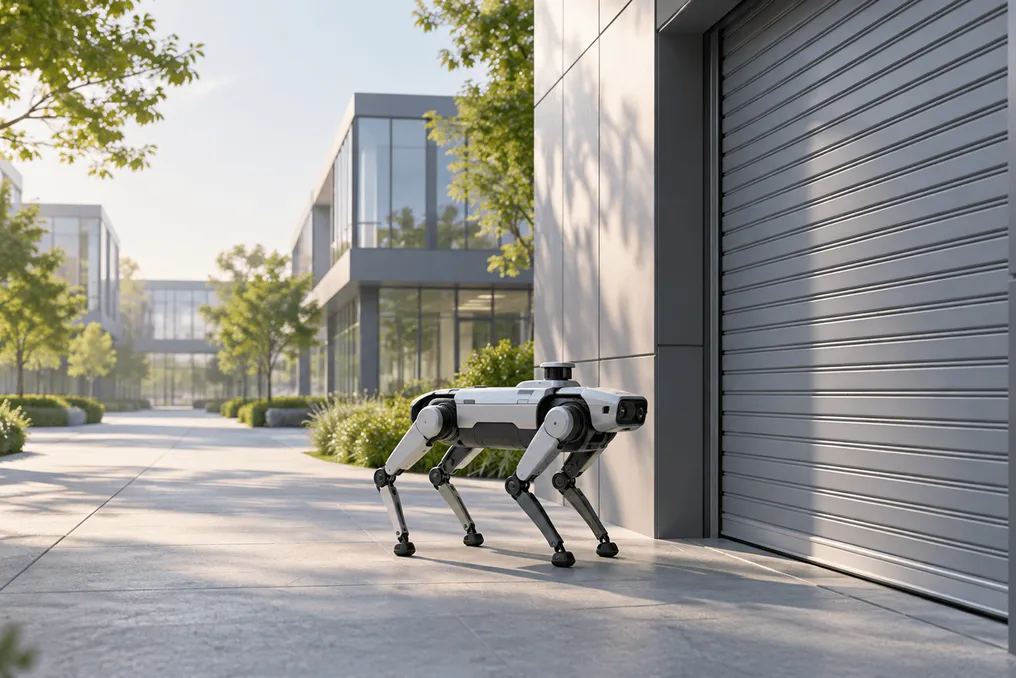
Amap, the mapping and navigation platform for Alibaba, has deployed its quadruped robot, Tutu, to conduct regular inspections on the premises of the Alibaba campus in Xisi, located in Hangzhou. During the Qincheng Conference 2026, Amap presented a case study and a joint solution for a smart campus with the Alibaba Group's General Affairs Department and the Qincheng Zhihui Campus Services division, according to a report by the Chinese robotics publication Robot Qianzhan published on Tencent News.
It is important to note that Amap does not develop its own hardware for robots or manage campus operations. Instead, the company provides intelligent spatial solutions and task execution capabilities: it utilizes a robotic body for mobility and integrates it with campus task and operations management systems.
In recent months, Tutu has been tested in areas such as assisting visually impaired people, conducting tours, purchase assistance, inspections, and last-mile delivery. The software underpinning the robot's operation is Amap's ABot system, which is structured in three levels.
The basic data layer, including ABot-World and ABot-Earth, provides the world model and spatial data base for understanding the environment and simulation. The modeling layer includes the basic navigation model ABot-N1 and the manipulation model ABot-M0.5. The agent layer, consisting of ABot-AgentOS and ABot-ER, is responsible for task planning, execution, and memory, and also tracks object states and spatial relationships.
The movement system uses a dual-speed approach: the cloud performs high-level planning based on task data and maps, while the robot itself generates its route on the device using live camera data. This allows it to adapt to narrow corridors, crowds, and temporary obstacles instead of stopping.
Novelty of the System in the Xisi Campus
The novelty in the Xisi campus is the work order loop. This joint solution transforms the service catalog, inspection targets, inspection frequency, and acceptance standards into executable tasks that are then linked to maps, access permissions, campus objects, and work orders. For example, for a fire door, the robot must reach the correct location, adjust the viewing angle so that the photo meets inspection requirements, and send the captured evidence for review and action by staff.
Complex cases are reviewed and tagged by humans, after which the information is returned for model evaluation and testing. Additional tasks, such as checking a temporary construction site, can be inserted, and the robot resumes its normal route.
Roles are distributed among four parties: the Alibaba General Affairs team sets the actual tasks and standards; Qincheng Zhihui handles service maintenance and acceptance; Amap is responsible for navigation and multi-stage execution; and campus specialists make the final decisions. The initial use case is security patrolling, with plans for light delivery, guest tours, and fire safety support.
An open question remains regarding the possibility of reusing this architecture in other campuses while maintaining the standards for each task and lines of responsibility.