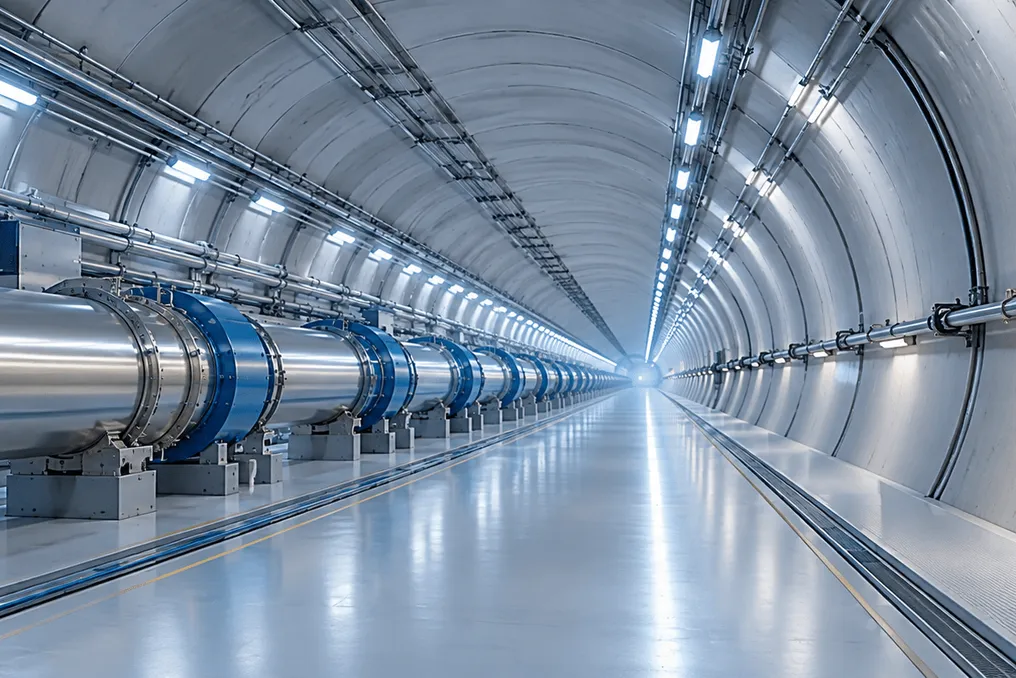
The Chinese Spallation Neutron Source (CSNS) in Dongguan has reached a beam power level exceeding 200 kW and has officially entered operational mode for users at this level, which is double the capacity planned for the first phase of the project.
The Institute of High Energy Physics (IHEP) of the Chinese Academy of Sciences announced this achievement on October 24, specifying that it was realized on October 20 after an almost month-long period of beam commissioning.
IHEP views this moment as an important milestone for the second phase of the project, CSNS-II, and as key confirmation on the path toward the target of 500 kW.
To minimize disruptions for users, the CSNS-II team is installing modernization equipment during the facility's annual summer shutdown. This year, front-end equipment for the linear accelerator, all solid-state modulators, and the third magnetic alloy cavity in the fast-cycling synchrotron have been installed and tested. Thus, all CSNS-II accelerator equipment is now installed, with the exception of the superconducting sector.
Operating at increased power complicated the task of matching hardware and controlling beam losses, as changes in equipment parameters were combined with effects such as space charge and beam impedance instability. The accelerator team tuned key sections of the modernized linear accelerator, including the RFQ and MEBT, and made significant adjustments to the operating regime. IHEP reports that this allowed for the elimination of collective beam instability and raised the beam density index above the highest level recorded for comparable accelerators worldwide, while beam losses actually decreased with increasing power.
On the target side, the team installed and tested a new target, T8, on September 25. This target is equipped with a cooling system designed to operate at 200 kW and new temperature monitoring for the target plates, which will serve as the basis for designing the high-power CSNS-II target. Additionally, maintenance was performed on 11 of the facility's neutron detectors available to users during the summer.
IHEP also notes that this test run provided experience for the next stage—increasing the energy of the linear accelerator beam to 300 MeV. Construction of CSNS-II is about halfway complete; construction was finished at the end of September, and a 1 kW-class two-Kelvin helium refrigerator was installed on October 15. After the modernization is complete, the source is expected to provide researchers in materials science, life sciences, and energy with a more powerful neutron source.