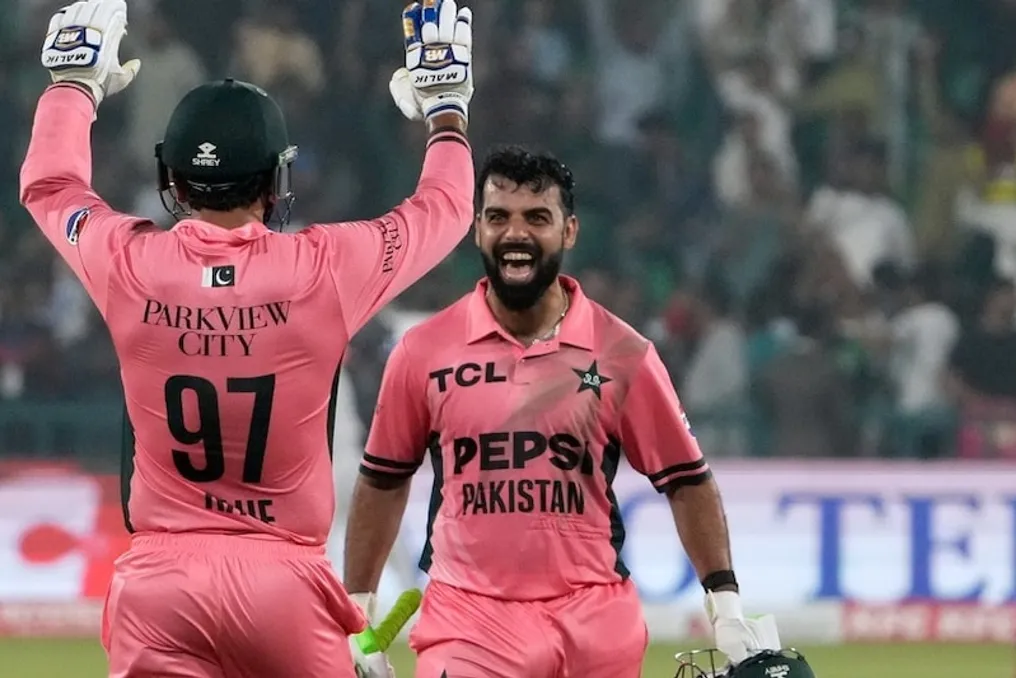
In the ODI Tri-series match between Pakistan and England, held on October 25th at Gaddafi Stadium in Lahore, Shadab Khan played a decisive innings, turning a defeat into a victory for the Pakistani team.
Pakistan lost nine wickets with a score of 154 runs, and an additional 88 runs were needed for victory. However, Shadab, along with Haris Rauf, managed to change the course of the game by adding 89 runs without loss of wicket for the tenth wicket, securing the win for Pakistan and qualification for the Tri-series final.
Shadab Khan scored 113 runs without loss of wicket off 96 balls, including 13 fours and five sixes. This marked his first century in ODI format. Haris Rauf, batting at number eleven, supported him by scoring seven runs.
Despite England having the last wicket remaining, both batsmen maintained composure under pressure. Ultimately, Rauf hit the winning four, bringing an unforgettable victory to Pakistan.
The partnership between Shadab Khan and Haris Rauf became the largest partnership in successfully chasing a target in ODIs for the tenth wicket. Previously, this record belonged to Derek Murray and Andy Roberts, who scored 64 runs without loss of wicket against Pakistan during the 1975 World Cup.
During his innings, Shadab reduced the pressure of the target by constantly hitting boundaries. Rauf, on the other side of the field, defended his wicket and played thoughtfully when necessary. Their combined play completely changed the course of the contest.
Prior to this, Pakistan captain Shaheen Shah Afridi played a key role in restricting England's score to 241 runs. He took four wickets for 46 runs, while Rajaulullah, making his ODI debut, secured two wickets.
England's innings started poorly, and the team lost three wickets for only 19 runs. After this, Ben Duckett stabilized the game, scoring 105 runs off 111 balls. Sam Curran earned 42 runs, and they formed a partnership of 93 runs for the fifth wicket. In the end, Gus Atkinson added 36 runs without loss of wicket, taking the team to an acceptable total.