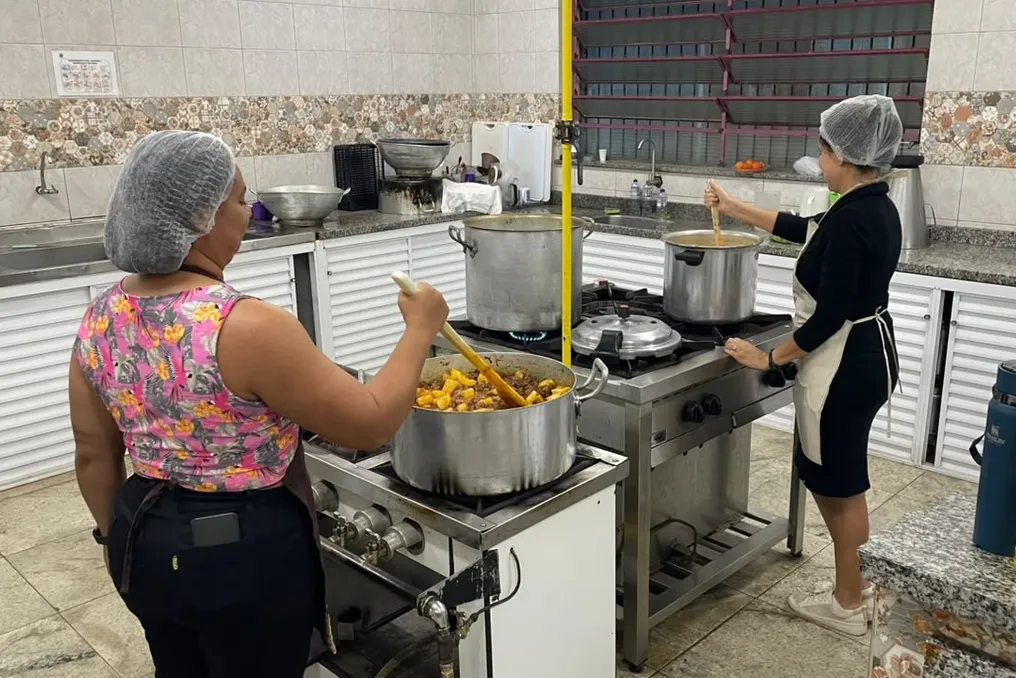
The Municipal School «Professora Maria Aparecida de Luca Moore», located in Limeira (SP), provided meals for staff acting as poll workers during the election period. The menu served that day consisted of rice, beans, pot roast accompanied by cassava, sautéed kale, and pineapple juice.
This initiative to provide food to poll workers and the community is the result of the school administration and direction, supported by donations. The responsible cook, Claudia Aparecida de Mário, began preparations on Sunday at 7 am, with service expected to end around 3 pm.
Claudia stated that providing meals brings benefits such as convenience, community support, and alignment with the concept of Citizen School. She emphasized that since poll workers do not need to leave the premises, the lunch allows them to remain at the school. Furthermore, she mentioned that the rainy weather that day contributed to greater general tranquility.
Election Information
The elections contested include Senator Flávio Bolsonaro (PL) and President Luiz Inácio Lula da Silva (PT), who seeks re-election. In the first round, held on October 4th, Flávio obtained 47.03% of the votes, surpassing the 45.16% registered by Lula.
For voters, the Superior Electoral Court (TSE) provides an online consultation system, accessible through the official website, where it is necessary to enter CPF or voter ID, date of birth, and mother's name to find the electoral domicile, including voting zone, section, address, and municipality.
Required Documentation to Vote
To ensure access to the ballot box, it is mandatory to present an official photo identification document, in addition to signing the voting sheet and receiving the receipt. Although not mandatory, carrying the voter registration card assists the citizen in indicating the electoral section.
Accepted documents include identity card (RG), social identity, work card, national driver's license (CNH), passport, or another legally equivalent document, professional category cards recognized by law (such as OAB, CRM, CREA), and the military reserve certificate for cis or transgender men. Documents will be accepted even if expired, as long as they allow for the identification of the voter. Birth and marriage certificates are not valid for voting because they do not have a photograph.
Additionally, the voter can bring a paper containing the electoral slip with their candidate numbers noted, or use the e-Título application.
Restrictions on Electronic Device Use
The TSE prohibits the use of mobile phones, tablets, two-way radios, cameras, smart glasses, and any other electronic device capable of recording, transmitting, or disclosing the voter's choice inside the voting booth. However, using the device to display the e-Título is permitted, and this must be presented to the poll worker at the time of voting. It is strictly illegal to photograph or film the electoral process, whether one's own or that of others.
Voting Procedure
The voter must enter the desired candidate's number into the electronic ballot box and verify that the name and photo displayed on the equipment are correct. If there is an error, it is possible to press the 'correct' key and type the appropriate number. Upon confirmation, the ballot box emits a validation sound, preventing subsequent changes.
If the voter chooses not to vote for any candidate, they can select the 'blank' key and then 'confirm'. The TSE clarifies that a blank vote is not counted as a valid vote, but is only recorded for statistical purposes. There is also the null vote, which occurs when the voter enters a number that does not correspond to any candidate or party and finalizes the selection.