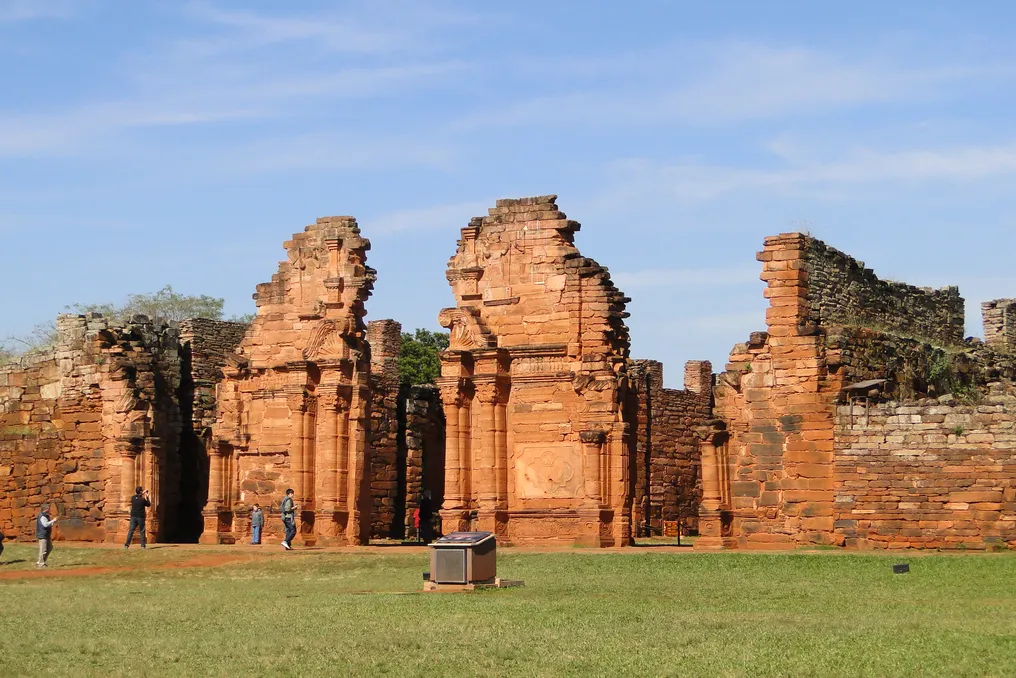
The Missions region, covering Argentina, Paraguay, and southern Brazil, is known for the ruins of old Jesuit settlements built between the 16th and 18th centuries. Along the border, in the gaucho towns of San Miguel das Missões and Santo Ângelo, the traces of this heritage are best known.
However, it is in Argentina that the most complete example of such an ancient settlement is located—the ruins of San Ignacio Mini, situated in the current municipality of San Ignacio. Although the church facade here is not as majestic as in San Miguel, these ruins are better preserved over time, considering the remains of other structures.
These ruins have been a UNESCO World Heritage site since 1984 and are only 250 km from the border with Brazil, near the Foz do Iguaçu region. Ruins of other settlements, such as Santa Ana, Santa Maria la Mayor, and Nuestra Señora de Loreto, are also preserved in the vicinity. History, architecture, and archaeology enthusiasts are recommended to plan a complete trip along the Missions route, both inside and outside Brazil.
San Ignacio Mini represents the most impressive archaeological site in the Misiones province of Argentina. Walking through the old settlement, one can see the structures and buildings that constituted daily life in the Mission, including the plaza, church, college, and cemetery.
At the entrance to the complex is a mansion that functions as a museum, telling the story of the Jesuit missions. The collection includes historical artifacts, sculptures, and a model of the original settlement. The museum demonstrates the influence of colonizers on the indigenous peoples of the region: the sculptures and architecture of the site contain elements of European Baroque, and the sound of the Guarani people blends with violins and flutes; examples of music can be heard in the multimedia hall.
Regarding the ruins themselves, visitors should prepare for walking, as they are located on a large open area. A guide contract is not required: audio guides are available, explaining the history and the buildings. There are also signs distributed among the ruins with printed images showing how the original structures looked during the Mission period.
In the evening, San Ignacio Mini hosts a light and sound show with projections on the ruins (modeled after the light and sound show in San Miguel das Missões), recounting the history of the Jesuit missions. This attraction is one of the main highlights of the visit.
Leaving Foz do Iguaçu, one can travel by private or rented car. With careful time planning, a day trip is possible, although this would require skipping the evening light show or being prepared to spend the last part of the trip at night.
For those already in Argentina, Puerto Iguazú serves as a landmark, the 'sister' city of Foz do Iguaçu in the Misiones province. The ruins are about 3-4 hours away by car, depending on the pace of travel.
If San Ignacio is part of a broader route that includes Brazilian Missions, planning should take more than one day. Leaving San Miguel das Missões, the most famous point on this side, the shortest route is about 285 km, but the travel time must also account for the need to cross the border by ferry, at the Port Mauá and Alba Posse border, which makes the route longer. It is rarely covered in less than 5 hours.
The best time to visit the ruins is spring and autumn. This way, one can avoid the winter cold and the scorching summer heat in the region. The ruins are open from 7:30 AM to 6:00 PM, and a ticket must be purchased for entry. Tickets can be bought at the box office with cash or via QR code (cards accepted on site) or in advance on the website.
The general entrance fee is 22 thousand Argentine pesos based on September 2026 prices (about 75 Brazilian reais), but discounts are available for residents of Misiones and Argentine citizens. A major advantage of the pass is that it is valid for 15 days after purchase and can be used to visit other Jesuit missions in the province.
The Missions were founded by the Congregation of Jesus (Jesuits) with the aim of converting the indigenous peoples of the region to Catholicism and protecting them from the slavery of colonizers. The settlements were organized in the pattern of European civilization, with life controlled by priests. The Guarani people lost their autonomy and were forced to abandon a significant part of their customs during this process.
The indigenous inhabitants living in the missions obeyed the rules of the missionaries and the system of collective production, which ensured the survival of the mini-community. The era of the Missions ended in the so-called Guaranitic Wars, when the settlements were suddenly included in land exchange agreements signed by Portugal and Spain. They were abandoned against bandits and the armies of the two European powers, and the settlements were quickly destroyed between 1753 and 1756, and most of the indigenous population fighting in the conflict was annihilated.