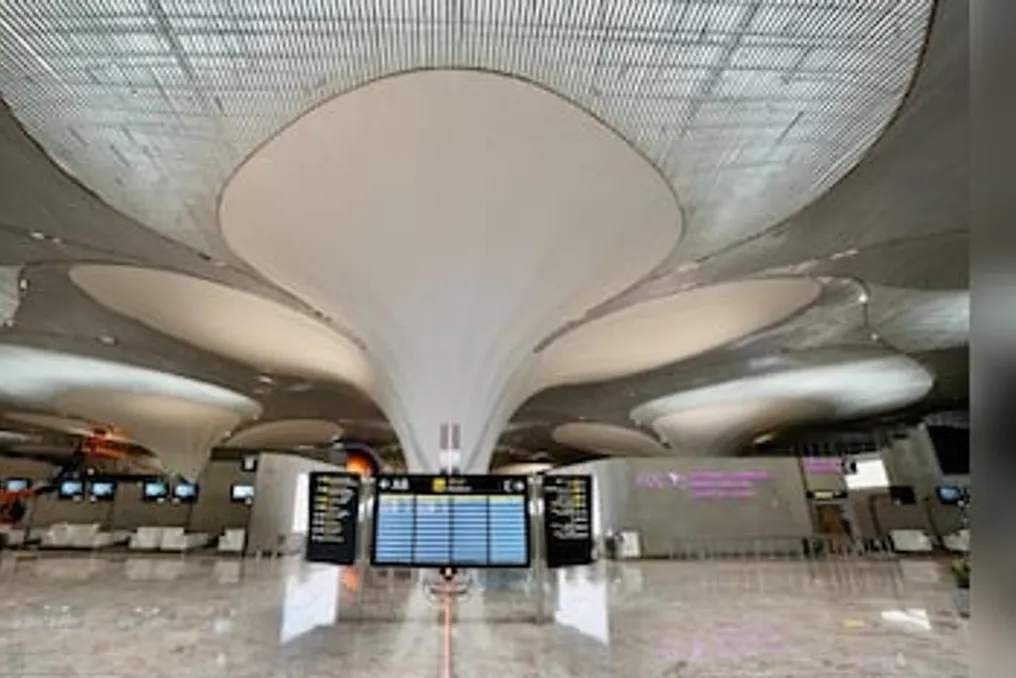
IndiGo and Air India Group announced on Sunday plans to shift about a third of their international flights from Mumbai airport to Navi Mumbai airport between January and the summer season of next year. This decision marks a departure from the stance of foreign airlines that opposed the proposed relocation.
According to data from the analytical firm Cirium, IndiGo currently operates 233 international departures per week from Mumbai airport. The airline, which is the largest in India, has stated its intention to move 12 daily flights, totaling 84 flights per week, to Navi Mumbai. This accounts for 36.1 percent of its current international departures.
Air India Group, which includes Air India and its subsidiary Air India Express, operates 134 international flights per week from Mumbai, according to Cirium data. On Sunday, the group named six destinations whose services it plans to transfer to the new airport. These destinations represent 46 weekly flights in the current schedule, or 34.3 percent of the group's total flights.
Thus, both major Indian airlines have effectively agreed to the long-standing demand by Mumbai International Airport Limited (MIAL) to relocate approximately one-third of their international flights to the new airport. Both airport operators—MIAL and Navi Mumbai International Airport Limited (NMIAL)—are under the control of the Adani Group.
In recent weeks, the airlines had presented a united front against MIAL's plan to move one-third of each airline's international flights to Navi Mumbai, a move necessary for the demolition and reconstruction of Terminal 1 at Mumbai airport.
MIAL initially proposed moving 265 out of 770 weekly international flights from Mumbai to Navi Mumbai. Until recently, the Airline Operators Committee (AOC), representing airlines at Mumbai airport, rejected these changes. Foreign carriers voiced serious objections. For instance, Air France-KLM stated on September 30th that separating passenger operations between the two airports made no operational sense, while Emirates reported on October 14th that Navi Mumbai required more auxiliary facilities before it could handle large-scale international operations.
IndiGo announced on Sunday that it plans to commence international operations from Navi Mumbai in February 2027 and gradually transfer 12 daily international flights from Mumbai airport between February and July. These services cover 11 destinations, including Bahrain, Riyadh, Dammam, Jeddah, Medina, Kuwait, Ras Al Khaimah, Fujairah, Muscat, Dhaka, and Jakarta. Furthermore, the airline will introduce a daily flight to Kathmandu, expanding its international network from Navi Mumbai to 12 destinations.
IndiGo will also transfer domestic flights required to connect passengers with these international services. The airline noted that this transition will free up capacity at Mumbai airport for the expansion of its international network in 2027, including new routes to Asia, Africa, and Europe using its growing fleet of Airbus A320 and A321, including the long-haul A321XLR.
IndiGo and Adani Airport Holdings Limited (AAHL) emphasized in a joint statement: 'The phased transition is designed to support a transparent, fair, and proportional redistribution of capacity within the dual system of Mumbai airports, taking into account each airline's presence at Mumbai airport.'
Air India Group announced on Sunday plans to gradually transfer services to six destinations—Jeddah, Riyadh, Dammam, Doha, Muscat, and Sharjah—to Navi Mumbai. This process is expected to be completed by the summer schedule of 2027. The group also reported that Air India Express will begin four daily domestic flights from Navi Mumbai in December 2026. The transfer of services to Kuwait and existing flights to Oman are planned for early 2027, with the Kuwait transfer depending on necessary approvals.
The reconstruction of Terminal 1 at Mumbai airport is expected to require the decommissioning of capacity designed for approximately 5 million passengers per year, starting from the summer schedule of 2027. MIAL stated that it will restore and maintain historical slots after the reconstruction of Terminal 1, which is projected to resume operations by 2030. Slots refer to allocated time for the takeoff or landing of a specific flight.
Until now, the airlines had jointly questioned the basis for the proposed transfer and requested detailed data on the capacity of each terminal at Mumbai airport. In a subsequent announcement last Monday, MIAL clearly stated that individual airlines are free to decide whether to transfer part or all of their operations to Navi Mumbai, temporarily suspend operations at Mumbai airport until Terminal 1 opens, or choose other options.