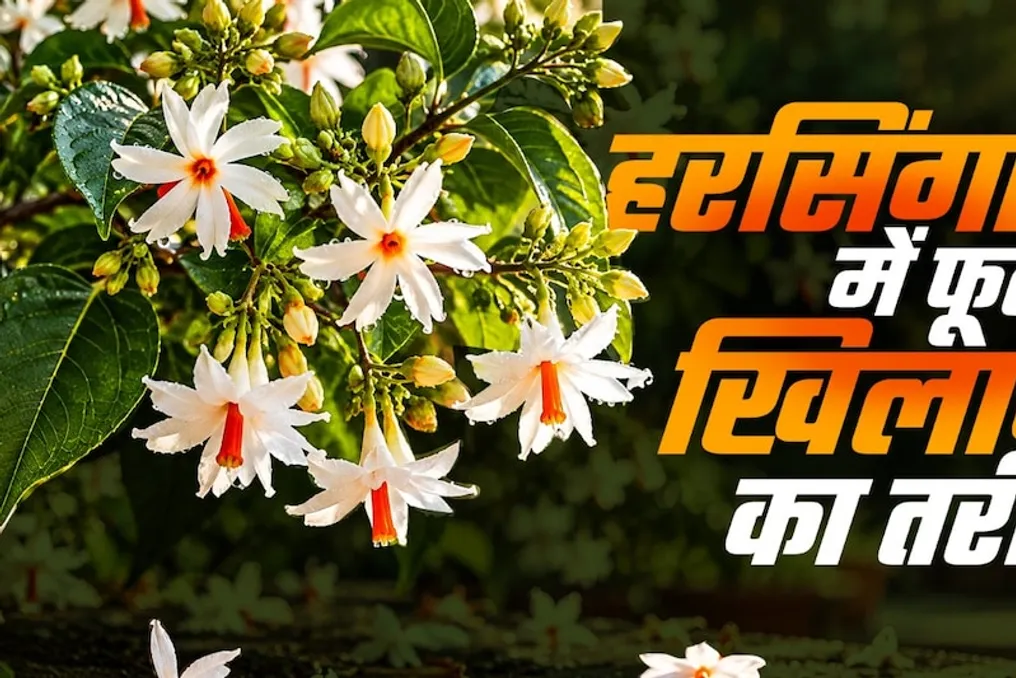
Many people are currently engaged in gardening, and among them, growing Harsingar, also known as Parijat, is popular. When the Harsingar plant blooms with white-orange flowers, the entire yard fills with fragrance. Due to its beauty, people like to plant it on balconies, rooftops, and in gardens.
However, there are often complaints that the plant does not flower, even despite careful care. Sometimes the leaves begin to wilt, and sometimes the entire plant dies, and owners do not understand what exactly the problem is.
If you also have a Harsingar growing at home and it is not flowering, you might be unknowingly making mistakes during care. In fact, excessive sunlight, lack of nutrients, and waterlogging in the soil can negatively affect the plant's growth and flowering. The good news is that by paying attention to a few simple points, you can help your plant stay healthy.
Below are three important aspects of caring for the Harsingar plant that will help you achieve abundant flowering.
- Do not place the plant under too bright sun
The Harsingar plant needs sunlight for good growth, but overly intense sun can damage its leaves and affect flowering. Therefore, the plant should be placed in soft morning sun. During peak heat hours when the sun becomes too strong, the pot should be moved to a place where there are fewer direct rays, but still good lighting.
- Do not forget to fertilize on time
If Harsingar is not flowering, one of the reasons may be a lack of nutrients in the soil. To maintain the health of the plant, fertilizers must be applied regularly. Vermicompost or organic fertilizers can be used. Special attention should be paid to the plant's needs during the flowering period. Harsingar usually flowers from August to December, although this period may vary depending on the weather and the condition of the plant itself. It is important to apply fertilizer in moderate amounts, as an excess of fertilizer can also harm the plant.
- Do not allow waterlogging in the pot
One of the most serious mistakes in plant care is watering with too much water. If water stagnates around the roots of the Harsingar for a long time, the roots can rot. This negatively affects the plant's health, causing leaf wilting. Before watering, always check the moisture level of the soil. If the soil is already moist, it is better to refrain from watering for some time. Furthermore, it is crucial that the pot has drainage holes to drain excess water so that moisture does not accumulate around the roots.
Other aspects to consider
To keep the Harsingar plant lush and green, it is not enough just to water and fertilize it. You must also monitor the type of soil, the level of light, and the space in which it grows. If the plant's leaves are constantly yellowing or its growth stops, you should first check the care methods. Instead of overwatering or fertilizing unnecessarily, you need to understand the plant's needs and make appropriate adjustments.