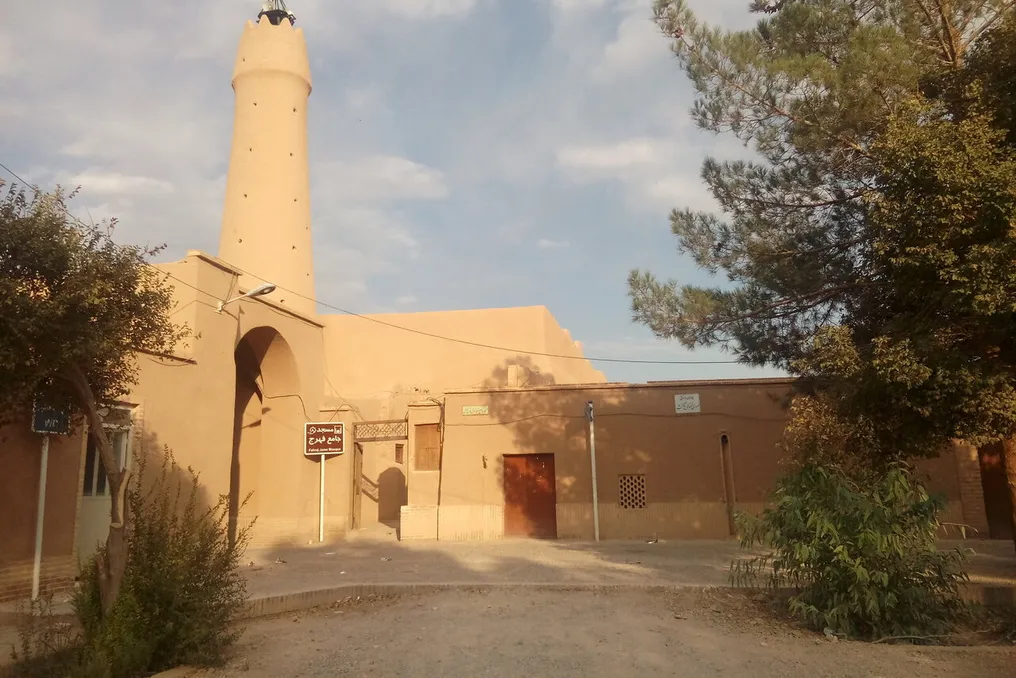
Located near the historic city of Yazd in central Iran, the Jame Mosque in Fahraj, also known as Masjid-e Jami Fahraj, is an outstanding site for travelers interested in the history, architecture, and Islamic heritage of Iran. A distinctive feature of this mosque is its simple earthen construction, ancient vaults, and historical minaret, which provide insight into an important period in the development of Iranian religious architecture.
The mosque is situated in Fahraj, approximately 25–30 kilometers southeast of Yazd, along an ancient route connecting Yazd with Bafq. Located in a arid landscape at the edge of the desert, the village reflects the region's long adaptation to dry conditions and traditional water supply systems, including qanats and deep wells.
A Landmark of Early Islamic Architecture
The Jame Mosque in Fahraj is widely recognized as one of the oldest surviving mosques in Iran. Historical accounts link its construction to the early Islamic period, following the conquest of Yazd by Muslim armies in the first century AH. However, the exact date of construction, the original patron, and the earliest history of the building are not definitively established. There has also been speculation about an even earlier origin, partly due to the region's pre-Islamic heritage and the historical practice of adapting existing sacred sites for new religious purposes.
The mosque holds particular architectural significance because it preserves elements related to the transition from early construction systems using columns and lintels to more developed vaulted structures. Alongside the Tarikhaneh in Damghan, Semnan province, it demonstrates an important stage in the development of the Iranian mosque, where massive piers increasingly replaced columns as the main load-bearing supports.
Built predominantly from adobe bricks and sun-dried materials, the mosque shows how local building methods adapted to religious architecture in a challenging desert environment. Its restrained appearance, with minimal decorative ornamentation, distinguishes it from many later monumental mosques in Iran.
Courtyard Framed by Ancient Arches
The mosque's architectural composition centers around an enclosed courtyard surrounded by arcades and a vaulted prayer hall. The courtyard, paved with clay tiles, contains a central ablution reservoir, which is currently empty. Thick rectangular piers divide the arcades into arched sections, creating a balanced rhythm along the internal facades.
The prayer hall is equipped with traditional Iranian cylindrical vaults supported by sturdy brick piers. These vaults, along with the oval and pointed arches over the entrances, reflect a combination of structural ingenuity and architectural traditions associated with the transition from the Sasanian era to the Islamic period.
There are three entrances in the prayer hall, with the central entrance being wider than the two side entrances. This arrangement reflects the importance of the main axis leading to the Qibla, the direction of prayer. The building also contains two mihrabs, or prayer niches, located close to each other. The larger, main mihrab is made of plaster and measures approximately 2.32 meters wide and 3.24 meters high.
Unlike many famous Iranian mosques, the Jame Mosque in Fahraj lacks a prominent dome, intricate tilework, or extensive inscriptions. Its architectural interest lies more in its proportions, construction methods, and the preservation of early building forms.
An Example of an Early Period Iranian Minaret
One of the most notable features of the mosque is its earthen minaret, which is believed to have been added later, possibly in the 10th century. Together with the early minaret in the ancient city of Nain, it represents an important preserved example of the development of the Iranian minaret.
The structure is shaped like a tapering cylinder with an internal spiral staircase, illuminated by narrow openings in the outer walls. A projecting balcony and triangular crenellations emphasize its vertical profile, creating a sharp contrast with the low, horizontal contour of the mosque's roof.
The minaret is significant not only in its immediate surroundings. The development of the cylindrical minaret became an influential feature of Islamic architecture, and related forms spread to regions such as Iraq, Syria, Anatolia, Afghanistan, and India in subsequent centuries.
A Pleasant Stop for Cultural Travelers
For visitors exploring Yazd and its surrounding historic settlements, the Jame Mosque in Fahraj offers the opportunity to discover a lesser-known architectural monument away from the region's more opulent structures. Its modest appearance encourages a closer study of the details of early Islamic construction, from the placement of arches and piers to the geometry of the vaulted prayer hall.
The mosque is particularly appealing to those interested in architectural history, archaeology, and cultural connections between pre-Islamic Persia and the Islamic period. Its location in Fahraj also makes it a potential stop on a journey through villages and desert landscapes southeast of Yazd.
However, the simplicity of the mosque has led to it receiving less public attention than some of Iran's more richly decorated historical buildings. Its historical significance lies precisely in the architectural innovations it preserves—features that were gradually overshadowed by later mosque designs, including the four-iwan plan, which became popular under the Seljuks.
For those seeking to understand Iran beyond its famous tiled domes and monumental courtyards, the Jame Mosque in Fahraj offers a compelling encounter with the foundations of the country's Islamic architectural heritage. It serves as a reminder that some of the most significant historical sites are not necessarily the most ornate, but rather those that retain traces of the evolution of architectural traditions over centuries.