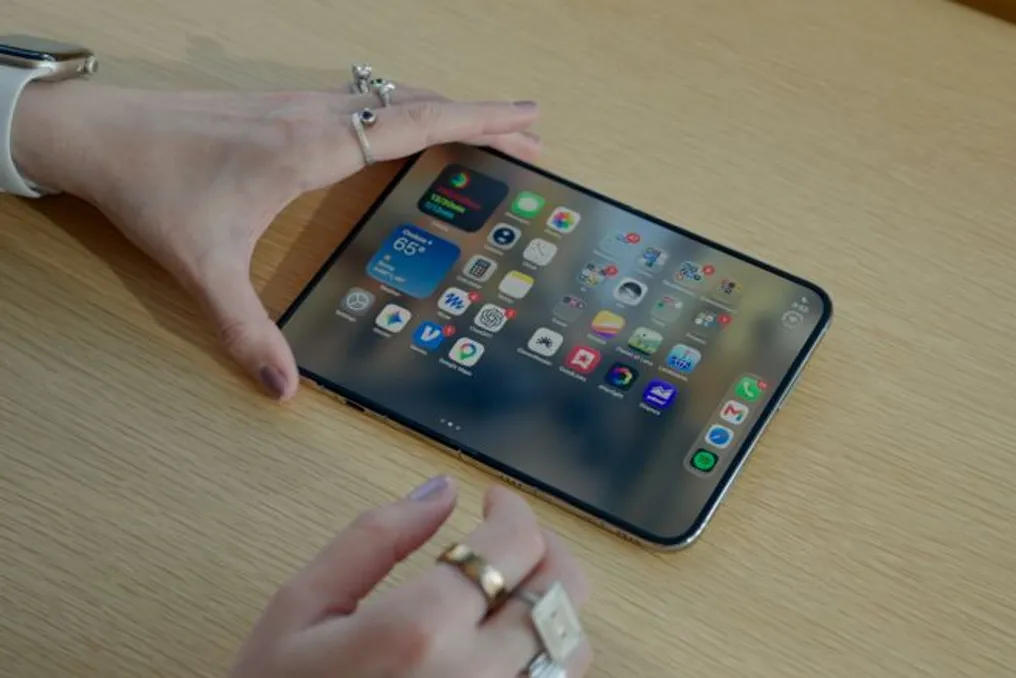
Apple's iPhone Duo is positioned as one of the company's most interesting phones in recent years, but its use faces certain difficulties.
After getting used to viewing content, reading, and scrolling through the feed on a large screen format, returning to a small display becomes challenging. The main problem is that many applications are still designed for use on smaller screens.
This review focuses on using the iPhone Duo, Apple's first foldable iPhone, which will be released on October 23rd. Its starting price is $2000, comparable to Apple's latest 14-inch MacBook Pro.
This is a significant step for Apple, which rarely changes the successful formula that brought iPhones over $200 billion in revenue last year. However, after many years of gradual iPhone updates, the company has faced the need to prove its ability to continue attracting consumers.
The author had the opportunity to test the new foldable phone, provided by CNN for testing purposes. The iPhone Duo served as a device for watching Netflix, an alarm clock by the bed, an extra screen for Sunday football matches, a miniature monitor when connected to a Bluetooth keyboard, and a camera with a built-in tripod.
Nevertheless, there were as many moments of disappointment due to incorrect application performance because developers had not yet updated them. Despite Apple's 'it just works' approach, the iPhone Duo requires a period of adaptation. Although the iPhone Duo's software felt significantly smoother and more dynamic compared to Android alternatives, many of its core functions are already available on Samsung or Google phones.
The iPhone Duo represents the biggest change Apple has made to the iPhone in almost 20 years of history. It features a 5.4-inch outer screen that unfolds to reveal a 7.6-inch inner display. In its closed state, the iPhone Duo resembles a passport, albeit thicker and heavier. When open, it looks more like a thinner and more compact iPad Mini.
One common question about the iPhone Duo is whether the crease is visible. Surprisingly, the answer is no. When using apps or scrolling the home screen, the crease is barely noticeable, and it is hardly felt when swiping across the display.
The unique form factor of the iPhone Duo allows for tasks that would be more difficult to accomplish on a standard phone. It can be set up like a tent or placed like a book while the screen is locked, turning the display into a desktop alarm clock, digital photo frame, or calendar. Some apps, such as the camera and Apple Fitness Plus, move to the top of the screen when partially folded, similar to a laptop, but this depends on whether developers have programmed their apps for this function.
When the phone is open, you can take selfies using the phone's rear cameras while previewing on the outer screen, which proved useful when filming videos for this review. The iPhone Duo is capable of running two applications simultaneously on the screen, which was convenient for looking up information or viewing content in multiple programs. For example, you can drag an image directly from the Photos app into a text message when both apps are active. The author also used split-screen mode to show a friend his Halloween costume and the movie it was based on at the same time.
While convenient, this is probably not the main reason to buy the iPhone Duo. The inner screen is best used when dedicating it entirely to one application, such as Netflix. Furthermore, the display has a matte finish, which reduces glare and does not smudge easily.
However, many popular applications, including Google Maps, Gmail, Call of Duty Mobile, and Uber, had not been updated for full utilization of the large screen during the Duo's pre-launch testing. Some apps appeared as floating windows in the center of the tablet screen. These apps can expand to take up most of the display, but they still do not fill the entire space. Other apps were updated to take up most of the screen but featured black bars on the sides. This happens when developers have not updated their apps using Apple's latest software development tools, as indicated on the company's website.
The good news is that even within a few days of ownership, more applications were updated, including Google, TikTok, Instagram, and Threads. But the uncertainty regarding how an app will look seems inconsistent and can be frustrating—this is an area where Android had an advantage.
Apps optimized for the Duo demonstrate potential. The author's current favorite app is the platformer puzzle game Planet of Lana, which looks magnificent and colorful on the larger Duo screen. Apple Books was also enjoyed for allowing page viewing on both sides of the screen when slightly folded, like a real book. Apple Messages and Mail apps also display the inbox on the left and messages on the right, allowing everything to be seen at once.
Considering the price, the iPhone Duo should handle all the tasks a regular phone can perform, and even more. The author's main concern was that the design might create a feeling of awkwardness when closed, but typing and swiping on the outer screen felt surprisingly natural and comfortable. The author even preferred Duo's wider keyboard over the keyboard on his iPhone 18 Pro.
Nevertheless, there was an initial learning curve. The author constantly accidentally pressed the side-mounted Siri button on the Duo instead of the volume buttons at the top. He also didn't realize that using split-screen mode required having an open application, rather than just opening a new app and dragging it from the home screen to one side of the display.
Battery life is acceptable and meets expectations for a new phone. The battery usually dropped to 35% or 46% when the author went to sleep, although this will always depend on the apps used and the frequency of using the tablet screen versus the outer display.
The cameras on the iPhone Duo are similar to those on the iPhone 18 Pro, but with one key difference: the telephoto lens is missing. This means that zoomed shots will not be as sharp or clear as those taken on the iPhone 18 Pro, although photos taken on both phones looked similar overall.
The biggest question asked about the iPhone Duo is whether it is worth its $2000. It is difficult to answer, considering it costs more than a month's rent for most Americans. The only reason to consider it is if you genuinely want a screen larger than any other phone, but one that still fits in your pocket.
Author's advice: wait until developers have more time to optimize their applications before making a decision. While the Duo is impressive, the apps still need to catch up.